I build the business around deep tech - from zero. 0-to-1 commercialization & GTM for AI companies. Writing on inference economics & AI margins. ex-EY.
If you are building or scaling an AI product, these are 3 questions worth asking early:
1) Can we switch models or providers if the economics change?
2) Are we using premium compute only where it matters?
3) If an agent runs for 45 minutes, can the user track progress and step in?
These answers decide margins, lock-in, and trust.
The bank may never join the sales call, but in capital-intensive deep tech it’s part of the buying committee.
CoreWeave: SOFR+225 in March, SOFR+550 in August. Same GPUs, different contract structure.
A benchmark proves the tech works. Financeability proves someone can deploy it.
The latency SLA is often the most underpriced line in a real-time AI contract.
Token prices can be adjusted. Latency can’t, because a tight p95/p99 means idle headroom you pay for or a priority-tier premium upstream.
Price it as a paid tier, tied to a metric, percentile and workload envelope.
@a16z Shorter cycles don’t just mean faster games. They mean more experiments, more failures survived, and more weird ideas that actually ship. That’s where the next great genres come from.
The tech works. The customer is interested. The pilot succeeds. And the deal still never reaches production.
Why? Often it’s the chain of dependencies between the sale, the delivery timeline and the customer’s operational readiness.
In my first piece for the @ForbesBizDev, I break down why these deals stall and the 7 commitments that carry them from validation into production.
@omooretweets@a16z@venturetwins The distribution framing is the strongest part. AI has outrun on capability and lagged on getting in front of customers, and agents that can evaluate and execute purchases are what close that gap.
Most failed commercial hires in deep tech start with an unclear commercial problem.
Don’t know who buys? Market research + ICP, not a Head of Sales.
Don’t know how to charge? Pricing & packaging expert.
Good deals stalling? COO for ownership + cadence.
Know exactly who buys? Now hire the Head of Sales.
“If I spend $12 in tokens on 50 cents of work, I go out of business”. Dell’s CTO on the AI cost trap. Cheaper tokens won’t fix it, since agents use more per task and per retry. The real question: which tasks earn back their tokens?
@a16z Using vibe coding to pressure-test a target’s moat is smart. And running M&A memos past AI versions of each leader to cut review cycles is a great use of AI in corp dev. Practical, not flashy.
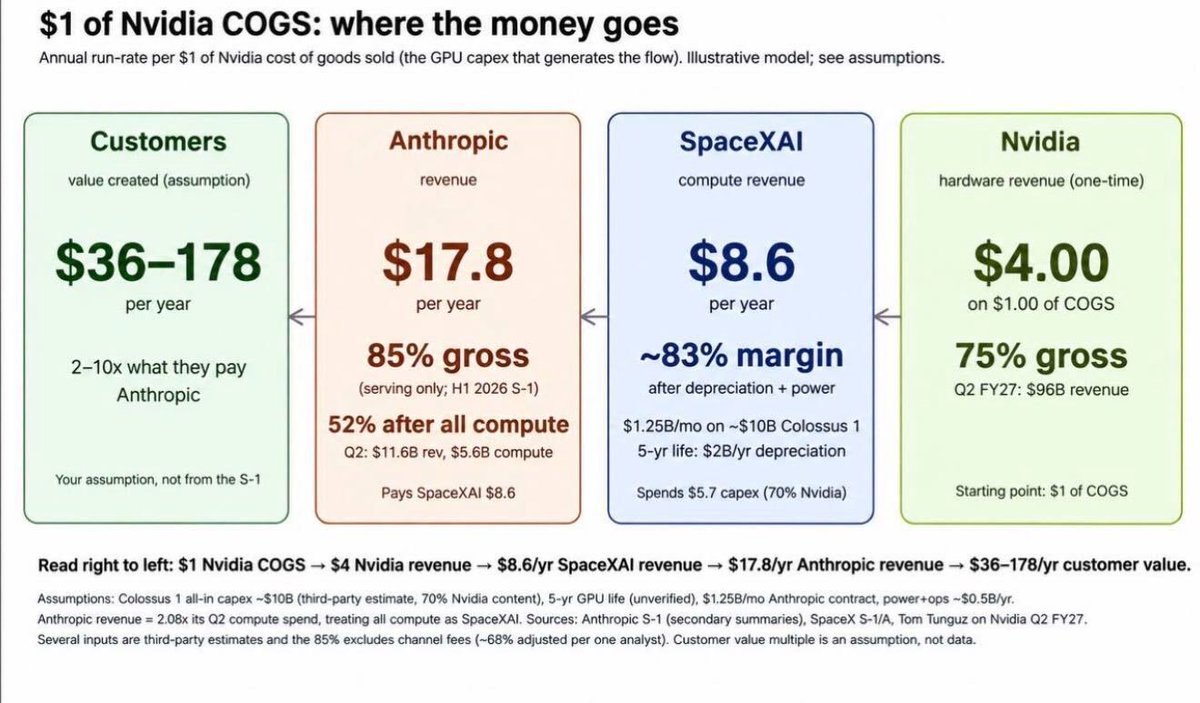
Fascinating breakdown on the latest @theallinpod: $1 of AI spend can turn into $178 in potential economic value.
Value creation ≠ profitability. Big gross margins don’t guarantee profits once infrastructure and R&D hit.
The real upside may be with customers getting 2-10x back per dollar. We’re just getting started.
Power is the new measure of land value.
Altus Group’s data on 80 data center land deals: Northern Virginia trades at a median $2.8M/acre, while low-capacity markets go as low as $28K. Sites near high-voltage substations sell at ~2x, and 230kV+ access carries a 2.4x premium.
Chips arrive in months. Grid power takes 18 to 36+. PJM’s auction hit its price cap three times running and still fell 6,831 MW short.
When money can’t buy speed, performance per watt decides what fits before a fixed energization date.
My rule: find the energization date before you find the buyer. If the talk starts with unit price, it’s the wrong person.
@saranormous Holding a prior because you’ve held it for years is just stubbornness with a track record. Revenue growth, retention and margins don’t care where the founders went to school.