Design nanobodies or minibinders for different targets. At least 5,000 designed sequences are expected to receive free wet-lab testing.
Prize pool: CNY 1,000,000.
Open worldwide.
Registration: Sep 24–Oct 31, 2026.
Contact: [email protected]#ProteinDesign#AIforScience
AI is opening new possibilities in de novo protein design—and the next critical test is experimental validation.
I’m pleased to share the Changjiang Cup 2026 Global AI Protein Design Challenge, an initiative I’ve had the opportunity to support.
Why is powerful AI still so hard to use in everyday biological research?
In this video, I break the challenge into three layers: data, models, and applications—and share how AI agents could bring AI and protein expertise together to support real R&D.
#AIforScience#AIAgents
Really proud to see my colleagues release VenusFold. 😄
On FoldBench, it achieved 0.80 mean lDDT-PLI and 69.78% docking success compared with AlphaFold 3, Protenix v2, Boltz-2, Chai-1, and other leading models.
A hard problem—and a result worth celebrating.👏
🚀Protein��ligand structure prediction, with open code and weights.
VenusFold achieved 69.78% docking success on the FoldBench protein–ligand benchmark.📊✨
We’ve released the inference code and model weights.
Code & weights in the next post ↓
#AIforScience
A docking workflow from our team’s MatwingsVenus™: one prompt to prepare structures and run AutoDock Vina & DiffDock.
I walk through both workflows and compare the outputs in this video ⬇
#AI#DrugDiscovery
Introducing PG-LLM, a benchmark testing if general-purpose LLMs can predict protein variant effects.
Across 217 tasks, Claude Opus 5 (Max) leads all tested LLMs at ρ = 0.406 and outperforms 49 of 95 specialized protein predictors when ranking 50 variants.
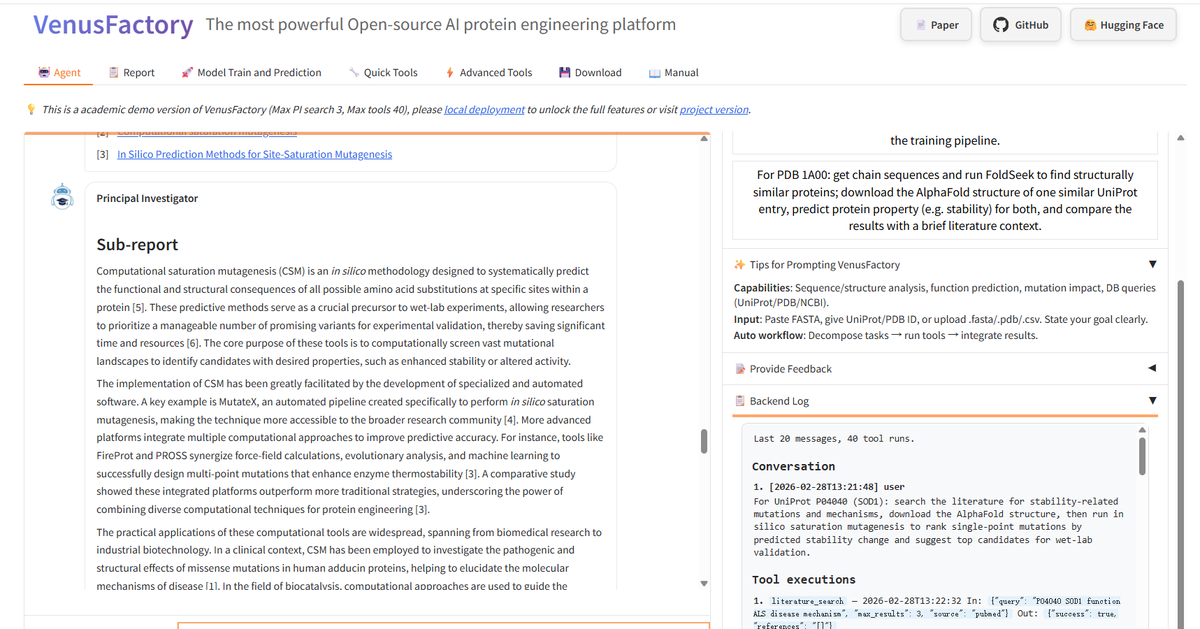
😆Our VenusFactory (AI4Protein) has received a major update, supporting Agent mode, online model training, AI protein report generation, various property predictions, and database retrieval.
Local deployment and experience are welcome!
Code: https://t.co/z27XIFuHRQ
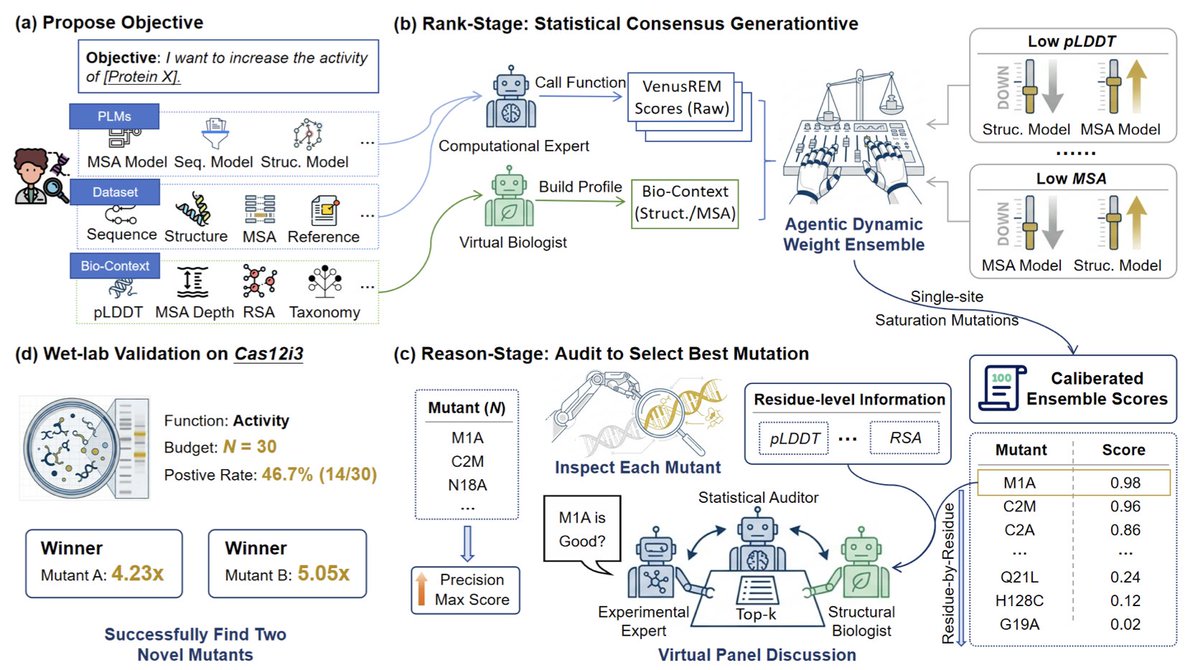
Rank-and-Reason: Multi-Agent Collaboration Accelerates Zero-Shot Protein Mutation Prediction
1 New SOTA on PROTEINGYM: a 0.551 Spearman ρ beats the prior best 0.518 by combining protein language models with a LLM-driven multi-agent panel instead of hand-tuned ensembles.
2 Two-stage agentic pipeline: Rank-stage fuses sequence/structure/MSA scores via a Computational Expert + Virtual Biologist that auto-calibrates weights; Reason-stage deploys a Virtual Expert Panel (statistical, structural, wet-lab auditors) to veto biophysically implausible hits.
3 Top-5 hit rate jumps 367 % on the high-coverage PROTEINGYM-DMS99 subset under tight N=30 budgets, showing the gap between global correlation and real selection precision is closed by inference-time chain-of-thought auditing.
4 Wet-lab proof on Cas12i3 nuclease: 14/30 variants improve activity (46.7 % success), two mutants reach 5.05× and 4.23× WT cleavage, validating the framework’s zero-shot utility for CRISPR enzyme engineering.
5 Framework is backend-agnostic: users can hot-swap any PLM or LLM; open prompts and modular code let labs plug proprietary predictors into the same auditing protocol.
💻Code: https://t.co/rVvrhtDBoP
📜Paper: https://t.co/NAtloLK1xE
#ProteinEngineering #ZeroShotLearning #MultiAgentSystems #CRISPR #DirectedEvolution #Bioinformatics
VENUSFACTORY: A Unified Platform for Protein Engineering Data Retrieval and Language Model Fine-Tuning
- This study presents VENUSFACTORY, a comprehensive AI-driven engine designed to enhance protein engineering through biological data retrieval, benchmarking, and protein language model (PLM) fine-tuning.
- The platform integrates more than 40 protein-related datasets and 40+ popular PLMs, supporting both command-line execution and a Gradio-based no-code interface, making it accessible to users across computer science and biology communities.
- VENUSFACTORY facilitates multithreaded data downloading from major databases like RCSB PDB, UniProt, InterPro, and AlphaFold DB, ensuring efficient data acquisition.
- It also supports the use of diverse PLM architectures such as ESM2, ANKH, PROTBERT, and PROTT5 for tasks like solubility prediction, localization, annotation, and mutation prediction.
- The framework provides various fine-tuning modules including Freeze, LoRA, and SES-Adapter, demonstrating superior performance across multiple tasks when compared to existing approaches.
- VENUSFACTORY's modular design supports comprehensive biological prediction tasks, enhancing the efficiency of developing novel protein models and improving AI-driven protein engineering.
💻Code: https://t.co/qXXnsRHwHk
📜Paper: https://t.co/sPjdCmKV75
#ProteinEngineering #AI #MachineLearning #PLMs #Bioinformatics #DeepLearning
VENUSX: Unlocking Fine-Grained Functional Understanding of Proteins
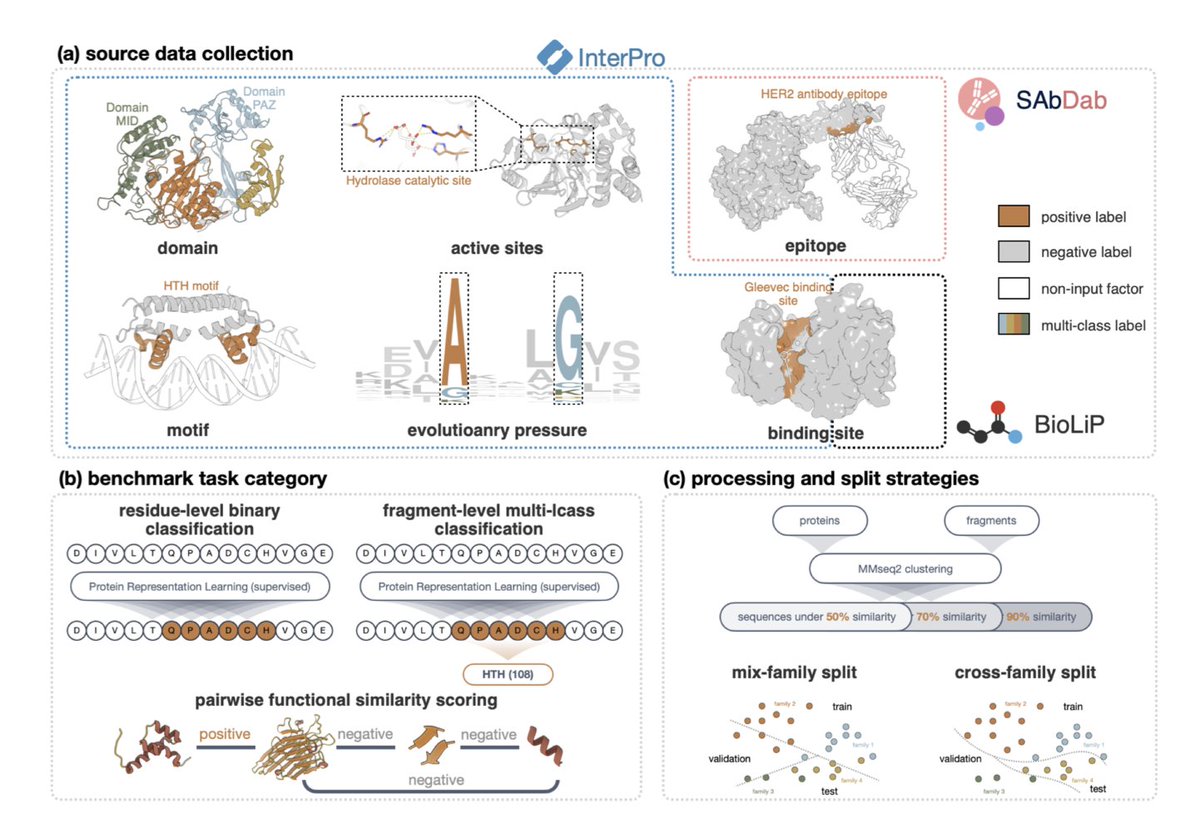
1.VENUSX is the first large-scale benchmark specifically designed to evaluate protein models at fine-grained functional levels—residue, fragment, and domain—addressing the critical gap left by coarse protein-level annotations in existing benchmarks.
2.It introduces three comprehensive task categories: residue-level binary classification, fragment-level multi-class classification, and pairwise functional similarity scoring, spanning over 878,000 curated examples and 56 datasets.
3.Residue-level tasks target the identification of functionally important residues, such as catalytic, binding, and epitope sites, enabling evaluation of models on fine-resolution interpretability and mechanistic understanding.
4.Fragment-level classification maps functional subregions to their InterPro family types (e.g., domains, motifs), supporting applications like domain annotation, multi-function prediction, and structural proteomics.
5.The pairwise similarity task assesses how well models capture functional relationships between proteins or fragments without supervision—crucial for enzyme discovery and remote homolog detection.
6.VENUSX is built from three high-quality sources: InterPro for functional domains and motifs, BioLiP for ligand binding sites, and SAbDab for antibody–antigen epitopes. Each entry is rigorously filtered and aligned with AlphaFold structures.
7.Both in-distribution (mix-family) and out-of-distribution (cross-family) splits are included, across identity thresholds of 50%, 70%, and 90%, enabling fair and challenging generalization tests.
8.Baseline evaluation covers diverse models: protein LMs (e.g., ESM2, PROTBERT), sequence–structure hybrids (e.g., SAPROT, PROTSSN), structure-only networks (e.g., GVP-GNN), and alignment tools (e.g., BLAST, TM-ALIGN, FOLDSEEK).
9.In residue-level tasks, sequence–structure models like SAPROT-650M outperform LMs by large margins on cross-family splits, especially for harder targets like catalytic and binding sites.
10.Fragment-level results show similar trends, with hybrid models achieving higher accuracy and macro-F1 scores—particularly in label-imbalanced settings where structure helps mitigate data skew.
11.In similarity scoring, structure-based methods like FOLDSEEK and TM-VEC dominate, but large sequence–structure models (e.g., PROTT5, SAPROT) are highly competitive and computationally more efficient.
12.Results highlight that many popular protein models generalize poorly to fine-grained tasks, often relying on global distributional cues rather than true functional signals—VENUSX exposes these limitations systematically.
13.The benchmark includes standardized naming conventions, balanced class splits, and interpretable evaluation metrics (AUPR, macro-F1, ROC-AUC), fostering reproducibility and benchmarking best practices.
14.VENUSX provides a critical resource to guide the development of next-generation protein models that are biologically interpretable, generalizable across protein families, and capable of learning fine-resolution function.
💻Code: https://t.co/cAjy4dXQiN
📜Paper: https://t.co/yU2XdR2wck
#ProteinFunction #Benchmarking #ResidueLevelAnnotation #ProteinLanguageModels #StructuralBiology #FunctionalPrediction #AI4Biology #ComputationalBiology
Have we hit a "scaling wall" for protein language models? 🤔 Our latest ProteinGym v1.3 release suggests that for zero-shot fitness prediction, simply making pLMs bigger isn't better beyond 1-4B parameters. The winning strategy? Combining MSAs & structure in multimodal models!
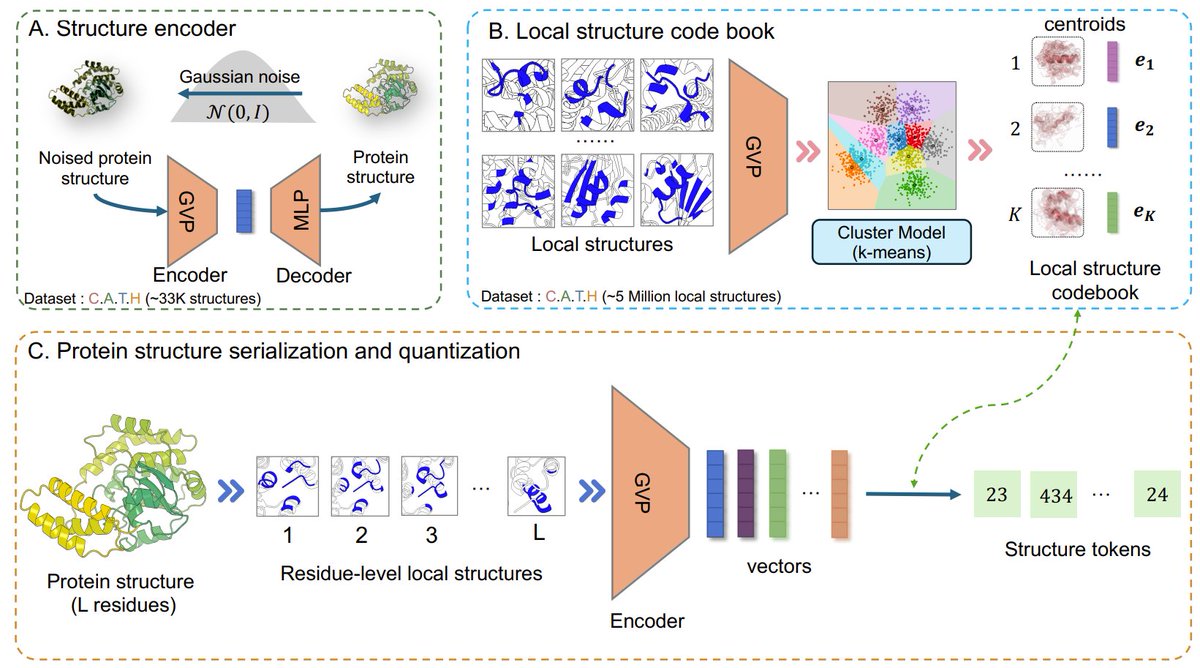
ProSST: Protein Language Modeling with Quantized Structure and Disentangled Attention
- Uses GVP to encode local structures into dense vectors, and k-means clustering to create a codebook of discrete tokens
- Trains MLM with both sequences and strucutre tokens with disentangled attention
Preprint: https://t.co/dwNbSJM8WD
Retrieval-Enhanced Mutation Mastery: Augmenting Zero-Shot Prediction of Protein Language Model
1. The study introduces ProtREM, a retrieval-enhanced protein language model (PLM) designed to predict the effects of mutations by integrating sequence, structure, and evolutionary features.
2. ProtREM combines disentangled multi-head cross-attention layers with evolutionary representations from homologous sequences, effectively integrating three types of biological information for protein representation.
3. ProtREM achieved state-of-the-art performance on ProteinGym, a benchmark with over 2 million mutants across 217 assays, outperforming previous models in mutation effect prediction across different protein properties.
4. A unique aspect of ProtREM is its ability to generate logits for each residue using a combination of sequence, structure, and multiple sequence alignment (MSA) data, enhancing mutation fitness predictions.
5. The model’s effectiveness was validated experimentally by designing 10 new mutants of phi29 DNA polymerase, with wet-lab experiments showing enhanced activity at higher temperatures for several of these mutants.
6. ProtREM also demonstrated strong performance in improving the stability and binding affinity of a VHH antibody, suggesting its practical utility for antibody engineering and synthetic biology applications.
7. Compared to existing models, ProtREM consistently ranks at the top across multiple functional assays, demonstrating its robustness and reliability for general-purpose mutation effect prediction.
8. The authors conclude that ProtREM’s retrieval-based approach effectively fills the gap of integrating sequence, structural, and evolutionary information, leading to superior mutation predictions and providing pivotal support for enzyme engineering.
💻Code: https://t.co/BINgeqj8e1
📜Paper: https://t.co/71Vu6abR2h
#ProteinLanguageModel #MutationPrediction #DeepLearning #EnzymeEngineering #ProtREM #SyntheticBiology #Bioinformatics #ProteinGym