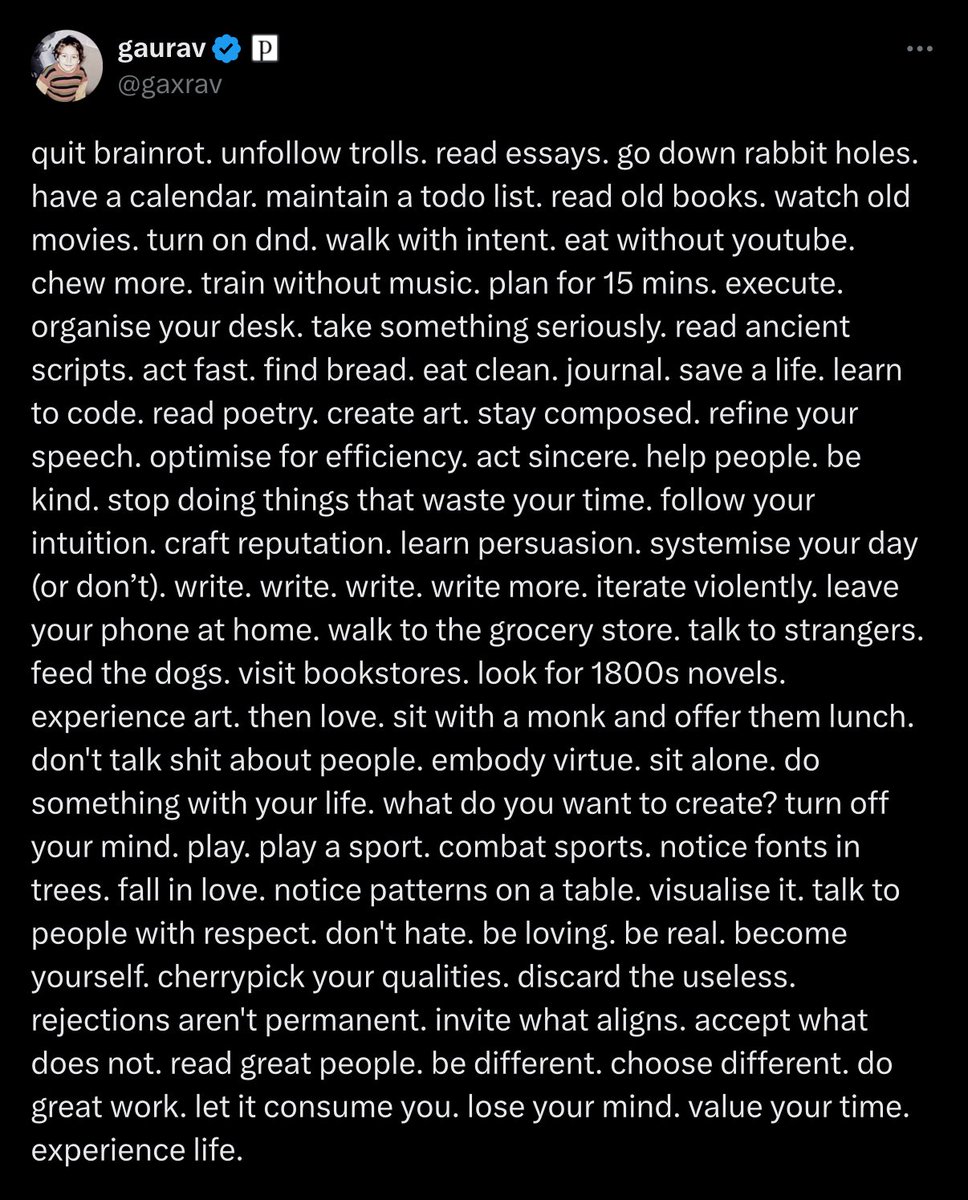
@Aniketh_Deb In investment, when the future is uncertain, you hedge. This concept can also be applied to skill building. Prepare for different AI scenarios.
You can also ask an ai assistant to help with how you should 'hedge'.
I want to clarify my thoughts on problem-solving in mathematics, and the potential consequences of AI for the field. For context, I’m quoting here my post in reply to Daniel Litt (who, echoing others, I find very clear, grounded, and insightful in his thinking).
The claim
The short version is that I think problem-solving is an immense, and pervasive part of modern mathematical research. Consequently, if human problem-solving disappears by virtue of the AIs becoming strictly and substantially better at it, then most of the time currently spent by modern mathematical researchers will have to be spent on an activity that is altogether pretty different. Whether such an activity is viable as a professional endeavour is something I am unsure of, but strongly encourage others to think about and try to envision, so that if/when the time comes, we can steer such a future into being.
Allow me to make this somewhat concrete: by problem-solving I mean questions of the form “is T true? If so find a proof. If not, find a disproof.” where T is a precise mathematical statement. I’ll also include “find an example of S, if there is one” where S is some structure (variety/category/property/isomorphism/….).
The argument
Ok. Now as I said (and some have echoed) I spend ~all of my time problem-solving as my primary goal. This has sub-goals, but my entire main research field disappears if someone solves the Zilber-Pink Conjecture in its more general form. This is a single conjecture (precisely stated!) and lots of mathematicians, postdocs, and graduate students are engaged in picking apart special cases of it, trying strategies, finding analogies to develop intuition, etc.. Of course, lots of motivation and intuition and analogizing and understanding have gone into deciding to make the ZP conjecture a focus! But the fact remains that this is now what is being worked on ~all of the time by this community. This is true of many mathematicians. They have a problem (or ten) and spend most of their time doing it. If someone solves it, they have to find a different problem. This can be a big, disorienting process involving a lot of energy, and is neither trivial nor always fun (though often rewarding in the end).
People have written a lot about Theory building vs. Problem-solving, and I want to first of all clarify I have nothing against theory building or theory builders! It is a valuable part of mathematics, and while there are differences in perspective between the “camps” there is way more mutual respect and agreement.
However, I gather there is a perception that theory-builders spend most of their time not-problem-solving, and I think this is largely untrue. Now I’m not a theory-builder primarily (though I’ve partaken a LITTLE BIT by necessity) so I am outside of my comfort zone. As such, I apologize for mistakes and welcome corrections!
But theory-building constantly runs through problem-solving. Let’s say you want to define the right notion of a cohomology theory. Of course you must make candidate definitions. But then what does it mean for it to be the right one? Well, you start asking if it has natural properties. These are T statements. Does it satisfy a Kunneth formula? Is it functorial in the right way? When you have the wrong one you have to find the properties it’s missing, and when you have the right one you have to prove that it indeed has those properties.
Again, I am not saying nor do I believe that this makes problem-solving “real math” and theory-building lesser. I am just trying to draw attention to the way I think research mathematicians operate, and mathematics is practiced.
To put all this a different way, imagine you had access to an AI oracle that could resolve statements T, but somehow lacked any creativity to build technology or make definitions (I think this is unlikely, but for the purpose of this thought experiment lets imagine it). How would your mathematics change, if you were a theory builder? Well, you make a definition, and want to know if it’s the right one. You immediately ask your oracle a thousand questions. From “are these basic properties true” to “ooh, so is this deep conjecture true?” and start getting back answers, and amending your definitions. You could invent and resolve entire research directions in days. But the confusion you would have had to push through to flesh out your theory would largely (probably not entirely) be instantly resolved and the whole process sped up tremendously by your oracle. A big part of the process would be gone. This is very very different to modern mathematics.
One more thought
This post is too long already, but I’ve seen some people say that they only do mathematics to find truth and others valourize that as the only virtuous way to be. I do not do mathematics only to find truth. I do it largely because I enjoy it and I am good at it. I also find it beautiful and am grateful I get to spend my days understanding beautiful things. But I enjoy the challenge, the process, resolving confusions, finding strategies, grappling with problems. I would like to push for this being de-stigmatized. Mathematicians are people who need money, housing, food, love, exercise, and a great deal of other stuff including various forms of meaning.
There are many people whose primary enjoyment of math comes through problem solving in one of its incarnations. If that disappears, that is not a trivial issue and many of them might not want to do it anymore (even if there were some way to proceed).
@AnnDooms@VanDammeEDU@wv012 * Deze lezing van Peter Scholze, over Euclides en meeteenheden, vanaf ongeveer 13:15: https://t.co/ktX7g285dB
Verrassend makkelijk (voor wat ik gewoon ben v Scholze) om de algemene lijn te volgen.
@AnnDooms@VanDammeEDU@wv012 Wat off-topic associaties (want ik ken niets v wiskunde-didactiek), maar deze uitleg over opp doet me denken wat denken een paar zaken:
* Grothendieck die in de lessen moeite had met het begrip 'oppervlakte' en dan op eigen houtje de maattheorie van Lebesgue heruitvond.
In the era of algorithmic distraction, the ability to maintain a single thread of thought for four hours is a superpower. It is the only way to solve hard problems.
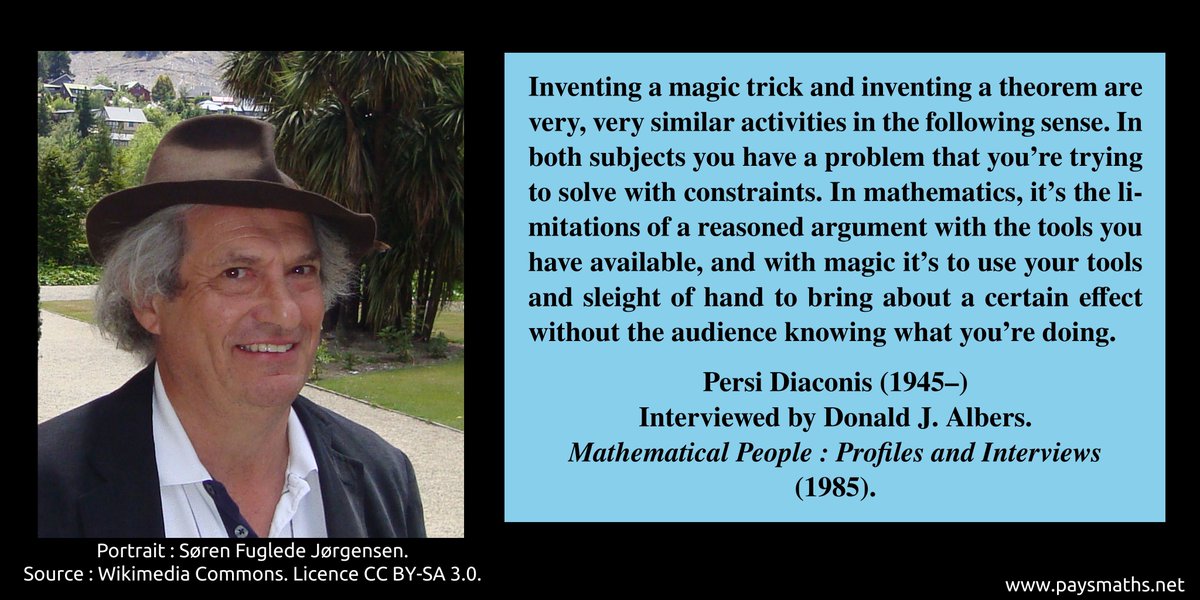
"Inventing a magic trick and inventing a theorem are very, very similar activities in the following sense. In both subjects you have a problem that you're trying to solve with constraints [...]" – Persi Diaconis (1945–)
#quote#mathematics#magic#maths#math
@SebastienBubeck@edfrenkel I remember a podcast with DeepMind's CEO Demis Hassabis (on Lex Fridman podcast ) that while there is progress being made in scientific fields, AI is at the moment not able (yet?) to make breakthrough creative scientific leaps like Einstein's relativity theories.
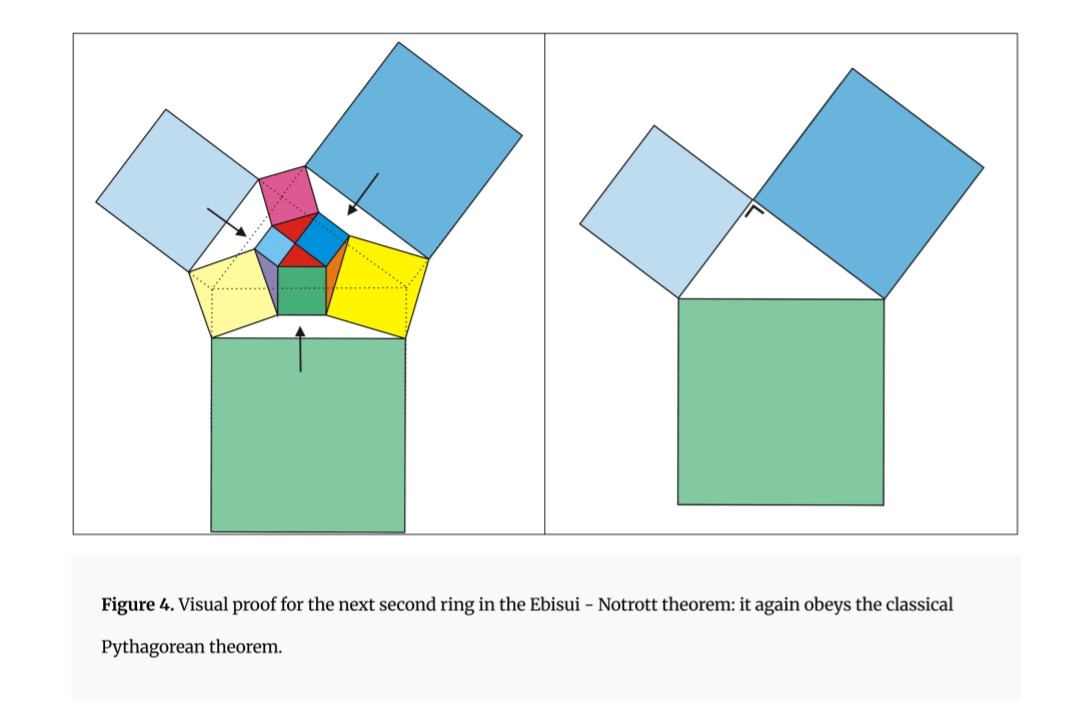
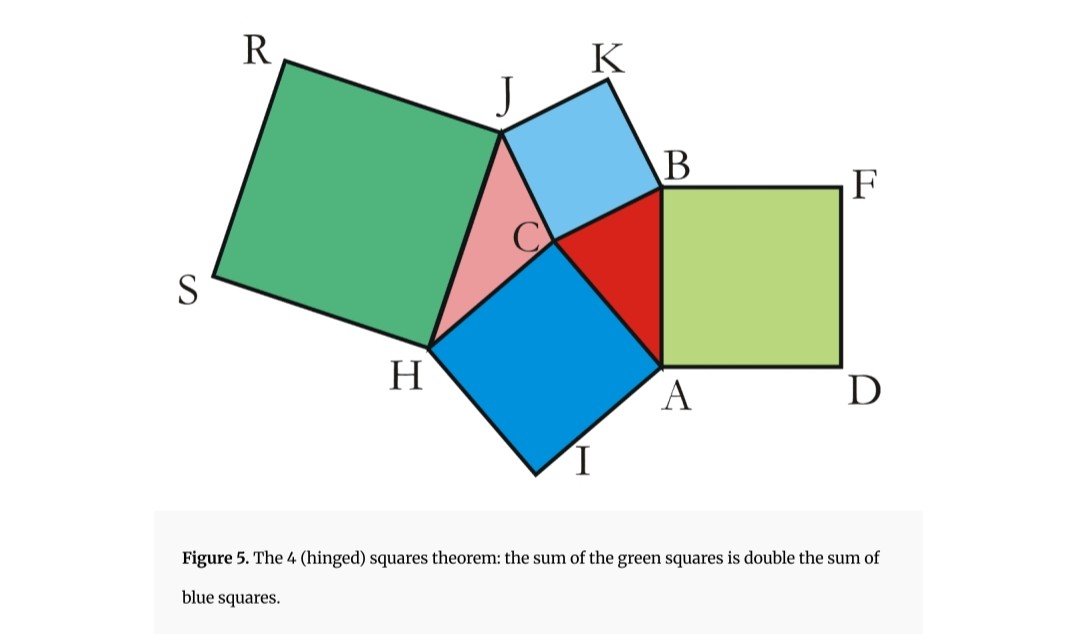
💡 "Visualizing Generalizations of the Pythagorean Theorem" - Article (Preprint v1) by Dirk Huylebrouck | Qeios https://t.co/Uwqr38MCgf
(The Power of Visualizing in Visual Assisted Proofs/Demonstrations.)
Last year, Loring Tu gave a course on Differential forms in algebraic topology at the NCTS, covering the first three chapters of his famous book with Bott. The lectures were recorded, and you can find the notes on his website. Links below.
What if the universe isn’t actually made of points, waves, fields, particles, or even Lagrangian submanifolds, but instead… natural transformations? The Yoneda Lemma, a theorem that identifies elements u ∈ F(A) with transformations Φᵤ: hₐ → F, makes this view mathematically concrete. The proof of the Yoneda Lemma takes perhaps three lines (hence why it’s a “lemma” despite its weight). 👇🧵 (1/22)
@vanranstmarc Dank om deze job op jou te nemen, ten dienste vd bevolking, goed beseffende dat een deel vd bevolking je hiervoor slecht ging - en nog steeds gaat - behandelen. Daar is moed voor nodig.