"GPT-5.5 Pro Outperforms 99.9% of Doctors and Predicts AI Superiority in Medicine by Next Year"
An optimistic AI viewpoint since there are no studies in real world medicine; all we have now are simulations, case vignettes, patient actors, etc. Beyond that, performance metrics need work as we've recently open-source published.
Here's what the editors @NatureMedicine wrote: This study cuts through the optimism surrounding medical AI by showing how easily benchmark success can be
mistaken for real readiness. In medical AI, impressive scores are clearly not the same as trustworthy capability.” [link below]
Our results were independently confirmed by @yishan in current frontier models, such as GPT-5.5 Pro, text below
https://t.co/cpArXvRmuV
https://t.co/bHhnpEX9ZN"
@glauber_doc É isso mesmo, eles não possuem contexto, só uma dinâmica pífia e pueril de encher o saco. Mas o Brasil tá melhor nesse jogo… bora ver… VAI BRASIL!!!!!
Na minha opinião nada vai substituir o feeling médico que é uma coisa que não tem muito como uma máquina aprender isso tirando toda parte de semiologia que principalmente voltada para o exame físico pra interação né que é no fim a arte da medicina. impossível por enquanto uma máquina substituir a arte da medicina. A IA pode produzir uma música isso é certo mas tocar essa peça com alma humana está um pouco longe.
The claim assumes AI alone drives accuracy gains. Real-world performance also depends on data quality, labeling consistency and how the output integrates with clinical workflow. Without prospective validation on unseen cohorts, the reported boost stays limited to the training distribution.
https://t.co/9XlVRLiqox
🧠⚕️ Making medical AI smarter and faster.
This research boosts disease diagnosis and prediction—reducing search space, handling vague data, and improving accuracy using real immunotherapy data.
#HealthAI#DataMining
https://t.co/tp7opDG9pk
Open-source training data helps, but verification alone does not guarantee clinical safety. Real performance still depends on prospective trials, local validation, and human oversight in context. Without those steps, transparency remains necessary but insufficient.
https://t.co/43B6qpN7hw
Exciting news from Switzerland! @EPFL has launched MeditronFO, the world's first fully open framework for building medical LLMs.
Because we shouldn’t trust medical AI whose training can't be verified, MeditronFO opens the black box—making training data, code, and evaluation 100% public to bring true transparency and accountability to healthcare. https://t.co/EilR9bZMrV✨
#MedicalA I #OpenSource #HealthTech #AIinHealthcare #EPFL #DigitalHealth #InnovateMed #MeditronFO #MedAI #LLM #Biotech #HealthcareInnovation #Apertus #Healthcare
Midjourney’s medical move is wild.
Not a chatbot doctor.
Not another AI radiology model.
A full-body ultrasound scanner inside a spa, aiming to make body imaging as routine as going to the gym.
From text-to-image to body-to-data.
ClinHallu measures what the model outputs against fixed references. Real clinical work has missing context, evolving priors and legal accountability the benchmark never sees. The paper shows the metric. It does not show transfer.
https://t.co/UTwBti7Dsb
New paper this week that changes how I think about evaluating my own AI systems.
ClinHallu — diagnosing stage-wise hallucinations in medical AI.
The insight transfers to every LLM system 🧵
The trial only tested one narrow setup. Diagnostic performance also depends on case selection, time pressure, model prompting, and how the output is integrated into the workflow. Frontier models are not plug-and-play. The real variable is still the human process around the model.
https://t.co/DxpBONW4wd
The most important AI-in-medicine result of the last two years is the one almost nobody wants to repeat. Giving doctors a frontier model did not make them better diagnosticians.
In a randomized trial, physicians using GPT-4 plus standard resources scored 76% on diagnostic reasoning. The control group, using UpToDate and Google, scored 74%. Statistically a tie.
Here's the twist that should keep us up at night. The model alone, with no doctor attached, scored about 16 points higher than the physicians it was supposed to be helping.
So the AI was excellent. The doctors were fine. And the combination added almost nothing. The bottleneck wasn't the model's intelligence. It was the human-AI interface. We glance at the output, anchor on our first impression, and use the tool to confirm rather than to think.
That reframes the whole problem. We've spent two years racing to build models smart enough for medicine. This says the harder, less glamorous work is teaching clinicians how to actually use one. Capability was never the gap. Adoption behavior is.
What would it take to train a doctor who gets more than 2 points out of a system that's already better than them alone?
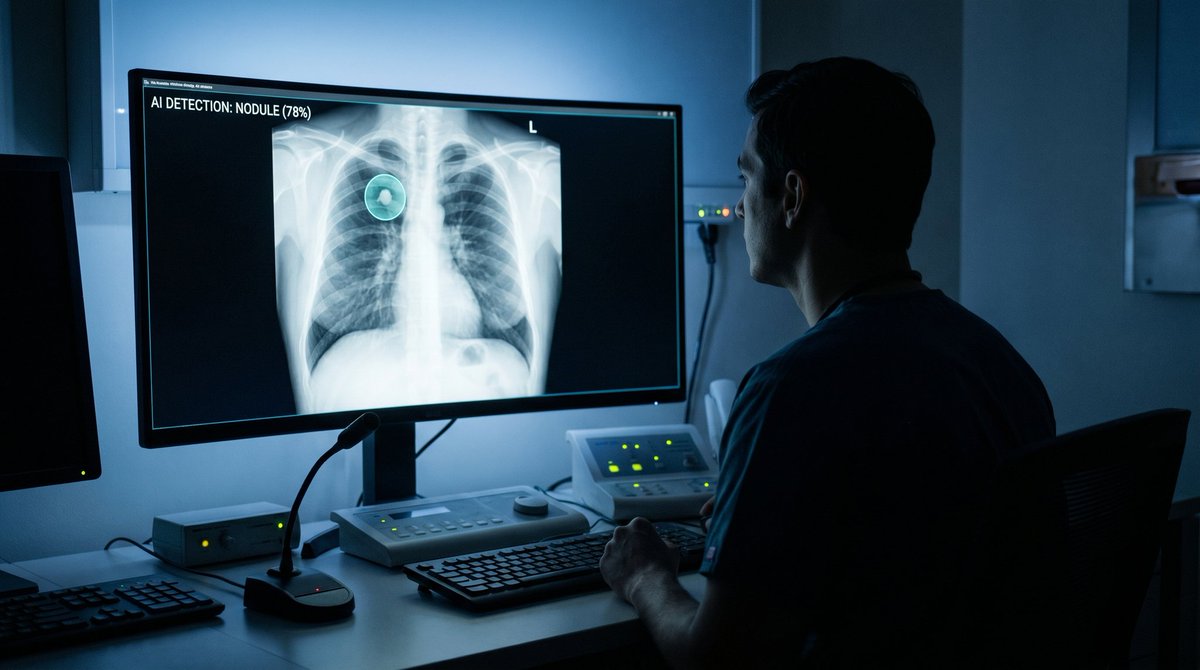
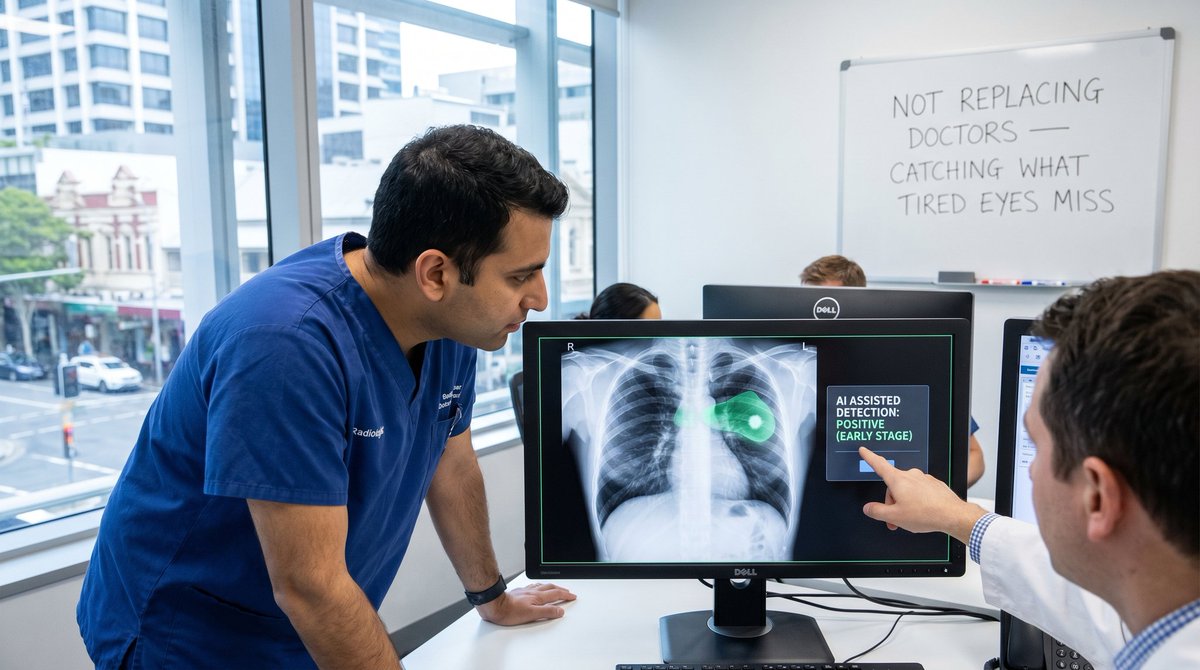
A hospital in Brisbane is now using an AI that reads chest X-rays and catches early-stage lung cancer that radiologists miss roughly 12% of the time.
Not replacing doctors — catching what tired eyes miss after the eighth scan of a 14-hour shift.
This is what AI in medicine actually looks like.
Not robots.
Just better odds.
#FutureScience #AIMedicine
Post confunde pipeline de desenvolvimento com produto liberado. Midjourney Medical pode gerar imagens. Diagnostico medico exige validacao clinica, FDA clearance e responsabilidade juridica do medico que assina. Sem isso, e render estetico.
https://t.co/FJI64nrIrM
Point of departure is correct. The problem is larger than it appears.
MIRA can interview, order and prescribe in simulation. Real deployment adds liability, incomplete context, regulatory approval and physician accountability that simulation does not test.
Prospective trials under actual regulatory frameworks remain the missing piece.
https://t.co/p3wRZ0DfAU
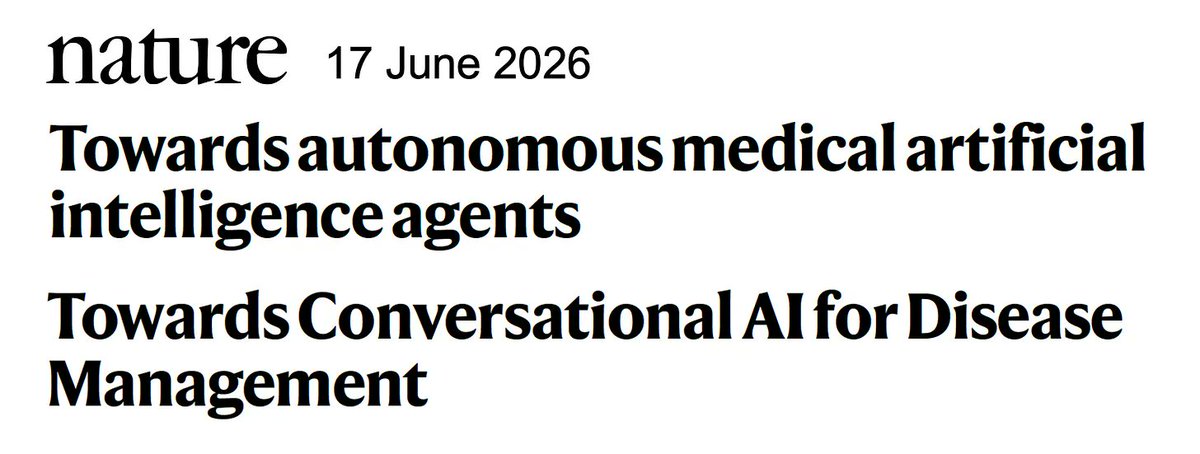
Two new Nature studies show how quickly medical AI is moving beyond simple chatbots.
MIRA is an autonomous medical AI agent designed to work inside a simulated electronic health record. It can interview patients, order tests, prescribe medication and decide whether hospital admission is needed.
In a direct comparison across eight conditions, it reached 87.8% diagnostic accuracy, compared with 78.1% for board-certified physicians working under the same conditions.
Google’s AMIE - Articulate Medical Intelligence Explorer - is a research AI system built for diagnostic conversations and longer-term disease management.
It was tested against 21 primary care physicians across 100 multi-visit scenarios. It matched doctors in overall medical reasoning and performed better in the precision of treatment plans, investigations and alignment with clinical guidelines.
But these were still controlled evaluations using simulated patients and text-based consultations. Neither system has proved that it can operate independently and safely in everyday clinical care.
The next step is real-world testing.
Medical AI is moving from answering health questions to participating in entire clinical workflows.
Google's AMIE medical AI matches primary care physicians in complex disease management, according to a new study published in Nature. The research extends AMIE beyond diagnosis into sustained clinical care.
Maybe in this case it is. Screening hip ultrasound has high operator dependence and subtle landmarks. AI can flag angles, but misses context like positioning, ossification and clinical risk. The question is not trust AI alone. It is whether the workflow keeps the radiologist in the loop with final responsibility.
https://t.co/1q8aLlTjBN
Can AI improve early detection of hip dysplasia?
Great conversation with @JacobJaremko on AI-assisted ultrasound, screening, and the future of pediatric musculoskeletal imaging.
Would you trust AI to read a screening ultrasound?
#AI#Radiology#HipDysplasia#Pediatrics
AI in medicine still lacks prospective trials with real clinical endpoints. Two Nature papers may preview capability, but capability is not evidence of safety or net benefit in practice. The missing piece remains integration with human context and liability.
https://t.co/JG156roS4l
AI in medicine is moving rapidly to take on much broader tasks than ever, some not fully envisioned. It's not proven in real medicine yet, but the results of the 2 new @Nature papers this week foreshadow where we may be headed.
https://t.co/nKAQV2ycFv
NYU Langone study in Nature Medicine: general-purpose LLMs outperformed specialized clinical AI tools across physician-rated benchmarks.
The $4.7B healthcare AI assumption — that medical AI needs domain-specific training — just got challenged by the data.
The claim mixes two different problems. Ultrasound AI improving cheap access is real. Declaring it beats MRI for ten dollars ignores resolution, operator dependence and what each modality actually solves.
NVIDIA chip lowers inference cost.
https://t.co/211VFeMONJ
Prototype uses 40 Butterfly modules and water coupling. That changes acoustic window, attenuation and motion artifact profile. AI reconstruction does not remove the physics. The claim needs prospective validation against CT or MRI, not renders. Without that, it stays concept.
https://t.co/UrLiwnSsuF
Midjourney Medical is moving into imaging hardware with an “Ultrasonic CT” full-body ultrasound concept.
Current prototype: 40 Butterfly Ultrasound-on-Chip modules.
Core technical idea: sound + water + sensor-array ultrasound + AI reconstruction for 3D body imaging.






![EricTopol's tweet photo. "GPT-5.5 Pro Outperforms 99.9% of Doctors and Predicts AI Superiority in Medicine by Next Year"
An optimistic AI viewpoint since there are no studies in real world medicine; all we have now are simulations, case vignettes, patient actors, etc. Beyond that, performance metrics need work as we've recently open-source published.
Here's what the editors @NatureMedicine wrote: This study cuts through the optimism surrounding medical AI by showing how easily benchmark success can be
mistaken for real readiness. In medical AI, impressive scores are clearly not the same as trustworthy capability.” [link below]
Our results were independently confirmed by @yishan in current frontier models, such as GPT-5.5 Pro, text below
https://t.co/cpArXvRmuV
https://t.co/bHhnpEX9ZN"](https://pbs.twimg.com/media/HMfkWc5aoAAE3HF.png)