grounded typhoon relief mission + 23-hour trip to hand-deliver satellite hardware = rocket startup
CEO Matija Milenovic and CTO Jacob Balaj both wanted a faster way to deliver cargo after their own logistics failures- and so, @Hop_Aero was born.
Their solution is Rook, an autonomous suborbital rocket built to fly cargo hundreds of kilometers and land in minutes.
Rocket cargo is crowded, though, and multiple startups are betting on orbital reentry (just ask our resident reentry guy @Douglas__Gorman).
Hop's approach (suborbital hops) still inherits the hard part: landing intact after hypersonic reentry.
Get the full story @payloadspace
https://t.co/PhntwiS5ts
(also testing if X truly is no longer anti-links in post too)
@Hop_Aero announced its selection into @ycombinator Summer 2026 batch this week—making a splash with a rendered video showing a small launcher capable of flying a 15-minute delivery route between Okinawa and Taiwan.
The launcher—Rook—is designed to take off from a standard 12-m shipping container, fly a suborbital arc, fly in at low hypersonic speeds, and land on unprepared surfaces, including in contested environments.
Payload reporter @vicky_woodburn connected with Hop CEO @milenovic925501, to dig into the details on the company's progress, including:
💸 Landing a $1.25M Direct-to-Phase-II SBIR in September 2025 from AFRL for a program it calls “Rapid Operations Over Kilometers.”
💾 Developing hopOS, an in-house software suite Milenovic said is modeled on SpaceX tools. The OS helped Hop generated the design for its engine, which went from software to hot-fire in about two months.
🚀 The company has hot-fire-tested its engine and ignition system, and flown one piece of hardware: a tether test of a ~3 m prototype at Infinity One Oklahoma Spaceport.
The full article is on Payload: https://t.co/J0PS79ciqP
Introducing Rook by @Hop_Aero (YC S26): an autonomous hypersonic cargo rocket that delivers 550 lbs up to 450 miles in ~15 minutes.
It launches from a standard 40-foot shipping container and lands on unprepared surfaces—no runways or fixed infrastructure required.
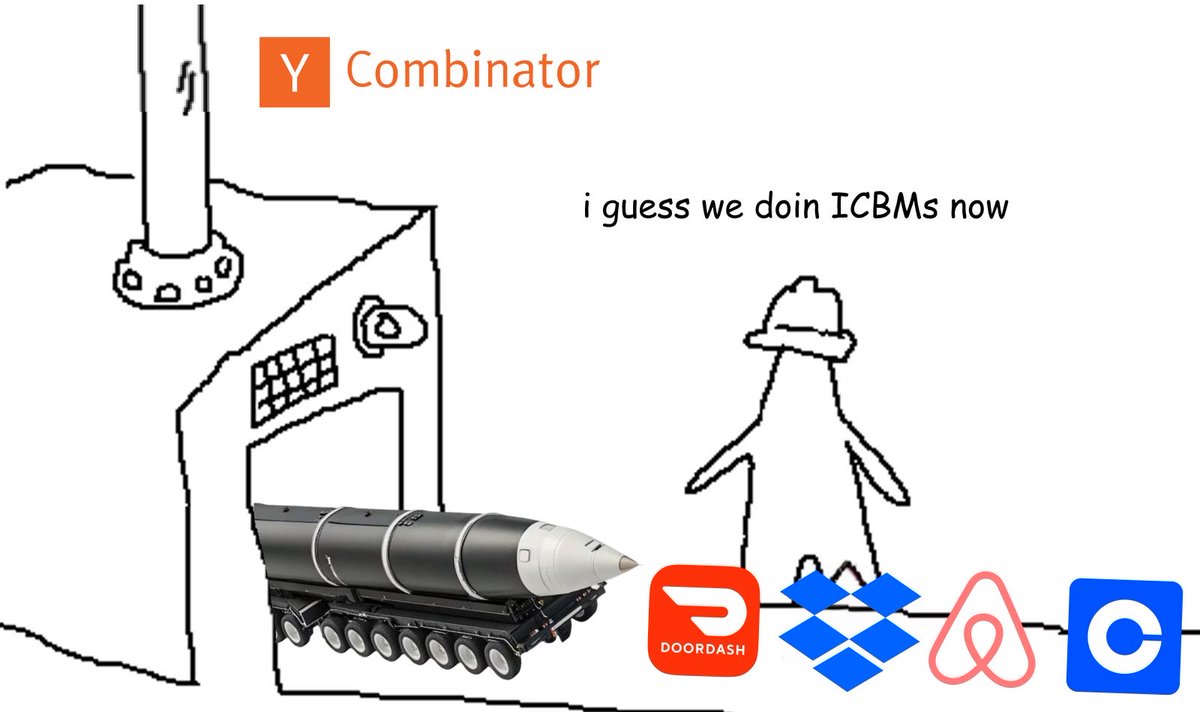
I'm sitting next to a YC partner (@borisjabes) who just spent the last 30 minutes debating with himself whether Hop Aero is /technically/ an ICBM
Current verdict: yes
Data centers cannot reach the scale they need on land. Grid interconnection queues are reaching a decade, resource competition burdens local communities, and project development is a very non-repeatable task.
We're building nuclear-powered, floating data centers: standalone power and compute, deployable anywhere, 4x faster than building on land.
Introducing @Atomarine_co (@ycombinator S26).