Tomorrow, Dominic Williams (@dominic_w) will present “Sovereign cloud for the AI era” at @DubaiAIFest on 27 October 2026, 3:10 pm GST (12:10 pm CET) on the Innovation Stage.
With Open Cloud, you create a cloud engine from nodes you choose by operator, country, datacenter, and hardware class. The Internet Computer combines them into one platform that keeps running when some nodes fail.
Choose where your cloud runs: opencloud dot org
@dominic_w Nice! This is bullish for NEAR! (I am holding NEAR because this market is delusional and I think it will go up a lot. Profits will rotate into ICP).
This is craazy. I asked one of our PhD engineers to look into NEAR *Confidential* Intents wondering how they designed their system. Unredacted, word-for-word, this was his answer 😱😱😱
"Everything I found out about the privacy claims and confidential intents is so bad that it seems almost comical and I cannot believe what I am seeing. Apparently they run a completely separate instance of the protocol, which is called FAR (as an opposite to NEAR), and that has a permissioned operator set. The entire confidentiality claim seems to rest upon the fact that it is a permissioned chain and the nodes are trusted to keep things private, there doesn't seem to be any deep technology behind it and it also does not seem to be open source. The entities running the nodes are also not publicly known.
I almost feel weird writing this because it is so absurdly bad that it feels like ... I don't know ... a simulation? I know the usual level of overpromising in Web3 but this is so many levels beyond believable that it still feels unreal."
ICP "cloud engines" launch trajectory:
DFINITY will soon begin disbursing coupons with enough cycles to create and power an engine for 1 month+, unlocking in sequence:
1. Agentic infrastructure ⚡️ Quickly build secure, sovereign onchain production apps using Claude Code, Codex, Caffeine, ...
2. Open SaaS beta release ⚡️ Install AIware apps that can run any enterprise, as easily as installing phone apps...
3. Unlimited growth ⚡️ A new end-to-end, mainstream onchain cloud tech stack will come into being.
*** What this means ***
ICP cloud engines are a new development on the Internet Computer designed to allow it to play the role of a revolutionary new cloud tech stack for the AI era.
Currently, the Internet Computer scales by combining internal subnets, which are akin to individual, high performance blockchains hosting secure serverless software called canisters (something like smart contracts, but much more powerful, which can be used to create huge onchain apps, which serve their web screens directly to users)
Cloud engines allow enterprises to create their own subnets that belong exclusively to them, which they control and configure — while their canister software can still seamlessly interoperate with software on the main network, and engines run by others.
An enterprise creates a cloud engine by choosing nodes from a marketplace, which the ICP protocol combines into a revolutionary serverless cloud platform for them, where the computation and data of their hosted apps and services is tamperproof (immune to infrastructure hacks) and always on (incredibly resilient), AI agents can build and update apps far more effectively than on traditional tech, and next generation AIware software can be created.
Today, enterprises demand to be able to control where their sotware and data lives, and cloud engines make that possible with no loss of flexibility. Cloud engines can even be re-configured with new nodes, without interrupting the hosted apps and services — the ICP protocol just handles it, granting complete sovereignty and freedom from vendor lock-in.
In advance of general release, cloud engines are already being used by governments and NGOs seeking to create sovereign cloud tech stacks and apps. On general release, they will be used in far more mainstream ways too.
Here are the details of what's coming.
*** Agentic Infrastructure ***
In the future, and really already today, nearly all of our apps and services will be created by AI agents rather than humans. Further, next generation software is "AIware," which has AI deeply integrated on the inside, which allows it to provide superpowers relative to traditional software.
Agents have different needs when they building things. They can write software orders of magnitude faster than humans, and we will demand they update our production apps and services at the speed of conversation. Functionality will be fluid and its shape will change to match what we want.
On traditional tech stacks, updating apps and services is a necessarily laborious and risky process for three reasons: 1) a security flaw might be introduced, 2) a systems configuration change might break them, and 3) the way that data is migrated might cause some to be lost, often in subtle ways that aren't detected at the time of the upgrade. This means that AI agents can't just be let of the leash to build and update at the speed they can.
ICP cloud engines solve this. Hosted software is tamperproof, so agents can update without needing security teams in the loop. Hosted software is serverless, and the data lives in the logic, so apps don't. need things like operating systems and databases configured to run, so agents can update apps without having sysadmin teams in the loop either. And, if Motoko 2.0, the world's first languge targeting agents is used as the backend language, its framework is able to detect when an app update by AI might cause data loss, and simply require the agent writing the code to try again, reducing potentially catastrophic data loss to a harmless retry.
Crucially, apps built with Motoko can also put AI agents on the inside, so that subject to permissions, they can see the data graph in the persistent memory used by serverless software on ICP, and access its functions. This enables you to instruct agents to do things in the apps for you, such as analyzing data, or performing actions, with great flexibility and power.
ICP cloud engines are agentic infrastructure that change the game — and it will be possible to use them as such from the moment they are released.
There is already a government using internal production software built on a cloud engine using Caffeine. But cloud engines will meet a wide range of mainstream needs, from solorpeneurs to startups, SMEs to corporations, governments and NGOs.
*** Open SaaS ***
The obvious question, is if AIware is so much better, shouldn't all enterprises be running on it? We believe they should, and that his must be enabled.
This has been a labor of love for me. A new venture associated with me will release the Open SaaS suite for use on cloud engines once they have been running a short while, which suite, as you've probably guessed from the name, is open source and free.
Open SaaS is a suite of every important SaaS (Software-as-a-Service) app used to run enterprises around the world today, reimagined as onchain AIware that runs on ICP cloud engines. Because of the unique nature of the software that ICP hosts, installing and maintaining these sophisticated enterprise apps on a cloud engine is as easy as installing and managing a phone app.
A small selection of the apps: Open Team, Open HR, Open Accounts, Open CRM, Open Projects, Open Email, Open Messaging, Open Signing, Open Knowledge, Op... etc. There are many more, and there will be surprises.
The user experiences are beautiful, and easily compete with the big money SaaS screens many enterprises are used to. Moreover, the are linked to what I called a "software factory" driven by AI, and the more enterprises that use them and provide feedback, the better they will get, in realtime.
Today's expensive SaaS silos make it hard to integrate and combine enterprise data, and to unleash the full power of AI. They are the opposite to Open SaaS.
In the future, enterprise users will spend far more time in AI chat than on SaaS screens. That's the future that Open SaaS enables and unlocks. Enterprise users can even say to their Open SaaS suite, "make me more profitable," and it will have a go.
The big surprise coming for the world: once you run your enterprise on AIware, and AI can access all your data in realtime, and is integrated with your software's actual functions — it can become as good at running your enterprise as writing software for you.
It's revolutionary, and ICP is pioneering this. Not a narrative, but real decentralized network tech.
Something I can share: DFINITY is in the process of migrating to Open SaaS from a vast suite of expensive SaaS silos, and is already reaping big benefits as we refocus ourselves for the era of AI.
****
What does this mean for the project?
I believe ICP cloud engines are the vector that will transform the the Internet Computer into a mainstream agentic infrastructure tech platform for enterprise— which direction platforms like Caffeine have already helped the network travel, by enabling many tens of thousands of users and enterprises to create onchain apps on the shared network through online conversation. Now, the next and most important phase is approaching.
Our go-to-market will proceed quietly as we rollout coupons and work to fettle the new network functionality, but I think that in hindsight, the launch of cloud engines will be seen as the most pivotal moment in Internet Computer history since network launch.
With this, ICP shall show the industry how networks can provide real agentic infrastructure.
Bear with us as we tie up loose ends. We never stop working, and you can be sure that we're trying to get this out as fast as possible 💪⚡️💥
Another CEX hack! Solution: MULTI/DEX, the 1st order book exchange that's:
1. Open source
2. Runs onchain
3. Verifiable ledger
Plus, the 1st with an AMM, providing cross-market swaps, AI assist... Only possible on the Internet Computer | ICP 💪. Prod soon.
https://t.co/OE42k3zrka
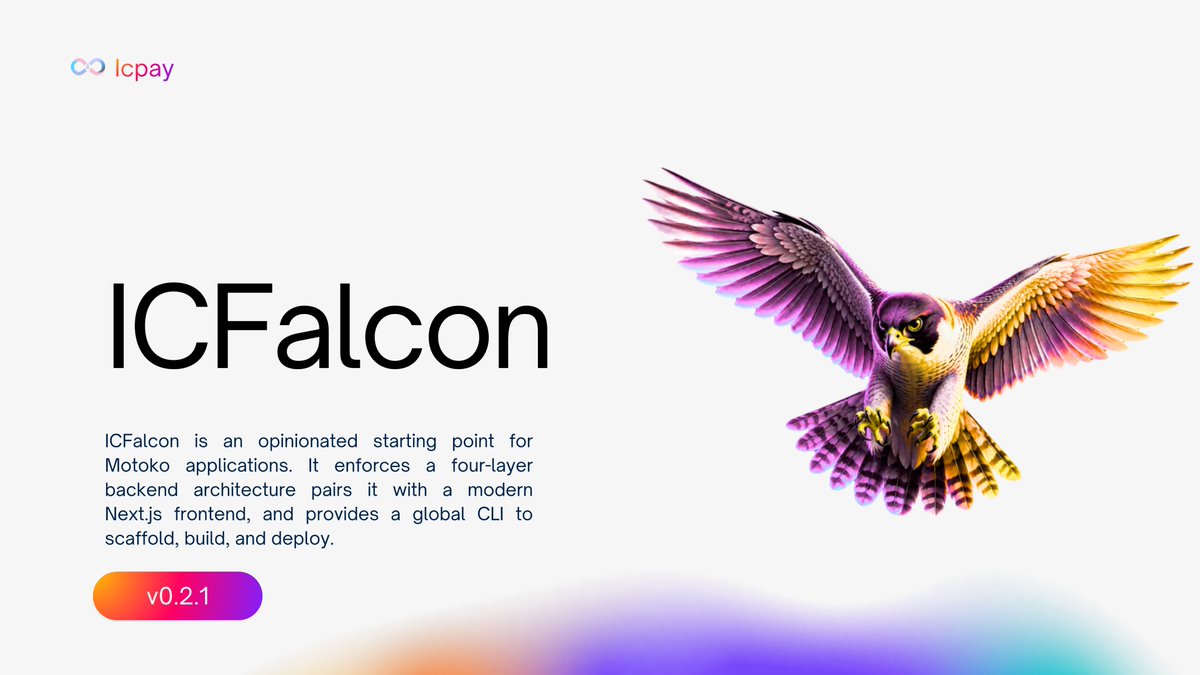
Update: IcFalcon v0.2.1 is now available on npm and GitHub.
IcFalcon is an application framework for the Internet Computer combining a Motoko backend, Next.js frontend, and the falcon developer CLI.
Summary of changes in v0.2.1:
1. Falcon Universe (Multi-Canister Event Mesh):
- Asynchronous pub/sub architecture for multi-canister orchestration
- Transactional Outbox backed by a high-throughput doubly-linked list queue
- Sliding-window Inbox for idempotent, duplicate-free event consumption
- Hierarchical wildcard topic routing ("order.*", "*") and IC timer heartbeats
2. Motoko Code Validator and Linter (falcon audit code:motoko):
- Code consistency checks and auto-formatting (--fix) for whitespace, CRLF, and EOF newlines
- Architectural layering enforcement (api layer direct access to storage is blocked)
- Ban on deprecated mo:base in favor of modern mo:core
- Integrated into production pre-flight checks (falcon p:check)
3. Package Ecosystem and Updates:
- Published universe package to the icp-hub registry (falcon add pkg universe)
- Integrated icp-sdk suite and ICPay canister controller management
Scaffold a project:
npm create icfalcon@latest my-app
Links:
GitHub: https://t.co/1EVn9CXLOO
NPM: https://t.co/msWxKLUaSk
Portal: https://t.co/FsQA3B32Ta
#ICP #InternetComputer #Motoko #Web3 #NextJS #FullStack
New internet-computer:native video up. Today I'm talking about the latest BlackRock paper which describes the Internet Computer infrastructure almost 1:1.
If you enjoy my videos, please consider a RT + ❤️!
Full video on YT below 👇👇👇
The DFINITY Foundation is delighted to continue its partnership with the WebAssembly Research Center at Carnegie Mellon University.
DFINITY began working with WebAssembly in its early days and built the Internet Computer around it.
Over the years, our engineers have supported WebAssembly's development, sharing their experience and feedback and contributing changes that have improved several operations.
https://t.co/aLk2PCCXW8
ICP isn’t just trying to build another blockchain… it’s trying to put the internet itself on-chain. 🌐⛓️
Apps, data, websites — and even direct interaction with Bitcoin & Ethereum.
Maybe it’s time to take another look at internet-computer:native 👀
Proud that DFINITY continues to support the WebAssembly community and contribute. Team member no 5 was co-inventor, giving us the foresight to build the Internet Computer network around this critical standard that's becoming increasingly pervasive.
https://t.co/exTsVLWE2P
@BobbyO_ I think there are two separate things. One is the full integration of ICP into the world.
And the other is a state where most people know that's the future but it's not yet integrated.
I think most will wish for the latter as it affects the price more.And it should happen sooner
The moment I can have access to GPU nodes, I’d only use open source AI from there on out.
The open source AIs are already good enough, most people simply can’t afford the hardware to power them.
Once they can afford them, it’s gg to the frontier labs.
$ICP is disruptive af!