Return to sport earlier than 9 months after anterior cruciate ligament reconstruction (ACLR) does not increase the risk of a new injury…
🔹🔹 𝗞𝗲𝘆 𝗧𝗮𝗸𝗲𝗮𝘄𝗮𝘆𝘀🔹🔹
▶️ Rehab matters! Athletes who finished the rehabilitation program had much better RTS rates.
▶️ The further you go, the better you do:
➔ Stop after strength training → 𝟱𝟬% RTS
➔ Stop after explosive/reactive training → 𝟳𝟬% RTS
➔ Complete the full program → 𝟵𝟬% RTS
▶️ if athletes met all discharge criteria, returning before 9 months did 𝗡𝗢𝗧 increase the risk of a new ACL or knee injury.
👇👇👇Read More 👇👇👇
▶️ Findings from a study conducted at the Aspetar Riadh Assessment and Movement Analysis Lab indicate that returning to sport earlier than 9 months after anterior cruciate ligament reconstruction (ACLR) does not increase the risk of a new injury. The study highlights that how an athlete returns is more critical than when.
▶️ ACL re-injury rates dropped by 50%, primarily due to the implementation of mandatory regular testing and structured progress monitoring throughout rehabilitation.
▶️ In a cohort of male athletes, rigorous adherence to the rehabilitation protocol significantly improved return-to-sport (RTS) rates, showing a clear dose-response relationship: greater progression in rehabilitation after ACLR led to a significantly higher likelihood of returning to pivoting sports. Athletes who met all discharge criteria were six times more likely to return to pivoting sports compared to those who did not complete the program.
▶️ Successful completion of rehabilitation and achievement of objective criteria significantly increased the odds of male athletes returning to pivoting sports. Consistent adherence to a structured rehabilitation protocol, progression based on objective criteria, and meeting discharge criteria were associated with low reinjury rates and a high probability of returning to pivoting sports, irrespective of surgery type or comorbidities. Notably, time to RTS did not appear to impact new knee injury rates, provided athletes met all RTS criteria. These findings emphasize the crucial role of personalized rehabilitation programs in optimizing outcomes for athletes post-ACLR.
🔗 Link 👉 https://t.co/w6L7yrxbHs
✍️Written by: @RoulaKotsifaki , @enda_king , @RoaldBahr and @RodWhiteley
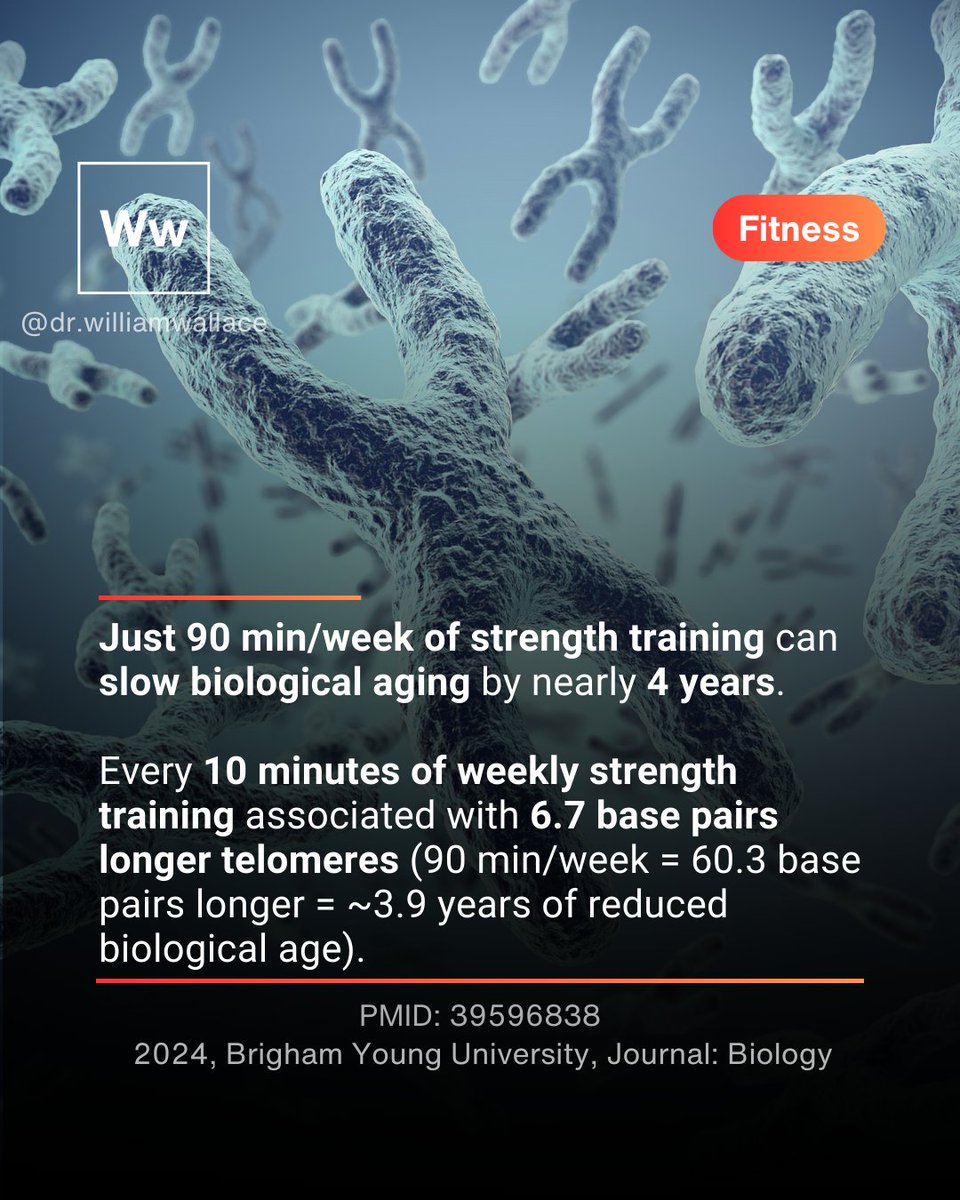
Recent research (PMID: 39596838) published in Biology showed a significant association between regular strength training and reduced biological aging in adults (as measured by leukocyte telomere length - see below for limitations). The study, involving a nationally representative sample of 4,814 U.S. adults aged 20–69 years, used data from the National Health and Nutrition Examination Survey to examine the relationship between strength training frequency and telomere length—a proposed biomarker of cellular aging.
Findings:
- Adults engaging in ≥90 minutes of strength training per week exhibited telomeres that were, on average, 60.3 base pairs longer than non-strength trainers.
- This telomere elongation corresponds to approximately 3.9 years of “reduced biological aging”
- A linear relationship was observed, with each 10-minute increase in weekly strength training time associated with 6.7 base pairs longer telomeres.
Strength training was defined as participation in resistance exercises such as weightlifting or bodyweight exercises, categorized into None (<10 minutes/week), Moderate (10–50 minutes/week), and High (≥60 minutes/week).
limitations of using leukocyte telomere length as a biomarker for aging:
- Tissue Variability: leukocyte telomeres reflect telomere length in white blood cells, which may not represent telomere length in other tissues.
- Lifestyle, stress, and acute or chronic conditions like inflammation can impact telomere measurements.
- Variability in telomere measurement techniques, such as can lead to inconsistencies across studies.
- Shortened telomeres are associated with aging and disease risk, but the exact causal relationships remain unclear.
The basics aren’t sexy.
They don’t sell.
They aren’t a quick fix.
They are simple to understand and yet difficult to practice consistently.
But they work!
If you want to focus on health and longevity, start here: https://t.co/555EVH1jzB
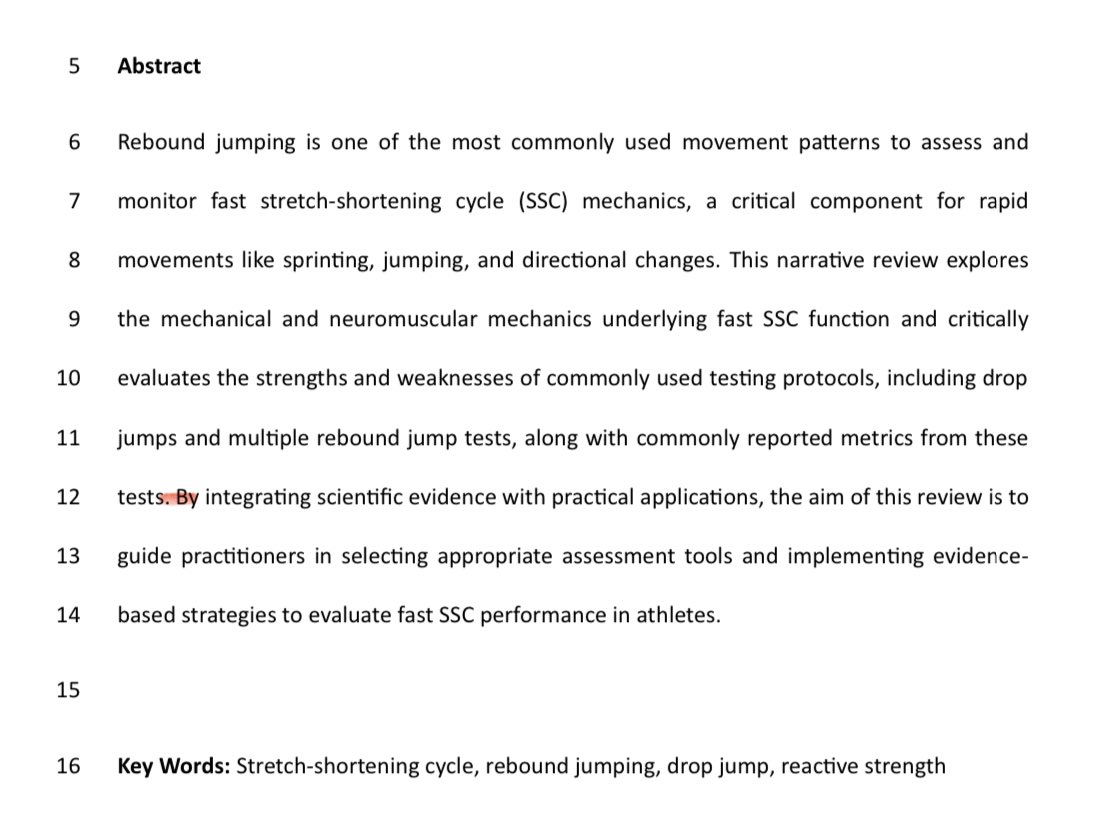
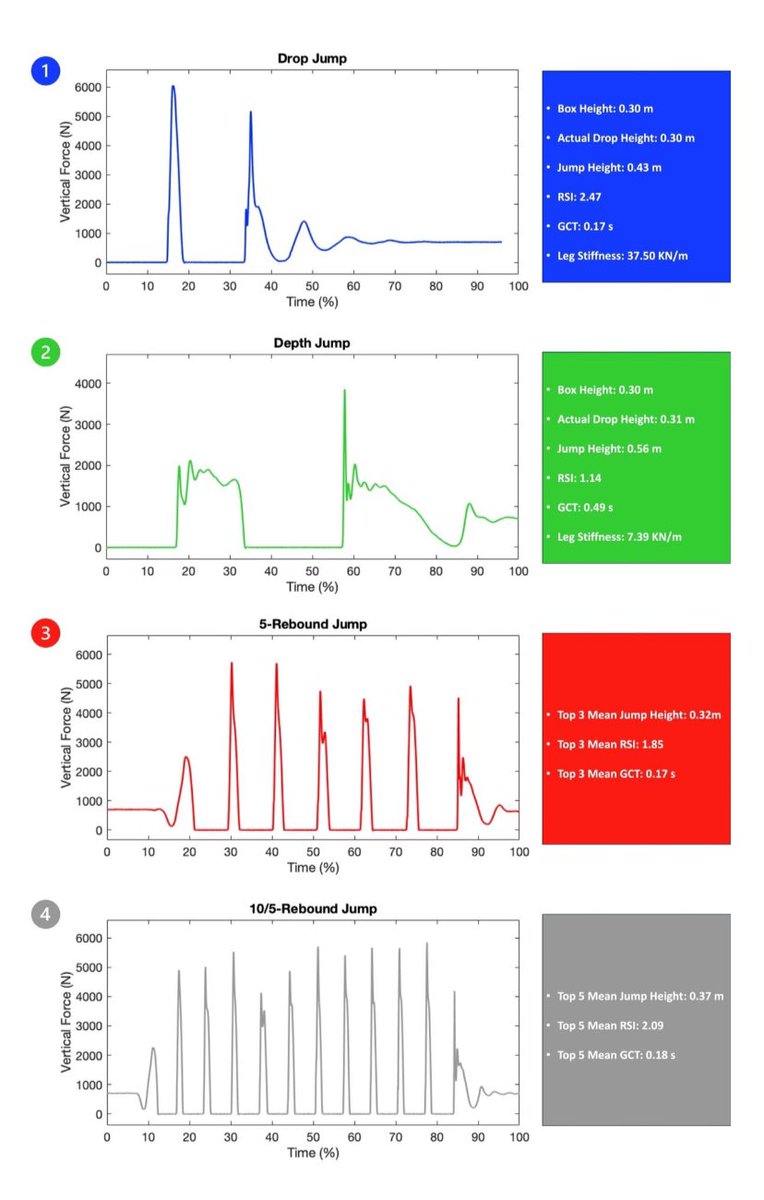
📄 New paper just accepted in #SCJ entitled: A Narrative Review of Rebound Jumping and Fast Stretch-Shortening Cycle Mechanics, led by the ever-impressive @Jiaqing_Xu96.
🔗 Link to accepted text on RG here: https://t.co/uWyAGhchde.
Can LPS replace traditional sprint tests? 🏃♀️ Our study finds LPS offers a nonintrusive, in-situ method to track max speed (MSS). While acceleration metrics need refinement, it’s a game-changer for easy monitoring.
🔗 FREE: https://t.co/sxfZot3cf3
Please RT!
Most influencers get fitness wrong.
They tell you to obsess over finding your Vo2max. No need for most.
They preach HIIT or zone 2…and neglect the rest.
Here’s the truth if you care about improving aerobic fitness for your long term health: https://t.co/rVL7KPdNVb
Pablo Aimar on how he learned many skills and dribbles playing with his friends in the street for fun, something that no longer happens nowdays📖
To see this beautiful talk FULL with ENGLISH SUBTITLES send me DM!❤️
Follow me for more!
During an era of shockingly predictable title wins, Klopp has done more than anyone to make leagues exciting. Without him: City would have won 5 on the bounce 18-22 with no-one within a dozen points & Bayern’s run of 11 would stretch back even further. ⬇️
https://t.co/GjODHyX8W1
📢 My latest blog post:
Defining high-speed, acceleration, and deceleration efforts in sport 🏃♂️
🔗 https://t.co/LwdjbG9juq
Let's dive into the details! 🧵