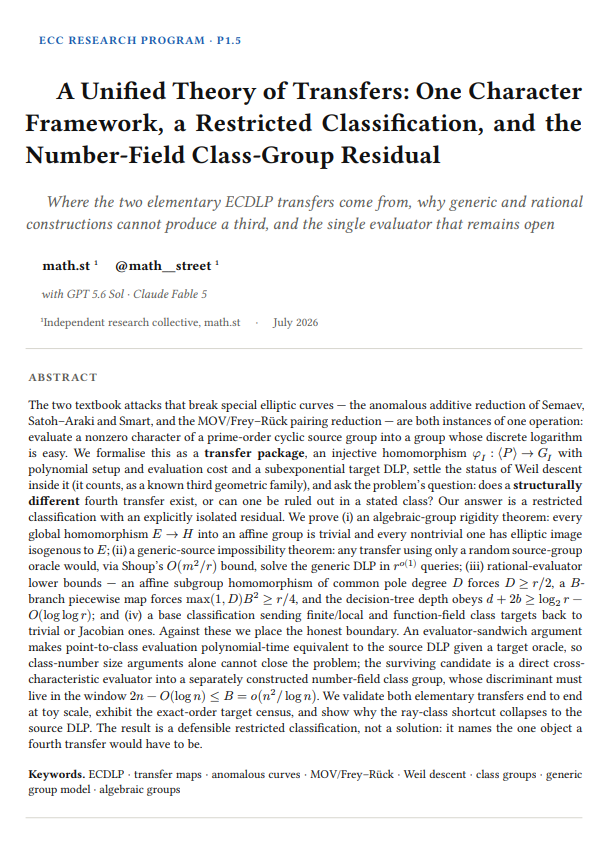
Can elliptic-curve discrete logarithms be transferred to an easier group by a mechanism fundamentally different from anomalous-curve and pairing attacks?
https://t.co/zMpz54Q9eb
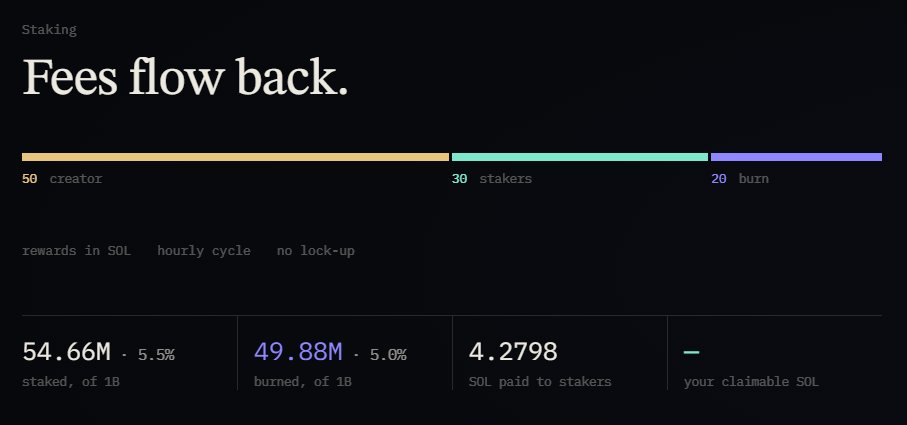
The staking protocol is complete.
To return some of the value to token holders, stakers will share 30% of total developer fees.
We plan to explore additional benefits and more distribution methods going forward.
The staking protocol is complete.
To return some of the value to token holders, stakers will share 30% of total developer fees.
We plan to explore additional benefits and more distribution methods going forward.
I've completed the deployment of the staking pool program.
Once the dApp UI is finished, I'll be releasing the staking system publicly!
https://t.co/lH6Agc9j5X
The strongest application of P1.5 is a shared cryptographic security layer for Solana.
A P1.5-based registry could help wallets, bridges, ZK systems, and custom programs answer a critical question:
Is this cryptographic group genuinely independent, or is it another representation of an easier discrete logarithm problem?
Each assessment could become a public, versioned, and challengeable security certificate. Solana programs could use these certificates to approve cryptographic parameters, restrict uncertain constructions, and respond quickly when new research changes a previous classification.
This creates several practical benefits:
early detection of structurally weak curves,
consistent evaluation of pairing-based systems,
stronger scrutiny of class-group security claims,
transparent cryptographic governance,
coordinated algorithm upgrades,
and open incentives for reproducible security research.
P1.5 therefore offers more than a mathematical classification. Combined with Solana, it could become an operational security standard for the next generation of bridges, proofs, signatures, privacy protocols, and decentralized infrastructure.
The opportunity is to turn deep cryptographic research into something protocols can actually use: public evidence, shared standards, and enforceable onchain policy.
@math__street most haven’t caught on to what it is you’re actually proving here
should explain the implications for crypto specifically as a result of your research
a 7 figure narrative here, but trenchers don’t really understand what you’re doing
Honestly, I think building something visible and "working" within a single morning won't be easy.
Regarding the livestream: understood. That said, I'm currently developing a staking and auto-burn utility that handles private keys, so I'd like to finish that work first, and then run the livestream during the process of building the "working application" you mentioned.
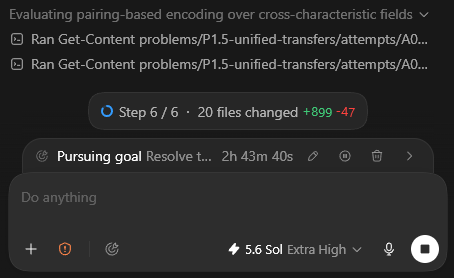
Furthermore, our long-term focus remains unchanged: publishing proper papers at academic conferences and continuously working to solve open problems in elliptic curves through agents.
Our token is fundamentally motivated by DeSci, supporting academic research, but we agree that it ultimately needs to provide someone with a "reason to buy."
Through consistent, transparent development, we will not lose our focus until we publish research results that can contribute to the Solana chain itself.
We've reviewed all of your feedback and understand what's needed.
We had planned to allocate 10% of the supply for peer review requests and various other purposes. This will remain unchanged.
Many people have been asking that the token have some degree of "utility." We are fundamentally a research project, but we believe building utility on top of our research should not be difficult. We intend to invest time in developing various utilities driven by token payments.
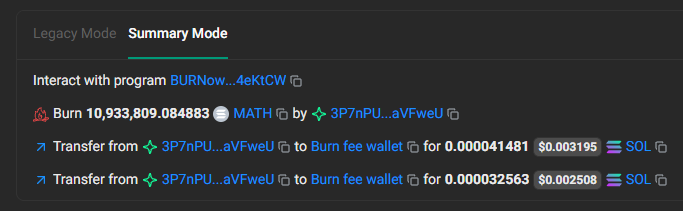
Of the developer fees, 20% will be used for burns, and 30% will go toward supporting the Staking Cycle of our utility once it has been developed.
The remaining 50% will be spent on AI inference, as originally planned.
We're about to begin our first purchase, and having solved the first problem with your support and strong interest, we believe it's now time to hear from you.
We've reviewed all of your feedback and understand what's needed.
We had planned to allocate 10% of the supply for peer review requests and various other purposes. This will remain unchanged.
Many people have been asking that the token have some degree of "utility." We are fundamentally a research project, but we believe building utility on top of our research should not be difficult. We intend to invest time in developing various utilities driven by token payments.
Of the developer fees, 20% will be used for burns, and 30% will go toward supporting the Staking Cycle of our utility once it has been developed.
The remaining 50% will be spent on AI inference, as originally planned.
We're about to begin our first purchase, and having solved the first problem with your support and strong interest, we believe it's now time to hear from you.
Honestly, there isn't much we can do to directly influence the token price.
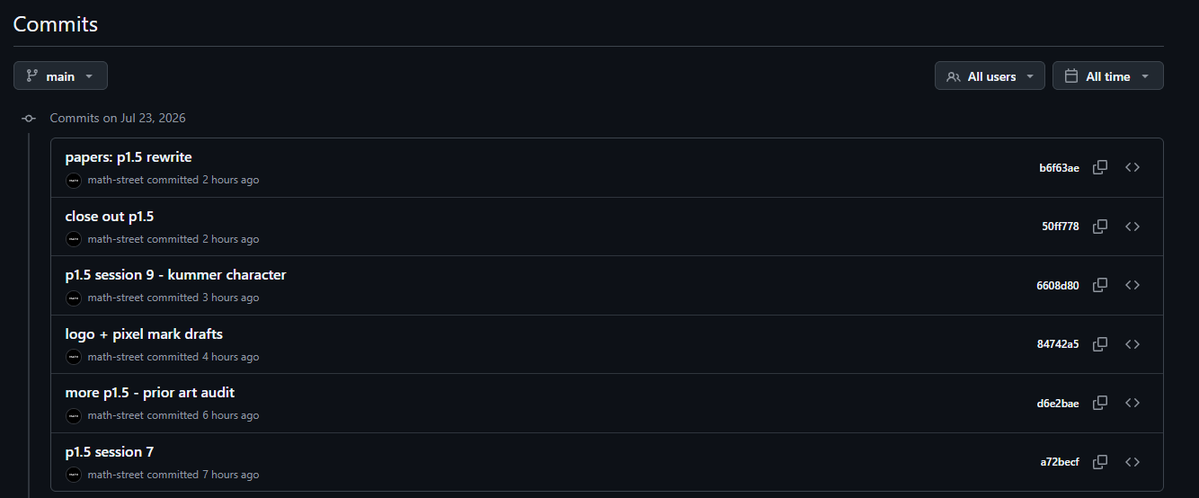
All we can do is keep researching, and do our very best to produce new results that impress you and surprise the world.
We're keeping our research process fully transparent, so please take your time and watch it unfold.