Researchers cut open the brains of Alzheimer’s patients and found a bacteria living inside 90% of them.
It’s the exact same bacteria that lives in your mouth right now.
For decades, medicine treated Alzheimer’s as an unavoidable genetic flaw or a random protein glitch.
The leading theory blamed "amyloid plaques”, sticky protein buildups that choke off brain cells. Big Pharma spent billions trying to destroy these plaques.
Almost every single drug trial failed.
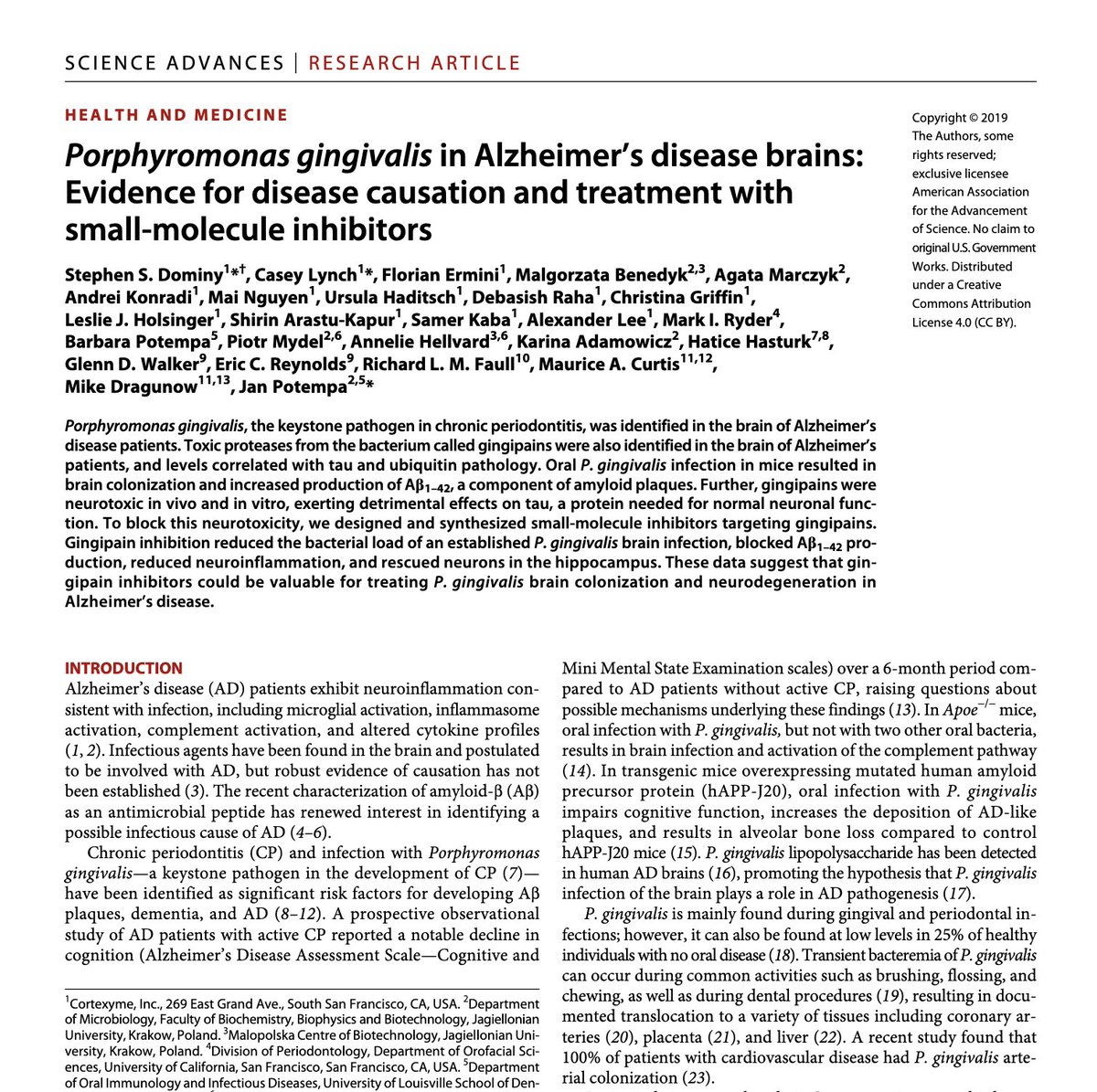
A groundbreaking study published in Science Advances revealed why.
The protein plaques aren't the primary cause of the disease.
They are the brain's desperation defense mechanism against an invader.
The culprit is Porphyromonas gingivalis, a common bacterium that thrives in infected gums.
When your gums bleed, the bacteria enters your bloodstream. Over years, it breaches the blood-brain barrier and secretes toxic enzymes called gingipains.
These toxic enzymes literally slice up brain tissue, destroy neurons, and trigger devastating memory loss.
To defend itself, the brain produces amyloid proteins to trap the bacteria.
We weren't looking at the cause of Alzheimer's.
We were looking at the crime scene aftermath.
When researchers infected healthy mice with the gum bacteria, the mice developed brain infections, amyloid plaques, and rapid neural damage.
When they gave the mice a targeted drug to block the bacterial enzymes, the brain infection cleared, neuroinflammation dropped, and dying neurons were rescued.
Alzheimer’s may not be an irreversible decay of the mind.
It might be a chronic bacterial infection we’ve been ignoring for decades.
The solution to one of humanity's most terrifying diseases might not start in a neurology ward.
It might start in your mouth.