I am proud to share the cover for my book: "America's Neglected Protectionist Tradition: The Economics that Forged a Nation."
The book will be published by @AnthemPress in the second half of this year.
More information can be found in the comments:
In the book, I divide the School into roughly four periods:
(1) The 1st period is associated with Alexander Hamilton and Tench Coxe and spans to about the Panic of 1819.
(2) The 2nd is associated with Mathew Carey, Raymond, Rae, List, etc. This spans from the Panic of 1819 to the publication of Henry Carey's ‘Past, Present, and Future’ in 1848.
(3) The 3rd spans from around Carey's ‘Past, Present, and Future’ to about the publication of Robert Ellis Thompson's Elements (1875).
(4) The last period spans from Thompson's ‘Elements’ to around the turn of the 19th/20th century. I also argue that this last group was the most refined.
As for the second question, I don't think the political reception should dictate whether a subject is worth researching. There is a theoretically-rich tradition of protectionist political economy that has been largely neglected, and I think it deserves our attention, especially given the contemporary resurgence of tariffs and industrial policy.
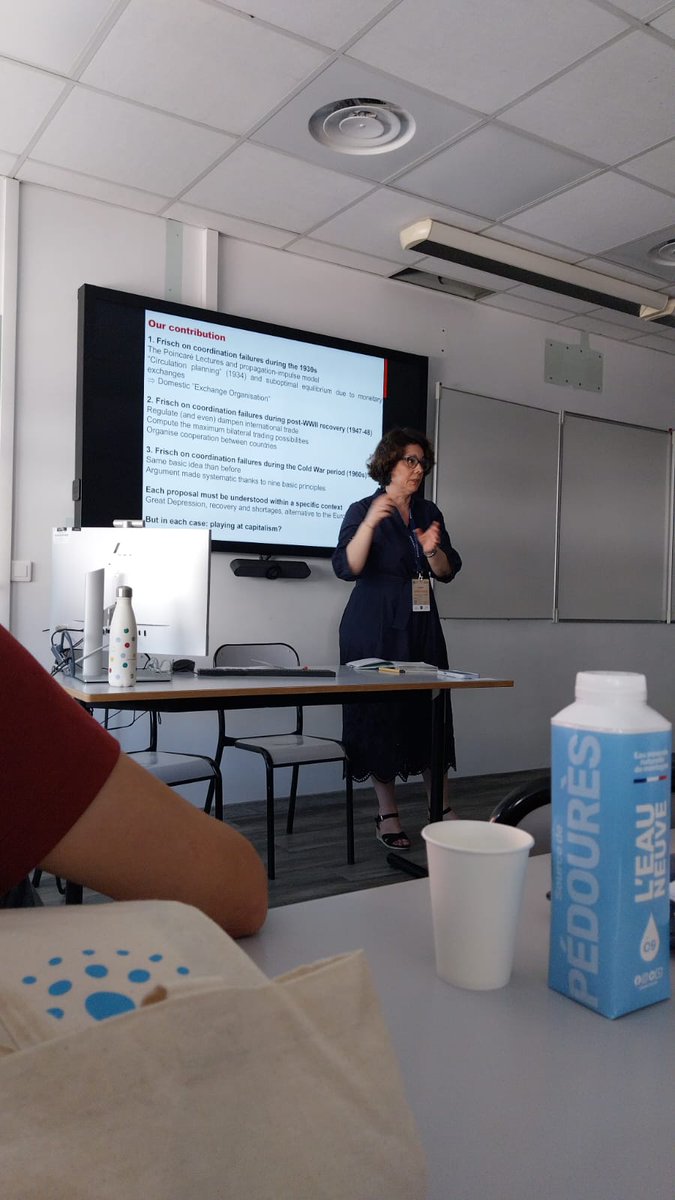
My recent talk on Alexander Hamilton's theory of tariff incidence from the joint conference of the European Society for the History of Economic Thought (ESHET) and the History of Economics Society (HES) - @Societies_HET.
I show that the American School of political economy had a coherent theory of tariff incidence which differed from Smith's maxim that the consumer pays the full cost of the tariff.
Could be useful for those who couldn't make it to the session or to the conference.
Link to paper in comments.
@Societies_HET You can also find my forthcoming book here, where I discuss the broader views of the American Protectionist School: https://t.co/ErcyOOLcqU
@rmcentush Published via Anthem Press (peer-reviewed academic press) and will be out by August. I reconstruct the system of the American Protectionists from roughly 70 economists from Hamilton to the end of the 19th century.
I’m not going to engage in a twitter back and forth on the question, but disagree that the commonalities are merely surface level. There are numerous parallels that cut to the core of economic theory. My book provides a comprehensive treatment of the School and my case can be found in there. Congratulations on your book. I look forward to reading when it comes out.
@_PeterRyan I also explore the diversity of talents argument in a recent article: https://t.co/ffkiQMU7Tl
This was a salient argument throughout the writings of the later American protectionists and it can be traced to Hamilton’s (and Coxe’s) Report.
@_PeterRyan There are pretty clear linkages between the Hamilton and the economics of the American System. The foundations of those later thinkers can be largely found in Hamilton’s writings. You might be interested in my forthcoming book on the topic: https://t.co/ErcyOOKEBm
Article: Alexander Hamilton, Tench Coxe, and the Diversity of Talents: A Neglected Argument in Early American Protectionist Thought, by Mathew A. Frith (open access)
https://t.co/c6n3VZuiMR
For those interested, I presented a talk on a draft of the article at the Winter Institute for the History and Philosophy of Economics held at @uaustinorg. A recording of the talk can be found here: https://t.co/fBDr6Nh7SU
Alexander Hamilton's Report on Manufactures is widely credited with the infant-industry argument. But it contains an equally powerful case for protection that virtually no one talks about: the diversity of talents argument.
My new article in the History of Economics Review explores this argument, and shows that Hamilton's Treasury Assistant, Tench Coxe, most likely developed the idea. The argument represents one of the sharpest breaks between Hamilton and Adam Smith.
The article is open access and can be downloaded for free in full (link in comments).
@josephdelkins Yes, I reviewed facsimiles of the original drafts via LOC (and HSP). The originals are consistent with Syrett and Cooke. To my knowledge, the Lodge collection only contains the final Report, so I wouldn't expect there to be any textual variation.
This chart from my article shows the development of the "diversity of talents" argument through Alexander Hamilton and Tench Coxe's various drafts of the Report on Manufactures and their other writings.
The trail points to Coxe, not Hamilton, as the argument's originator.
Alexander Hamilton's Report on Manufactures is widely credited with the infant-industry argument. But it contains an equally powerful case for protection that virtually no one talks about: the diversity of talents argument.
My new article in the History of Economics Review explores this argument, and shows that Hamilton's Treasury Assistant, Tench Coxe, most likely developed the idea. The argument represents one of the sharpest breaks between Hamilton and Adam Smith.
The article is open access and can be downloaded for free in full (link in comments).
@josephdelkins If you have all volumes then yes. However, volume 26 was a later addition (not included in the original set) and that includes Coxe’s 2nd draft.