@PawelHuryn I feel like this depends a lot on org structure and the attitudes of your team and management. This is the “ideal way”, but in the real world you’re likely to get mismatched expectations below or above you. Sometimes you can change those and make an impact other times you can’t.
@onejasonknight If your backlog is expected to be so comprehensive that it is considered a failure if it doesn't predict every possible customer request you probably have a culture problem to dig into. 🤣
@KiwiDenny I think many processes treat feedback as an afterthought. If you don't plan for it and make room for its implications it becomes useless. Feedback needs to be central to how time and work is planned. It shouldn't be at the end, it should be a driver.
@johncutlefish Have you seen this actually work out successfully? Or in a way that doesn’t involve just being forced to get into one of those nicely defined boxes? Makes me wonder which is easier, changing perceptions outside your control or just moving to somewhere new to start over.
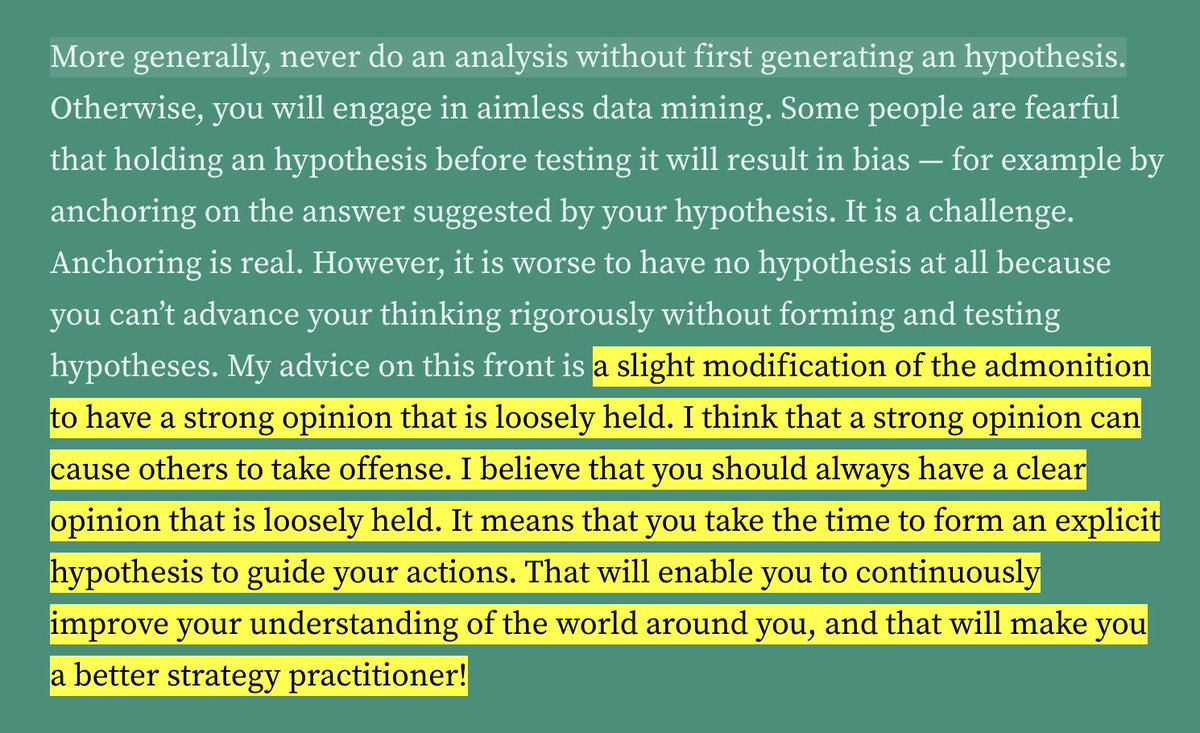
I like this take better. A "clear" instead of "strong" opinion loosely held. Clarity allows the opinion to be a hypothesis you can collect information about. Strong feels more like willing it true.
Extracted from the end of this article by @RogerLMartin
https://t.co/rG4Pqqzgki
@nurijanian When you said you got too "mathematical" for people to understand (after this line in your newsletter) what methods were you trying? Just was curious.
"I broke a recent hard problem down into its parts and looked for ways to change each variable to gain leverage."
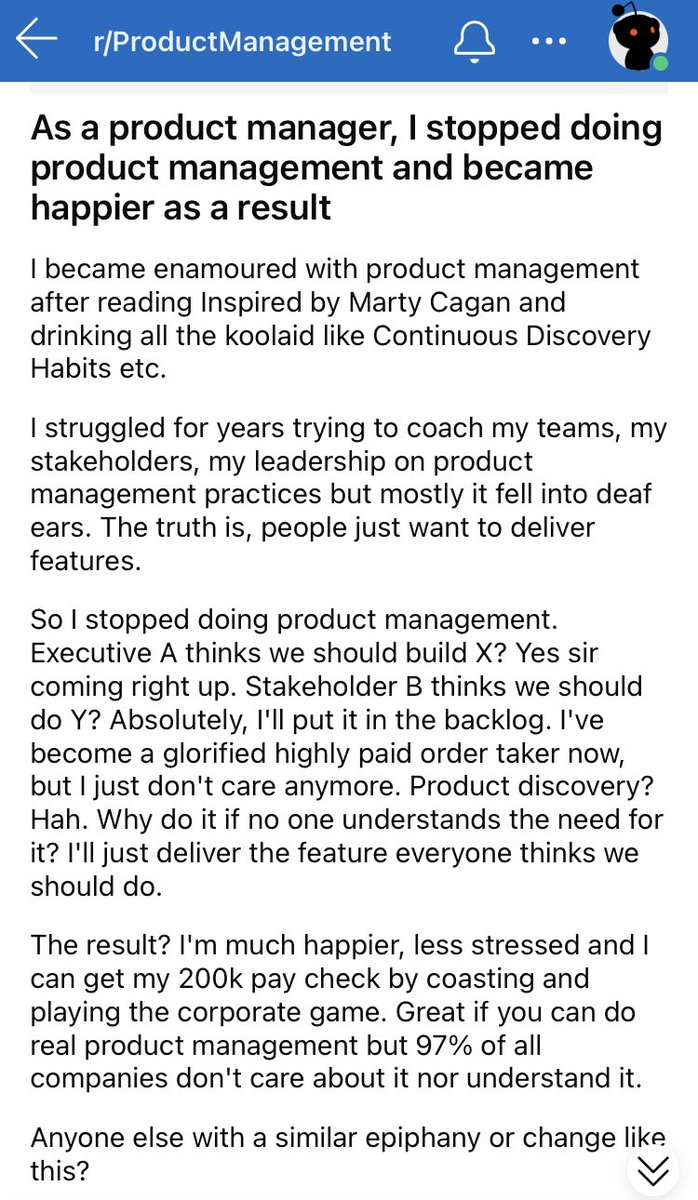
@nurijanian I feel like this is the source of the angst of the reddit post you recently tweeted. Lots of people told to do "product" and care a lot about their work when the org only supports them functioning as a PO on the dev team. Work and skills are pretty between these two.
Idea mashup simmering in my head this week: @bmoesta + @stuartablon + @ProfEricJohnson.
The hit or miss struggle for leaders to innovate is not a lack of will but a lack of deep skills paired with systems & defaults that need to be tweaked or hacked.
#jtbd#productmanagement
@bmoesta Example I like to use is "40 yr old, male, air traveler at their gate". One version of this person is chill'n, eating a snickers, cranking out some extra work. The other version is playing zone defense wrangling kids.
Same place, same person, different context and struggles.
@bmoesta Problem with personas is while they can be done well they are waaaay too easy to do poorly. Many times they are just made up or if they are researched based they tend to be based on flat non-narrative data, which as you pointed out misses the context that adds real meaning.
"… our conditioning is fit in, conform, obey, survive. And the survival mentality is not compatible with the flourishing mindset. You can’t be in survival mode and scarcity mode and at the same time flourish and take advantage of any abundance."
- @fortelabs
@fortelabs Enjoyed your conversation with @david_perell on his podcast about this. Definitely seems like the bleeding edge of education is self selecting and community seeking. Easier to engage if you are enjoying it and finding a tribe.
https://t.co/AFHGuVJvz1
@mulegirl@ProfEricJohnson Went down the same rabbit hole this evening. Glad to hear the book was good in the product / design context. I'll probably pick it up soon.
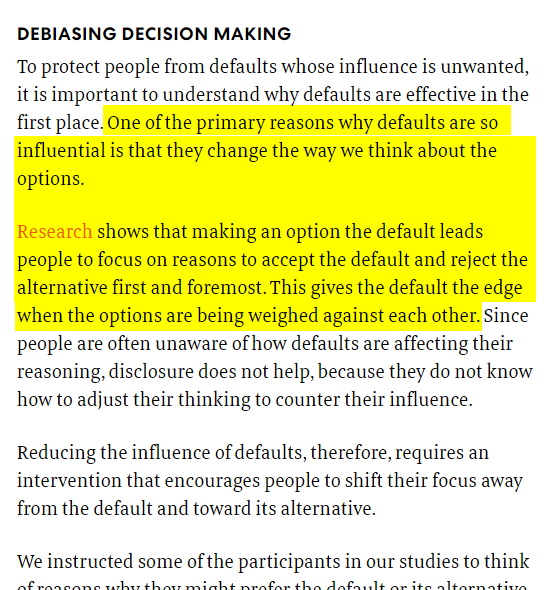
How do defaults affect how your teams work and how your users engage in your products?
I thought this was an interesting take on defaults and how they frame alternative choices.
Curious to hear stories of this playing out, thoughts?
https://t.co/q5Yioe1Fbq
#productmanagement
We interviewed @bmoesta on @BehindTheProd and discussed his new book. If you follow Bob as extensively as I do you'll pick up a few new things in this episode.
https://t.co/Jg6v9BHZ3e
Links to Bob's books & JTBD resources:
https://t.co/t7YbufZie0
#productmanagement#jtbd