Tim Cook's final day as Apple CEO.
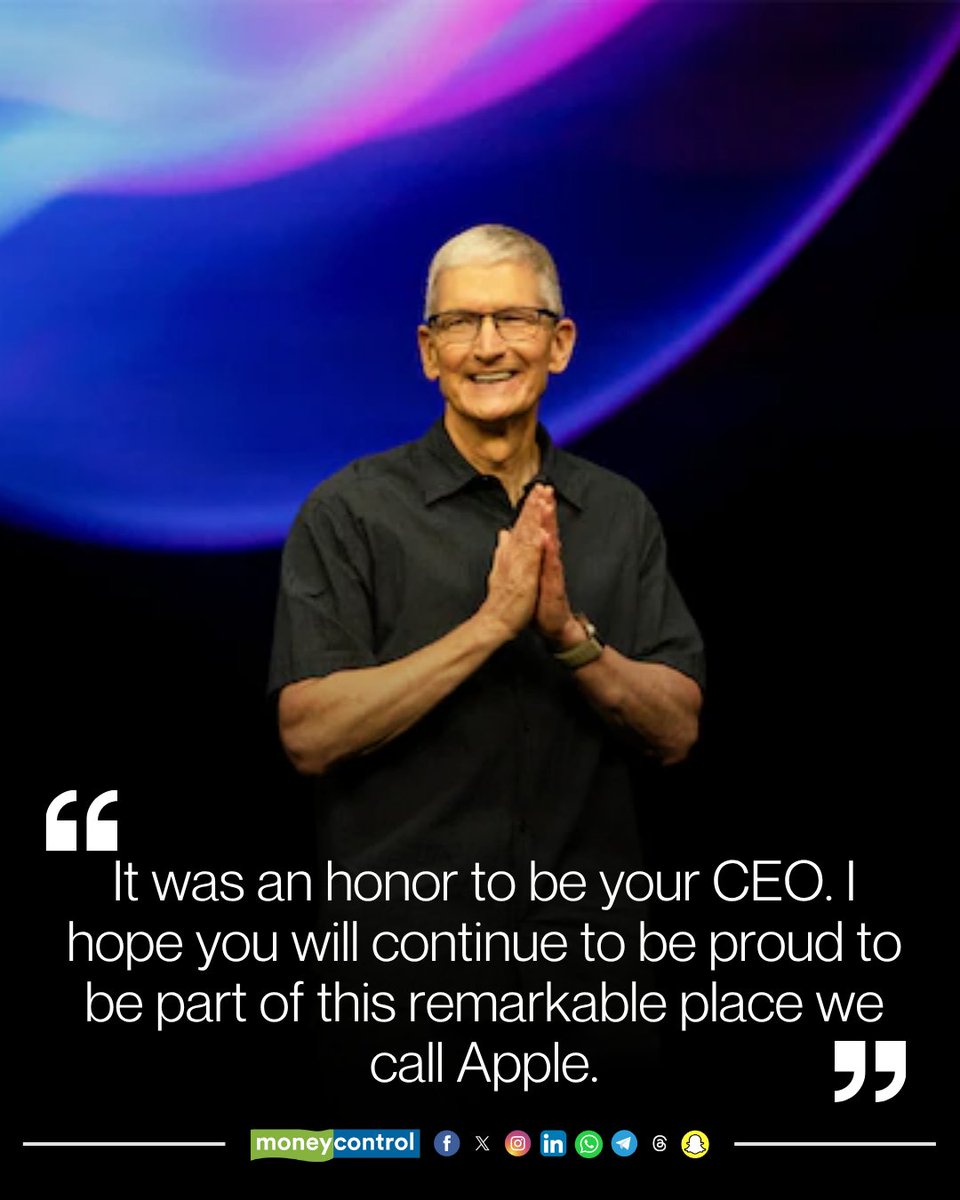
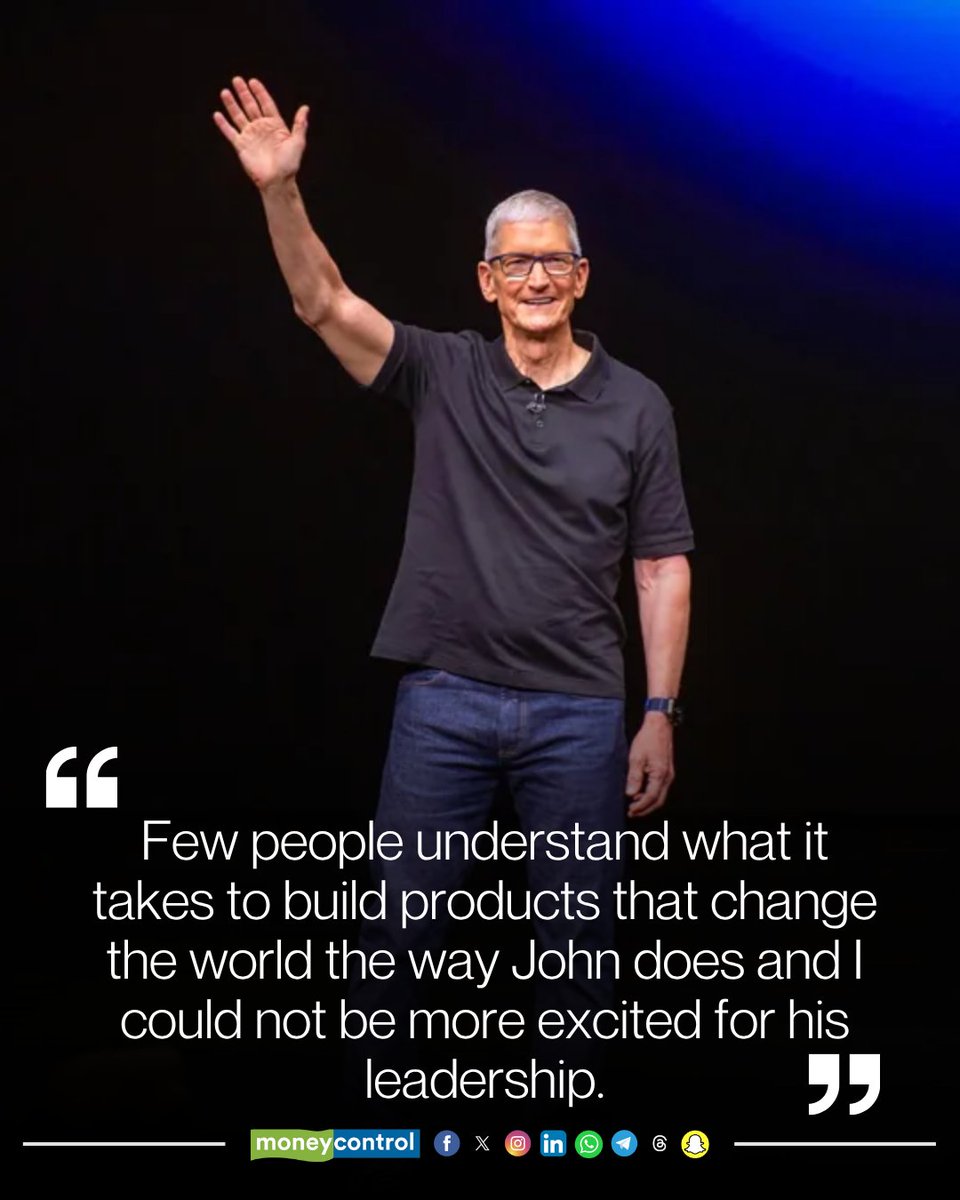
Apple's Tim Cook told employees that he’ll miss the role of chief executive officer but has “enormous comfort” in the leadership of his replacement, John Ternus.
Cook made the comments in an email to all employees on August 31st, his final day as CEO. Cook took over for Steve Jobs in August 2011, when he embarked on a record-breaking 15-year tenure that included the launch of the Apple Watch, AirPods, and major expansions to the iPhone, iPad and Mac lines.
“As you know, I am not leaving Apple. But I am stepping away from a role that I have loved deeply,” Cook said in his email. “I will miss this work in ways I can only begin to imagine, even as I remain completely at peace with my decision.”
Here's what Tim Cook wrote in his final memo to all employees as CEO.
#TimCook #Apple
Sending lots of love to the Apple community on my last day as CEO. My title changes tomorrow, but the love I have for the Apple community never will. Thank you for being a constant source of inspiration. My gratitude is endless, and I’m excited for the next chapter!
Apple fired Steve Jobs.
He walked into MIT and gave the most honest 60-minute business lecture ever recorded.
No PR filter. No image to protect. Just raw thinking from the guy who built Apple once — and was about to do it again.
Watch this instead of Netflix tonight.
Bookmark it for later
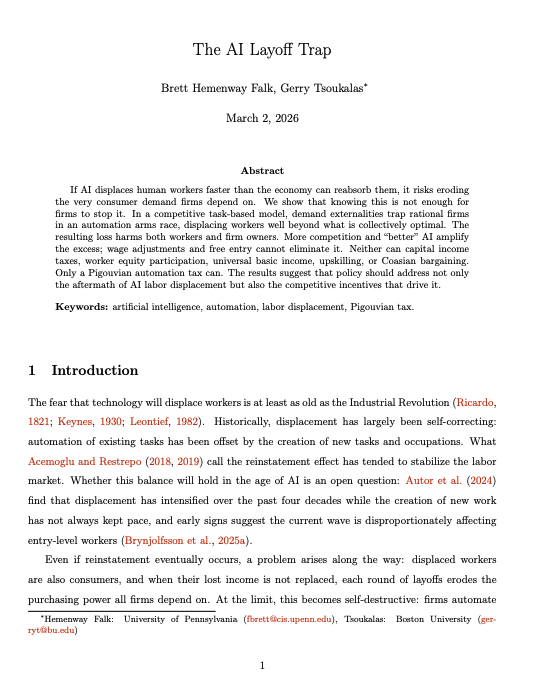
🚨BREAKING: Two researchers from UPenn and Boston University just published a paper that should be uncomfortable reading for every CEO automating their workforce right now.
The argument is straightforward. Every company replacing workers with AI is also eliminating its own future customers. Laid off workers stop spending. Enough of them stop spending and nobody can afford to buy anything. The companies that fired everyone end up selling into an economy with no purchasing power left.
Every executive can see this. The math is not complicated. But here is why nobody stops.
If you do not automate, your competitor does. They cut costs, lower prices, take your market share, and you collapse anyway. So every company automates knowing it is collectively destructive because the alternative is dying alone while everyone else survives. The researchers proved this is a Prisoner's Dilemma playing out in real time.
The numbers are already moving. Block cut nearly half its 10,000 employees this year. Jack Dorsey said AI made those roles unnecessary and that within the next year the majority of companies will reach the same conclusion. Salesforce replaced 4,000 customer support agents with AI. Goldman Sachs deployed a coding tool that lets one engineer do the work of five. Over 100,000 tech workers were laid off in 2025 and AI was cited as the primary driver in more than half those cases. 80% of US workers hold jobs with tasks susceptible to AI automation.
The researchers tested every proposed solution. Universal basic income does not change a single company's incentive to automate. Capital income taxes adjust profit levels but not the per-task decision to replace a human. Collective bargaining cannot hold because automating is always the dominant strategy.
They also identified what they call a Red Queen effect. Better AI does not solve the problem, it accelerates it. Every company chases faster automation to gain market share over rivals but at the end everyone has automated equally, the gains cancel out, and the only thing left is more destroyed demand.
The one thing the math says could work is a Pigouvian automation tax. A per-task charge that forces companies to account for the demand they destroy each time they replace a worker.
The conclusion is that this is not a transfer of wealth from workers to owners. Both sides lose. Workers lose income. Companies lose customers. It is a deadweight loss with no market mechanism to stop it on its own.
PM @narendramodi Ji’s visionary ‘Make in India’ initiative has created jobs and provided skilling at an unprecedented scale.
Women have been the biggest beneficiaries of these opportunities.
India is preparing a skilled workforce for the next phase of electronics manufacturing - Robotics, Drones, EVs, Smart Cars, Precision components, Advanced tooling, and Smart glasses.
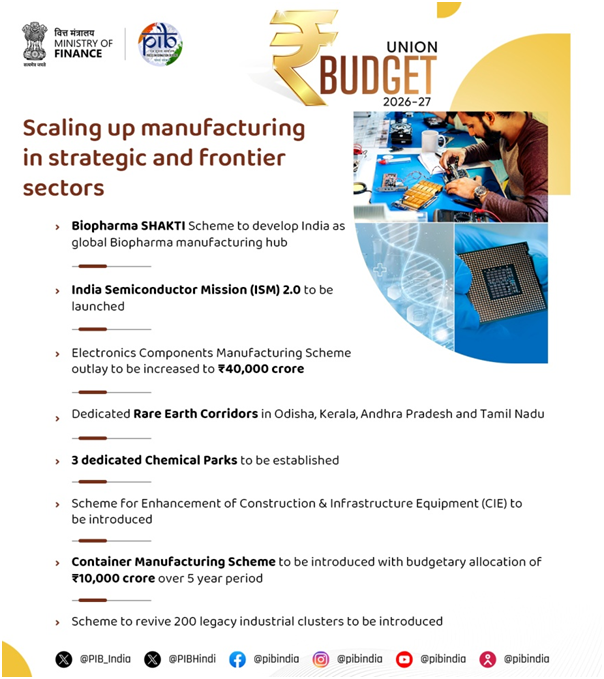
To scale up manufacturing in strategic and frontier sectors, the Union Finance Minister proposed to launch:
👉 Biopharma SHAKTI
👉 India Semiconductor Mission (ISM) 2.0
👉 Electronics Components Manufacturing Scheme
👉Dedicated Rare Earth Corridors in Odisha, Kerala,
Andhra Pradesh and Tamil Nadu
👉3 dedicated Chemical Parks
👉Scheme to revive 200 legacy industrial clusters
#ViksitBharatBudget
#TodayinParliament The Finance Minister is scheduled to present the Union Budget 2026-27 in Parliament today. The Finance Bill, 2026 which contains the financial proposals for the year, is listed for introduction in Lok Sabha. #Budget2026
🇮🇳 Make in India powering electronics industry!
📱India’s smartphone exports hit a record $2.4 billion in October.
Total $16 billion smartphone exports in 7 months of FY26 so far.
Component manufacturing ecosystem is also taking shape.
‘Make in India’ impact!🚀
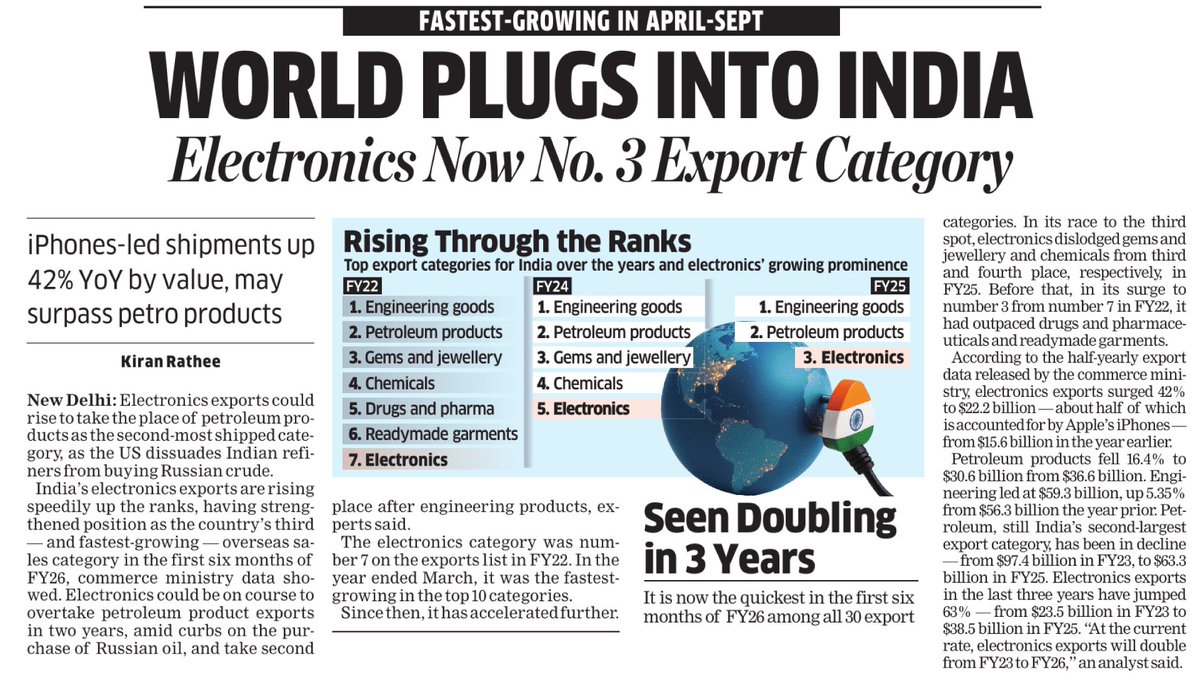
Electronics become the country’s third largest and fastest-growing export category in first six months of FY26. On course to be the second largest exported item.
📈 FY’26 off to a strong start:
– $3 bn smartphone exports in May alone (+74% YoY)
– $5.5 bn exports in Apr-May
– $8.2 bn electronics exports in Apr-May (+47% YoY)
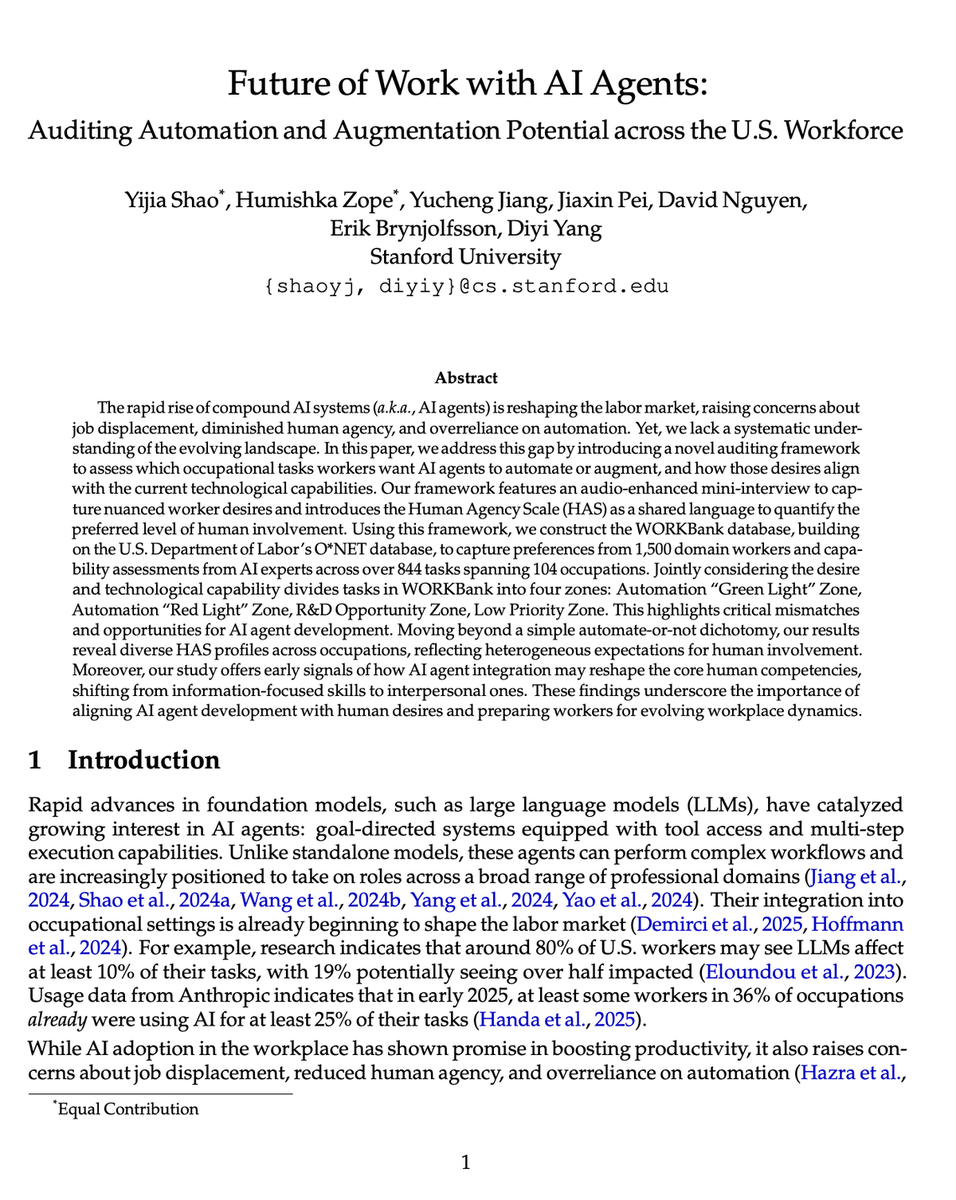
BREAKING: Stanford just surveyed 1,500 workers and AI experts about which jobs AI will actually replace and automate.
Turns out, we've been building AI for all the WRONG jobs.
Here's what they discovered:
(hint: the "AI takeover" is happening backwards)