Got shit for this on LinkedIn for being "contra-Europe"
Anyway, if you’re a European builder and know you should already be in SF, this one’s for you → @jointhebridge
Find your people, build fast, and raise in SF. 40 spots. Spring 2026.
i turn 30 today
here’s what i learned:
1. prestige is a drug, closer to heroin than anyone admits. a respected title, income security, a luxurious environment, existing as "superior" in other people’s eyes. once that identity sets, leaving is almost impossible. it feels like the suicide of the ego. that’s why brilliant people stay decades in positions that quietly kill them. I watched it in the best law firms
2. my cancer at 24 broke a curse. when you should be dead, social artifacts stop working. I needed something bigger to keep going: a quest. that’s what carried me through the bar, through the top firms, and then out of all of it
3. I have always suffered disproportionately from my own risk-taking. I’m an introvert; in high school I entered public speaking competitions because I’d read you must seek difficulty on purpose. nausea, cold sweats, stomach pain, every time, for ten years, through law school. it never became comfortable.
when you look at athletes, it doesn’t hurt less after a thousand sessions. they just read the pain differently
4. everything in the universe drifts toward dispersion. being alive is the one rebellion against that law. so is attention. so is building. the day you stop choosing voluntary discomfort you’ve started disappearing
5. you can fall in love with failed iterations. multiplying errors is the fastest form of learning that exists. obsessing over the end goal is a beautiful way to stay frustrated forever
6. what actually remains is the emotion. the works, games, movies that marked you young. friendship. love. almost nothing else survives. and here’s the paradox that took me longest to accept: the quest gives you a direction but you can only ever live in the present step. anticipation breeds pessimism and guaranteed disappointment. presence is where the whole thing actually happens. meditate. contemplate the moment. celebrate every win
The fallacy of this is that more creates more. More hours, more hiring, more something.
And it is true in a sense. If you put in more work, more work will happen. But I think for most startups, the leverage is really in how differently you approach the problem, how well you cultivate your team, and the strategy.
Any large company can outspend you on hours. They have thousands or tens of thousands more people, spending more hours. If hours worked were the metric, every large company and government organization would always win and do the best work. More hours, better output.
This thinking is often representative of younger founders, where the startup becomes their identity and life. They have a hard time doing anything else, and cannot understand that your work is not the person that is you. But activities outside of work can grow you as a person too and make you do better work.
I’ve never worked this way. As a designer, I always saw the need to take a step back, to take a break. At times, I might work 12 hours or 16 hours, or whatever amount was needed, but it wasn’t the norm. You just can't grind design, you need inspiration. But taking that step away from the work, would give me more perspective, inspiration and I could approach the problem differently or I could just see the solution.
Grinding is never good for any creative problem, and startups or creating new products are often mostly about creative problem solving. Grinding works ok for email jobs, or where you just executing on very clear playbook.
With Linear, we’ve never worked this way. We work reasonable hours, 5 days a week. All of us founders have families. Many of our employees have families. I personally stop every evening, spend time with the family, cook dinner for the family, eat dinner together, and focus on things outside of work. Sometimes I work in the late evenings or weekends, but to me the pride is that I don’t need to. Company should be succesful without it.
My goal is to build a company that is sustainable in the long term, and doesn’t require heroics or personal sacrifices every single day.
There are times when our team is heroic. Launches, incidents, some other work that just needs to be done. They will work late into the night because they know it is the right thing. But we don’t require that every day or every week, and the more this happens, the more I think it is a failure of our company and leadership. The team and the leaders should always keep a reserve to use when something is needed.
Our thinking was also that quality, which we value, doesn’t emerge from working more or stressing people more. It emerges when you create the conditions for it to emerge. Often it is the appreciation, space, time, and how the person feels. A person who is rested will do better work.
I wouldn’t attribute much of our success to working a lot. The success came from having clear thinking, ideas, and focus to do the right things.
I sometimes wish we could move the culture more toward a Zen master.
Real mastery is not exerting the most effort. It is achieving the outcome with the least necessary effort.
The Silicon Valley I came to in 2016 -- once a low-status refuge for weirdos, naive tinkerers, and missionaries -- has been overrun by input-maxxing Kumon striver types.
Company-building for this class of “entrepreneurs” is an exercise in performative escalations between startups touting their inputs: who can burn the most tokens, who can work the most hours, who can get the most views on an over-produced launch video.
This is why even “ARR,” which should be (and once was) an output of an excellent product and sales engine, has become a noisy, somewhat fake input -- into a machine designed to capture the zeitgeist for 15 minutes, dupe VCs, and maximize fundamentals-agnostic capital flows into a business. Actual company-building is a sideshow for the “cracked” YC-backed founder-striver.
When you talk to many of these people, they have no idea why they’re building what they’re building in the same way that a 16 year old doesn’t really know why he joined 12 clubs or took 15 AP classes -- only that they desperately want to maximize their visible, measurable inputs, tell you about it, and collect their gold star.
It’s easy to place the blame on YC, and they surely deserve plenty of it, but YC’s turn towards performative, low-stakes, incrementalist entrepreneurship is really just another symptom of the broader problems plaguing Silicon Valley: the inevitability of industry maturation and the playbook-ization of startups, demographic change, financial nihilism downstream of bad policy and psychopathic rhetoric coming from some leaders, etc.
The real progress being made amidst all of this is astounding, but the increasingly absurd shenanigans won’t stop until the culture punishes bad behavior and we prosecute, literally, some of the criminals running these companies.
Be your self, not someone you were assigned to be!
Bezos won on time horizon, not AWS or 1-Click.
If your bets have to work in 3 years, you compete with everyone. Every smart, funded team is chasing the same 3-year problems. Short horizon, crowded field.
Stretch to 7 and the field collapses. Investors want returns, employees want vesting, founders want proof. Almost nobody can sit in a bet that doesn't pay for most of a decade. The patience is the moat, and it costs you, that's why it works.
But you can't fake a 7-year horizon on a problem you don't actually care about. Pick the users and the problem Moloch assigned you, the safe ones, the fundable ones, and you'll bail the first hard year. Pick the ones that are actually yours and you'll still be there when everyone else has quit.
So the real prerequisite isn't discipline. It's knowing yourself well enough to choose a problem and a set of people you care about that you'll serve them for decades.
Just talked to a mech eng undergrad from ETH getting depressed by the lack of truly ambitious people working on non-trivial problems in Zurich.
ETH’s real problem isn’t a lack of talent, it’s a lack of ambition and first-principles thinking.
Watch a team of humanoid robots running a full 8-hr shift at human performance levels. This is fully autonomous running Helix-02 https://t.co/IdZR0T1F5I
il y a une génération entière qui pense débarquer dans la silicon valley pour changer le monde grâce à opus 4.7 sans une seule ligne de code dans le sang, sans la moindre intuition technique, sans même savoir distinguer une API REST d’un serveur MCP et le drame c’est qu’ils sont au minimum 10 millions à avoir exactement la même idée en même temps, biberonnés aux mêmes threads twitter, aux mêmes podcasts y combinator, aux mêmes prompts copiés collés…on assiste à la production industrielle de clones entrepreneurs persuadés d’être uniques
de mon côté je pense que plus l’IA démocratise l’accès à l’intelligence générative plus la rente revient à ceux qui maîtrisent ce que l’IA fait mal car quand un outil très puissant devient disponible à prix nul pour 1 milliard de personnes simultanément, l’avantage compétitif se déplace immédiatement vers ce que l’outil ne sait pas faire correctement
en d’autres termes je pense que notre époque exige exactement le contraire de ce que tout le monde fait, + le modèle devient puissant + l’humain doit devenir profond, + l’IA optimise les réponses + chaque builder doit maîtriser les questions, + le prompt est facile + le savoir faire technique réel devient un avantage stratégique décisif
le vrai conseil pour celui qui veut construire quelque chose qui compte c’est de fuir le mimétisme du moment, fermer ChatGPT et opus 4.7, ouvrir un livre de thermodynamique, de génie chimique, de neurosciences ou de cryptographie, apprendre à souder un capteur, à cultiver une bactérie ou à calibrer un capteur à microns…
ce sera douloureux, lent, inconfortable et profondément démodé et c’est exactement pour ça que les rares qui le feront se retrouveront seuls sur des continents entiers d’opportunités que les esprits suiveurs n’ont aucune chance d’apercevoir car à mon sens plus tout le monde fait pareil plus la curiosité obsessionnelle pour différentes disciplines devient un superpouvoir
retenez que l’exécution réelle dans le monde physique habite toujours en dehors du prompt & appartient à ceux qui acceptent de mettre les mains dans la matière et notamment à ceux qui sont prêts à échouer, à itérer, à recommencer pendant un certains temps avant de prétendre changer le monde
storyteller is exploding as a job category in SF
bc the new generation of founders is defined by the story they tell while building.
so the post-AI era shifts everything toward acquisition science and art.
I know a top-tier VC/incubator in San Francisco hiring its storyteller
reply below and I’ll send the details
ENTREPRENEURS FIRST: THE BRIDGE - FALL APPLICATIONS NOW OPEN
The Bridge is for non-US builders who want to start massive companies but are pre-idea / pre-team / pre-everything
details:
>$250k first check for the best teams
>8-week in-person residency in SF - housing, workspace, food, visa paperwork all on us
> funded → stay 3 more months in the EF SF office to build & raise
> 40 spots. zero cost. very competitive
built by Entrepreneurs First. $ 16B+ in portfolio value behind us.
we called it The Bridge bc thats what it is - the fastest line from anywhere in the world to silicon valley.
most of the best founders dont start with a perfect idea. they start w/ curiosity, talent & the willingness to build until something clicks.
the most important companies of the last decade started this way:
>tinkering w/ side projects
>hacking on open source
>weird prototypes w/ friends
>exploring a space before the opportunity was obvious
so instead of a polished pitch deck, we give you:
>time
>network
>housing & visas
>enough capital to start
show up w/ technical ambition & curiosity. 8 weeks in SF, 40 of the sharpest non-US builders on earth in one house. find your co-founder. find your market. talk to users. ship prototypes. stress test. at the end, the best teams pitch our IC for the $250k & 3 more months in the EF office to turn it into a real company.
what does that look like on the other side?
cleo → unicorn
aztec network → a16z
gensyn → a16z
polyAI → khosla
neptune robotics → sequoia
magdrive → founders fund
$ 16B+ portfolio value & climbing.
every program offers sessions, some take a call, few put you in a house - one puts you in a house & onto a roster backed by patrick & john collison, demis hassabis, daniel gross, nat friedman, reid hoffman, mustafa suleyman, eric schmidt & mati staniszewski.
who we want:
>engineers who ship fast
>builders w/ side projects in their history
>hackers who pick up new systems in a weekend
>future CEOs who can sell, grow & distribute
>people whod start companies eventually anyway
we're targeting founders outside the US on purpose. its a bet on the next wave - the talent thats nowhere near silicon valley but should be.
if thats you - apply now.
You raise your seed round.....now what?
The first thing you do when $1-2M hits the bank account is open the app, look at the number, take the screenshot, smile, send it to your family group chat to make your dickhead brother jealous....then close it.
You just got 18-24 months if you're disciplined, 8-10 if you're stupid.
Firstly,
Don't change your fucking life.
Pay yourself enough to not stress about rent. $80-120k depending on city, even lower if you can stomach it.
If you pay yourself $350k after a $2M raise.....chances are, you will not last. You're not running a company just yet.....it's an experiment...one that will end quickly if you prioritize short term gains > long term greatness.
Same with office. You don't need one. The "we need a real space for the culture" is bullshit.
Work from home.
Your only job for the first 6 months is to talk to users and ship quickly.
If you raised $2M and you're not doing (minimum) 5 customer calls a week as a founder........your priorities are messed up.
You need to understand as quickly as possible if the people who use your product, come back without you begging them to do so!
Almost everything else is a vanity exercise.
Series A timeline in 2026 is 600+ days from seed.
Less than 15% of seed-funded startups ever raise an A.
So track burn weekly.
Know your runway to the day.
Every dollar should ship product or facilitates customer feedback .
If a tool, hire, or expense doesn't do that, stop it.
Conference tickets? No. PR firm? Absolutely fucking not. "Brand consultant" don't be stupid. Logo redesign? GTFOH.
72% of seed stage burn is "people".
74% of startup failures involve premature scaling.
You raise, you feel pressure to "build the team," you hire 4 people in 90 days, burn goes from $40k/mo to $180k/mo, the new hires don't have product to work on because there isn't one yet, you spend your time managing them instead of talking to users, runway evaporates, you're back fundraising at month 9 with worse metrics than when you started.
Stay 2-3 founders + AI for as long as humanly possible.
The teams crushing right now have 4 people doing what 15 used to do just 24 months ago.
When/If you do hire.......focus on builders, forget managers. Focus on operators, not "credentials".
If you're not using AI for code (Cursor, Claude Code), customer support, sales prospecting, content, ops, brand, recruitment vetting......your competition is winning.
Tech is commodity now. GTM and data are the moats. Use AI to compress everything that isn't either of those things.
Try to avoid giving advisors equity.
An "advisor" (who you mistakenly thought would enhance "credibility optics") who takes 1%, for doing absolutely nothing, is the same prick that costs you seven figures in a future round.
Model dilution before signing every SAFE.
Don't talk to VCs for 6 months. (forget the "always raising" mindset for now) Keep relationships warm with periodic updates but take the foot of the gas slightly.
I know. I'm a VC saying this. But I mean it. The gravitational, distractional pull of the next round, will fuck up your focus harder than anything else.
Send your existing investors a 5 line monthly email. Don't go to investor dinners. Don't "build relationships for the A." If you're talking to VCs more than building, again, your priorities are misjudged and it will show up against your development goals.
The money will fuck with your head. People will ultimately treat you differently. Nobody really prepares you for that.
You'll get DMs from people you haven't talked to since school. You'll feel the urge to announce, to LinkedIn post, to look like a "real founder."
You'll also be lonelier than ever. You raised, your "friends" think you've made it, you can't tell them you're scared shitless and don't know if it'll work.
I would recommend finding 1-2 founders.....who are 6 months ahead of you, and text them weekly.
That's effective therapy (at least from my personal experience).
Last thing.
The party ended when the money hit.
Now you have a shot and a clock.....the only thing that matters is whether you ship something people genuinely want before that timer runs out.
Most people who give you advice in the next 6 months are probably going to try selling you something. Filter everything ruthlessly. Trust your user feedback and trust the burn rate.
Now go build and say "no"...... consistently.
Godspeed.
The romanticization of being a startup founder is kind of insane to me:
– You’re statistically unlikely to succeed
– You’ll have no life and be totally consumed
- Incredible lows
– You’re locking yourself in for 10+ years
This is insanely hard and NOT for everyone.
it’s a tragedy to watch young people gain access to the most powerful AI tools to date & immediately jump to launching slop.
if you know your talent would be wasted on ai email farms or social media bots, I’d encourage you to:
1/ buy your first arduino
2/ read about esoteric industries that actually support the world
3/ build something out of your league that matters
We support 14yr olds building for offshore wind, local agriculture, and more at @bagelfund.
Don’t waste your youth on things that don’t matter.
Growing suspicion that there are vanishingly few use cases for consumer agents. People don’t do work in their personal lives. The only people who do are sf dorks using spreadsheets to plan trips to tahoe
What a surprise - the EU’s proposal defers legal authority to national courts, aka it will stay a shitshow. EU bureaucracy once again doing what it does best: create more problems.
This week the upcoming proposal on "EU Inc." by the European Commission was leaked. We looked into the details.
It contains a lot of improvements but yet fails on the actual main goal: Creating one true standard across Europe that creates legal certainty for our startups.
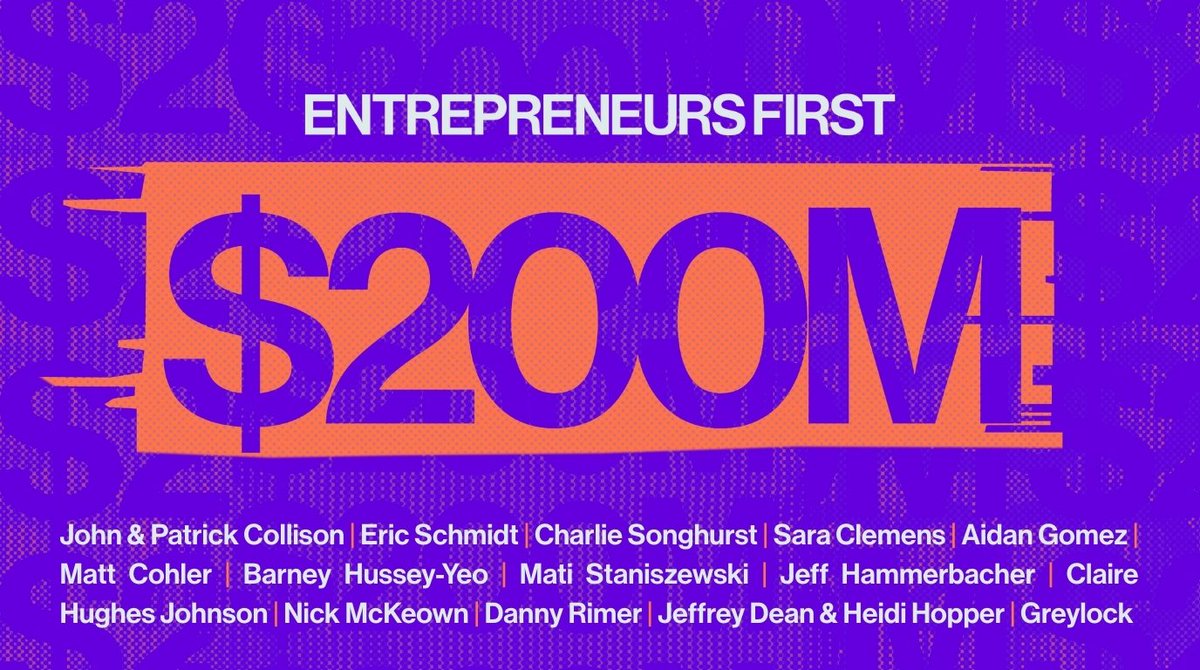
We’re excited to announce that @join_ef has raised $200m of fresh capital, including $130m into our management company at a unicorn valuation, to be the natural home of the world’s most ambitious people in the Age of Entrepreneurship 🧵