Agents are part of a massive, interconnected ecosystem. But how do they find and trust each other across different platforms?
Today, we’re proud to announce the Agentic Resource Discovery (ARD), an open specification alongside industry partners (including Cisco, Databricks, GitHub, GoDaddy, Hugging Face, Microsoft, NVIDIA, Salesforce, ServiceNow, and Snowflake). ARD gives any agent a secure, decentralized way to discover and verify capabilities (like tools, skills, MCP servers, and other agents) anywhere on the web.
Read the full announcement and get started: https://t.co/1I9WsT0tyH
Introducing the Open Knowledge Format (OKF), an open specification that formalizes the LLM-wiki pattern into a portable, interoperable format.
AI is only as smart as the context we give it. As we build more advanced, agentic AI systems, they need accurate metadata and context to be useful. But in most organizations, that context is locked inside fragmented data catalogs, isolated wikis, scattered code comments, or the minds of senior engineers. Every time a new AI agent is built, teams are forced to solve the exact same context-assembly problem from scratch.
To solve this, we've announced OKF, a vendor-neutral, open specification that formalizes the "LLM-wiki pattern" into a portable, interoperable format. It provides a standardized way to represent the enterprise knowledge that modern AI systems rely on.
— Just markdown: readable in any editor, renderable on GitHub, indexable by any search tool
— Just files: shippable as a tarball, hostable in any git repo, mountable on any filesystem
— Just YAML frontmatter: for the small set of structured fields that need to be queryable: type, title, description, resource, tags, and timestamp
We’ve also shipped reference implementations to help you hit the ground running, including an enrichment agent for BigQuery, a static HTML visualizer, and live sample bundles on @github → https://t.co/ilhAMCrcTc
➕ Knowledge Catalog can now natively ingest OKF!
Stop reinventing data models and building bespoke integrations for every new AI tool. Here's more about how OKF works → https://t.co/FR4kJRsgEH
You can now run Kimi K2.7 Code locally! 🌘
We shrank the 1T model to 325GB (-48%) via Dynamic 2-bit where important layers are upcasted.
Run at >40 tok/s on 330GB RAM/VRAM setups.
Run full precision on 610 GB.
Guide: https://t.co/SXZJ3IHMpY
GGUF: https://t.co/2lpUx7u0r8
Introducing Claude Fable 5: a Mythos-class model that we’ve made safe for general use.
Its capabilities exceed those of any model we’ve ever made generally available.
New course: Transformers in Practice. You'll get a practical view of how transformer-based LLMs work, so you can reason about their behavior, diagnose problems like slow inference, and make smarter decisions about deployment. This course is built in partnership with @AMD and taught by @realSharonZhou.
You'll see how transformers generate text one token at a time, how the model decides which earlier words matter most when predicting the next one, and how techniques like quantization speed up inference on GPUs. This is not a video-only course; interactive visualizations throughout let you play with these concepts and build intuition that sticks.
Skills you'll gain:
- Understand why LLMs hallucinate, and RAG and chain-of-thought shape what they generate
- Look inside the model to see how attention and layers combine to predict the next token
- Diagnose inference bottlenecks and learn the techniques that speed up transformers on GPUs
Join and understand what's really happening inside your LLMs: https://t.co/oS6ekeHsIw
Anthropic CEO: "AI will write 100% of code within a year"
developers spend 4 years in university learning to code
Claude learned it from every book ever written
if the hardest skill is already handled - the gap is no longer about what you know
it's about how well you've configured the tool that knows everything
most people haven't done that yet
the article below is where you start
Boris Cherny, the creator of Claude Code at Anthropic, just listed 9 patterns that waste 73% of your tokens.
in this podcast he breaks down exactly how the model burns tokens before it even reads your prompt:
- the 14% you lose to CLAUDE.md before typing a word
- the 13% you pay re-reading old chat history
- the 11% from hooks you forgot you installed
- why most "Claude got dumber" complaints are wrong
if you're hitting Max limits more than once a week, you have at least 4 of these. Probably 7.
instead of another show tonight, watch this.
my own breakdown based on 400+ hours of usage is below, read it after the podcast
Want to transcribe Luganda speech with AI? This fine-tuned Whisper model does exactly that. It's a small, efficient model trained on 400 hours of Luganda audio. Perfect for developers and researchers working on African language tech.
// Agentic Harness Engineering //
Pay attention to this one, AI devs.
(bookmark it)
Most coding-agent harnesses are still tuned by hand or brittle trial-and-error self-evolution.
This new work introduces Agentic Harness Engineering, a framework that makes harness evolution observable. They do this through three layers: components as revertible files, experience as condensed evidence from millions of trajectory tokens, and decisions as falsifiable predictions checked against task outcomes.
Each edit becomes a contract you can verify or revert.
Results: pass@1 on Terminal-Bench 2 climbs from 69.7% to 77.0% in ten iterations, beating human-designed Codex-CLI (71.9%) and self-evolving baselines like ACE and TF-GRPO.
The evolved harness also transfers across model families with +5.1 to +10.1 point gains, while using 12% fewer tokens than the seed on SWE-bench-verified.
Harness work is the biggest hidden cost in most agent systems. This is the first credible recipe for letting the harness improve itself without drifting into noise.
Paper: https://t.co/9fEgqwlTSf
Learn to build effective AI agents in our academy: https://t.co/1e8RZKs4uX
We're opening the doors at AI Dev 26 today, and celebrating with a little something for everyone:
AI Prompting for Everyone, a new course taught by @AndrewYNg, is now live! 🎉
Learn how to get accurate answers, better writing, and more useful outputs from the AI tools you already use — whether you're an engineer, a marketer, a salesperson, in finance, or anything in between.
Enroll today: https://t.co/gfhK6E1Zf5
New course: Spec-Driven Development with Coding Agents, built in partnership with @jetbrains, and taught by @paulweveritt.
Vibe coding is fast, but often produces code that doesn't match what you asked for. This short course teaches you spec-driven development: write a detailed spec defining what to build, and work with your coding agent to implement it. Many of the best developers already build this way.
A spec lets you control large code changes with a few words, preserve context across agent sessions, and stay in control as your project grows in complexity.
Skills you'll gain:
- Write a detailed specification to define your mission, tech stack, and roadmap, giving your agent the context it needs from the start
- Plan, implement, and validate features in iterative loops using a spec as your agent's guide
- Apply the same repeatable workflow to both new and legacy codebases
- Package your workflow into a portable agent skill that works across agents and IDEs
Join and write specs that keep your coding agent on track!
https://t.co/hI4GwuvhtN
I'm excited about voice as a UI layer for existing visual applications — where speech and screen update together. This goes well beyond voice-only use cases like call center automation.
The barrier has been a hard technical tradeoff: low-latency voice models lack reliability, while agentic pipelines (speech-to-text → LLM → text-to-speech) are intelligent but too slow for conversation. Ashwyn Sharma and team at Vocal Bridge (an AI Fund portfolio company) address this with a dual-agent architecture: a foreground agent for real-time conversation, a background agent for reasoning, guardrails, and tool calls.
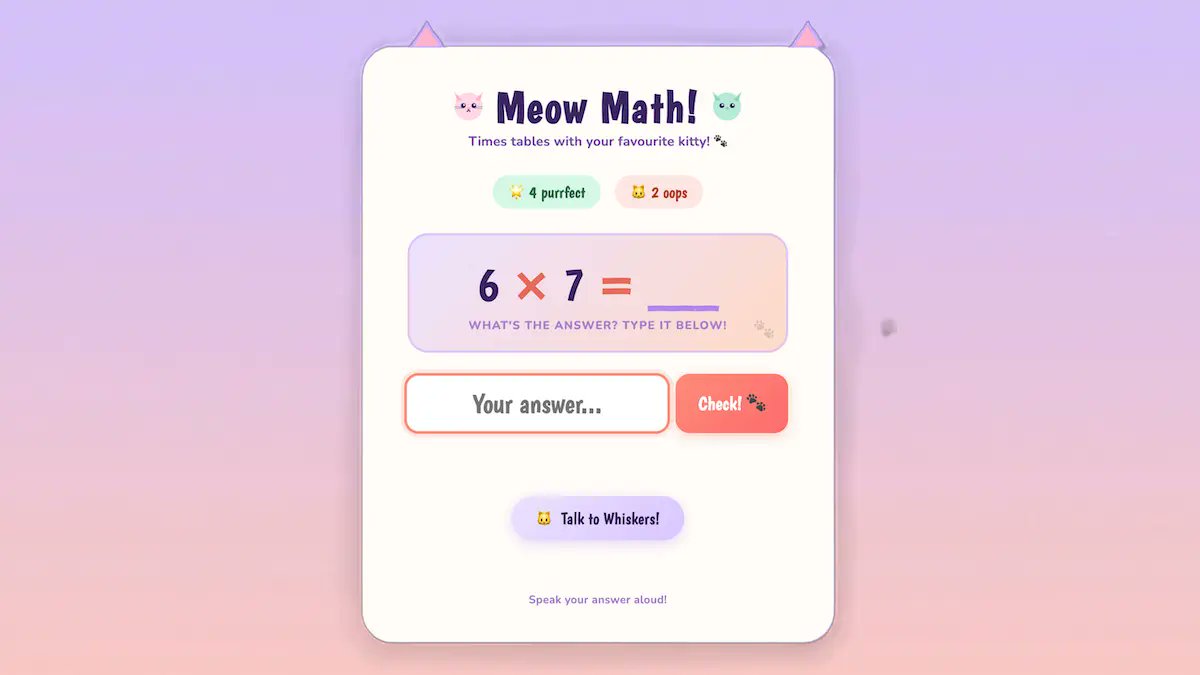
I used Vocal Bridge to add voice to a math-quiz app I'd built for my daughter; this took less than an hour with Claude Code. She speaks her answers, the app responds verbally and updates the questions and animations on screen.
Only a tiny fraction of developers have ever built a voice app. If you'd like to try building one, check out Vocal Bridge for free: https://t.co/nGrFznAMLh