Third world communists are the enemy. They've taken over our greatest American city. They're taking over one of our two major political parties. They hate this country. They hate white people. They hate our heritage and traditions. This is the fight. Get in the game or go away.
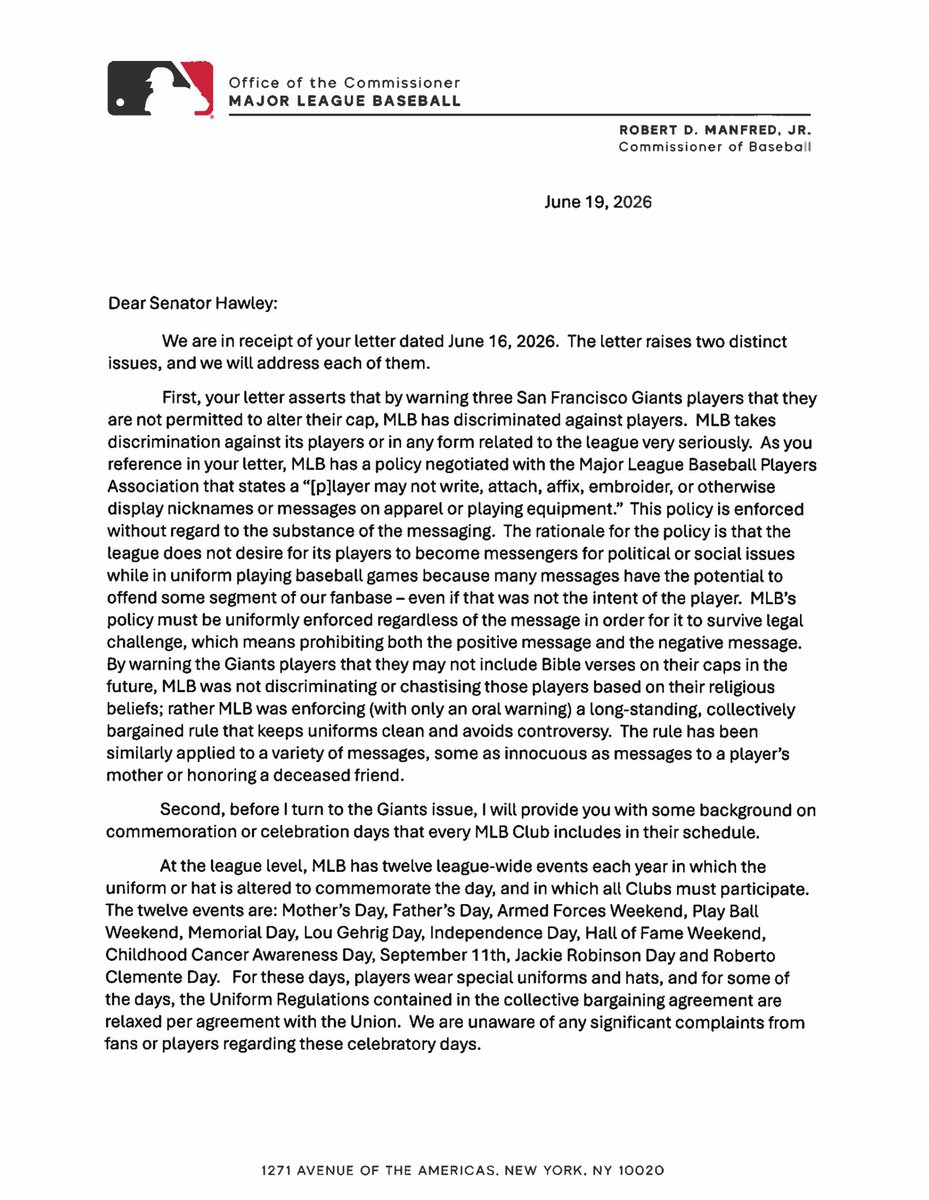
.@MLB Commissioner writes to me and admits they were wrong to threaten the Giants players over Bible verses and promises never to fine or discipline these players - or any players for their religious beliefs
This kind of oppression of women is not something we should ever welcome into the United States.
This is not multiculturalism. This is not diversity. This is subjugation.
I'm a cardiologist. I prescribe cholesterol-lowering drugs every single day. They save lives. That science is settled and I will never tell you otherwise.
But I'm going to say something that will make a lot of my colleagues uncomfortable — because someone needs to say it, and your doctor probably won't.
Too many physicians make you feel crazy when you bring up statin side effects.
You walk into your appointment and say "my muscles ache constantly" — and you're told it's in your head. You say "I'm exhausted all the time" — and you're told it's your age. You say "my sex drive disappeared" — and you get an awkward silence followed by a subject change. You say "I don't feel like myself anymore" — and you're told the benefits outweigh the risks, take the pill, stop reading the internet.
I've watched it happen in my own field for twenty years. The conversation gets shut down. The patient gets dismissed. And then they do the one thing we should be most afraid of — they stop the medication entirely, without telling us, and lose the cardiovascular protection that's keeping them alive.
That is the real cost of not being honest. Not the side effects themselves — the silence that drives patients away from treatment.
In my practice, I see statin-related complications in at least 25% of my patients. Muscle pain. Fatigue that doesn't resolve with sleep. Reduced sexual drive. Brain fog. Cramping. Joint stiffness. Weakness that makes exercise — the very thing we tell them to do — feel impossible.
Some of these improve with CoQ10 supplementation and optimizing vitamin D. Many do not.
I wrote about the diabetes risk of statins in a New York Times op-ed in 2012. The backlash from the cardiology establishment was immediate. I was told I was undermining trust in a life-saving drug class. Fourteen years later, every major guideline acknowledges the risk I warned about. It's in the prescribing information. The physicians who attacked me for saying it now teach it to their residents.
The truth doesn't care about professional comfort. It never has.
Now a paper published this week in Science Advances has finally explained the mechanism behind statin myopathy — and the finding validates what millions of patients have been telling their doctors for years.
Researchers discovered that statins activate the NLRP3 inflammasome in muscle cells — triggering an inflammatory cascade that causes muscle cell death, activates atrophy pathways, and disrupts muscle metabolism. This is entirely independent of the drug's cholesterol-lowering effect.
The muscle damage isn't caused by lowering cholesterol. It's caused by a completely separate pharmacological action through a different pathway.
The critical implication: the side effect can potentially be separated from the benefit.
Blocking NLRP3 or restoring isoprenoids prevented muscle cell death without interfering with cholesterol reduction. Future therapies could preserve the cardiovascular protection while eliminating the muscle toxicity.
Even more striking — the researchers found that background systemic inflammation significantly lowered the statin dose needed to trigger muscle damage. Patients with chronic inflammation, gut dysbiosis, or metabolic syndrome may be experiencing myopathy at doses their doctors consider "too low to cause problems." They're not imagining it. Their inflammatory state is priming the pathway.
The muscle pain was never in their heads. It was in their NLRP3 inflammasome. And we finally have the molecular proof.
Here's what I actually do in my practice — because I refuse to choose between protecting the heart and respecting the patient.
Whenever possible, I avoid statins as my first-line approach for eligible patients by using alternatives that lower LDL through entirely different mechanisms with no muscle toxicity:
PCSK9 inhibitors — Repatha and Praluent. Injections every 2-4 weeks that dramatically lower LDL without touching muscle tissue. No myopathy. No fatigue. No brain fog. For patients who can access them, these are transformative.
Inclisiran — Leqvio. An siRNA injection I administer twice a year in my office. It silences the PCSK9 gene in the liver. Two shots a year. LDL drops roughly 50%. No muscle side effects. No daily pills. Now approved as first-line monotherapy. This is the future of lipid management and I use it aggressively.
When statins ARE clinically necessary — and sometimes they are, especially post-heart attack or in combination therapy — I choose hydrophilic statins like rosuvastatin or pravastatin. These do not easily cross the blood-brain barrier. The cognitive complaints — the fog, the memory issues, the feeling of "not being yourself" — are substantially less common with these formulations because the drug stays out of the central nervous system.
I never prescribe a statin without CoQ10. 100-300mg daily. Statins deplete the cellular energy molecule your muscles and heart depend on. Replenishing it reduces muscle symptoms in many patients. It should be standard practice. The fact that it isn't is a failure of our field.
I check vitamin D and optimize it aggressively. Low vitamin D — which is epidemic — worsens muscle symptoms independently and compounds whatever the statin is doing. Target 50-80 ng/mL, not the bare minimum of 30.
Bempedoic acid — Nexletol — for patients who can't tolerate any statin. Works upstream in the cholesterol pathway and is not active in muscle tissue. Specifically designed to avoid myopathy.
Ezetimibe added to a lower statin dose. Cut the statin intensity, add ezetimibe to maintain the LDL reduction, and halve the muscle exposure.
There is no excuse in 2026 for telling a patient "just deal with the muscle pain." The toolbox is deep. The alternatives exist. The only barrier is a physician's willingness to listen and adapt.
I want to speak directly to every patient who has been dismissed.
Your muscle pain is real. Your fatigue is real. Your cognitive changes are real. Your loss of drive — in every sense of the word — is real. A paper in Science Advances just proved the mechanism. You were never crazy. You were experiencing a documented inflammatory response in your muscle tissue that your doctor didn't have the science to explain — until this week.
And I want to speak directly to my colleagues.
We have to be honest. Not just about the benefits — which are enormous and undeniable — but about the side effects, the mechanism, and the alternatives. Patients who feel heard stay on treatment. Patients who feel dismissed stop their medications in silence — and die from the heart attacks we could have prevented if we'd simply been willing to have an honest conversation and switch the approach.
The cardiologist who tells you statins are flawless is not protecting you. The wellness influencer who tells you statins are poison is not protecting you either. The truth lives in the middle — where it always has.
Statins save lives. The side effects are real. The mechanism is now proven. The alternatives exist. And you deserve a doctor who holds all four of those truths at the same time.
Both things can be true. They always could.
Now we have the science to prove it.
BREAKING: The three major U.S. broadcast networks, ABC, CBS, and NBC, have yet to report on DNI Tulsi Gabbard’s recent declassification regarding Anthony Fauci’s cover-up of the COVID-19 pandemic.
Barack Obama, whose administration spied on Trump's campaign in 2016 and fabricated a conspiracy about him colluding with Russia, says it's incredibly important to have a "peaceful transfer of power after the people of spoken."
As a general rule, anytime Barack Obama lectures the country or its people on their purported sins—with Khalil Gibran pop platitudes—he is seeking absolution for his own obsessions by projecting his own guilty desires onto others.
The latest? At the dedication of his narcissistic Obama Presidential Center in Chicago—a $850 million flak-tower, monolithic boondoggle mired in debt—Obama lectured us on the need to resist the allure off "money, attention, [and] fame."
Thus spoke the owner of four homes, three of them multimillion-dollar mansions, whose last inert year in office was spent closing book and Netflix deals that ensured he would become a multimillionaire the moment he left office, and on spec, jets private to sermonize to various audiences–often at $400,000 a shot—on their own false-consciousness shortcomings.
Plain-speaking, frugal Harry Truman in obscure retirement in Independence, Missouri Obama certainly is not.
Rape gangs are not some kind of aberration. Ask any combat veteran what they saw in Afghanistan. The sexual torture and slavery of children is utterly commonplace in Muslim countries. It’s part of their “culture.” Which is why it’s suicidal to import that culture into the west.
I'm a cardiologist. If you've ever been told "your calcium score is zero — you're fine," I need you to read this carefully.
A new study just changed how I think about the most popular heart scan in preventive cardiology.
The NATURE-CT study — published in the Journal of Cardiovascular Computed Tomography in 2026 — tracked 205 low-risk, untreated adults with two detailed coronary CT angiograms roughly five years apart. No diabetes. No statins. No prior heart attacks. Average LDL around 112 mg/dL — what most labs still call "normal." Over half had a calcium score of exactly zero at baseline.
What happened over five years with no treatment:
Total plaque volume roughly doubled. From about 30 cubic millimeters to 59.
And here's the finding that should change how every patient and every physician thinks about the calcium score:
Nearly all the growth was non-calcified soft plaque — the lipid-rich, inflamed kind most linked to heart attacks. Soft plaque grew from 27.5 to 53.5 cubic millimeters. Calcified plaque barely moved — from 0.3 to 3.2.
The most dangerous subtype — low-attenuation plaque, the very soft, rupture-prone lesions that cause sudden cardiac events — was present in 9% of patients at baseline. Five years later: 23%. More than doubled.
Even among patients with a true zero calcium score at baseline, non-calcified plaque was often already present and grew substantially. Silently. Without symptoms.
Let me explain why this matters so much — because I've been ordering calcium scores for twenty years and I need you to understand what they can and cannot tell you.
A calcium score measures calcified plaque. Calcium in your arteries is essentially scar tissue — the healed residue of old inflammation. Think of it as a smoke detector that only detects fires that already burned out.
A zero score means: no old scarring detected. It predicts very low short-term event risk — typically a "warranty period" of 5-15 years depending on your other risk factors. That's genuinely reassuring and I still order this test regularly.
But a zero score does NOT mean zero plaque.
It means the scan is blind to the plaque that's most likely to kill you — the soft, active, lipid-rich plaque that's growing right now inside your artery walls. The plaque that ruptures without warning and causes the heart attack nobody saw coming.
This is why I've had patients on my cath lab table who said: "But my calcium score was zero two years ago."
It was zero. And the soft plaque that was already there — invisible to the calcium scan — kept growing until it ruptured.
A coronary CT angiogram with AI-enhanced plaque composition analysis is the difference between seeing old scars and seeing the active fire. It visualizes your arteries in 3D with contrast, quantifies total plaque burden, and — critically — tells me how much is soft and dangerous versus calcified and stable.
The NATURE-CT study used exactly this technology — Cleerly's AI plaque analysis — and it revealed what the calcium score alone would have completely missed: a near-doubling of dangerous plaque in "healthy" people with "normal" cholesterol over just five years.
Here's what this means for you:
If your calcium score is zero — celebrate it. It's genuinely good news. You have time. Use that time wisely.
Do not interpret it as "I'm fine forever." Plaque is building. In most adults over 40, it's already there — just in a form the calcium scan can't see.
Know your ApoB. This counts every atherogenic particle penetrating your artery walls. LDL of 112 — the average in this study — looks "normal" on a standard panel. But those particles were building plaque year after year in every single patient tracked. ApoB tells you the real particle burden. Most people have never had it checked.
Know your Lp(a). Test it once in your lifetime. 1 in 5 Americans are elevated. Completely genetic. Triples risk independently. Diet and exercise cannot lower it.
If you have risk factors — family history, elevated ApoB or Lp(a), metabolic syndrome, autoimmune disease — push for a full coronary CT angiogram with plaque analysis, not just a calcium score. The difference is the difference between seeing the scars and seeing the disease.
If soft plaque is found early, we can stabilize it. Statins don't just lower LDL — they stabilize plaque, making soft lesions harder and less likely to rupture. PCSK9 inhibitors drive LDL even lower. Lifestyle — Mediterranean diet, resistance training, sleep, stress management — reduces the inflammation that makes plaque vulnerable.
The goal of prevention isn't perfection. It's slowing the slope so dramatically that you never have an event. And the NATURE-CT data proves that the slope is steeper than we thought — even in people who look "low-risk" by every standard measure.
I've written on this platform about inflammation as the fire behind heart disease. About AI detecting inflamed arteries years before symptoms. About advanced lipid testing that catches what standard panels miss. This study ties all of it together into one devastating conclusion:
The standard playbook — check calcium score, if zero you're fine, see you in five years — is not enough.
It was never enough.
We were looking for old fires and missing the ones still burning.
Zero calcium buys you time. It buys you peace of mind. But what you do with that time — the ApoB you check, the lifestyle you build, the advanced imaging you pursue when risk factors warrant it — is what determines whether you stay healthy or become one of the patients on my table who says "but my score was zero."
Prevention works best before the calcium rises. Before the symptoms appear. Before the event that didn't have to happen.
Measure what matters. Act early. Stay ahead.
Your arteries will thank you for decades.