🚨 First study to investigate the prognostic relevance of Type 4a MI and PMI in #NSTEMI patients undergoing #PCI.
🚀 Excited to see our findings published in @CircAHA@American_Heart !
Read more 👉 https://t.co/9uG5iKaOZd
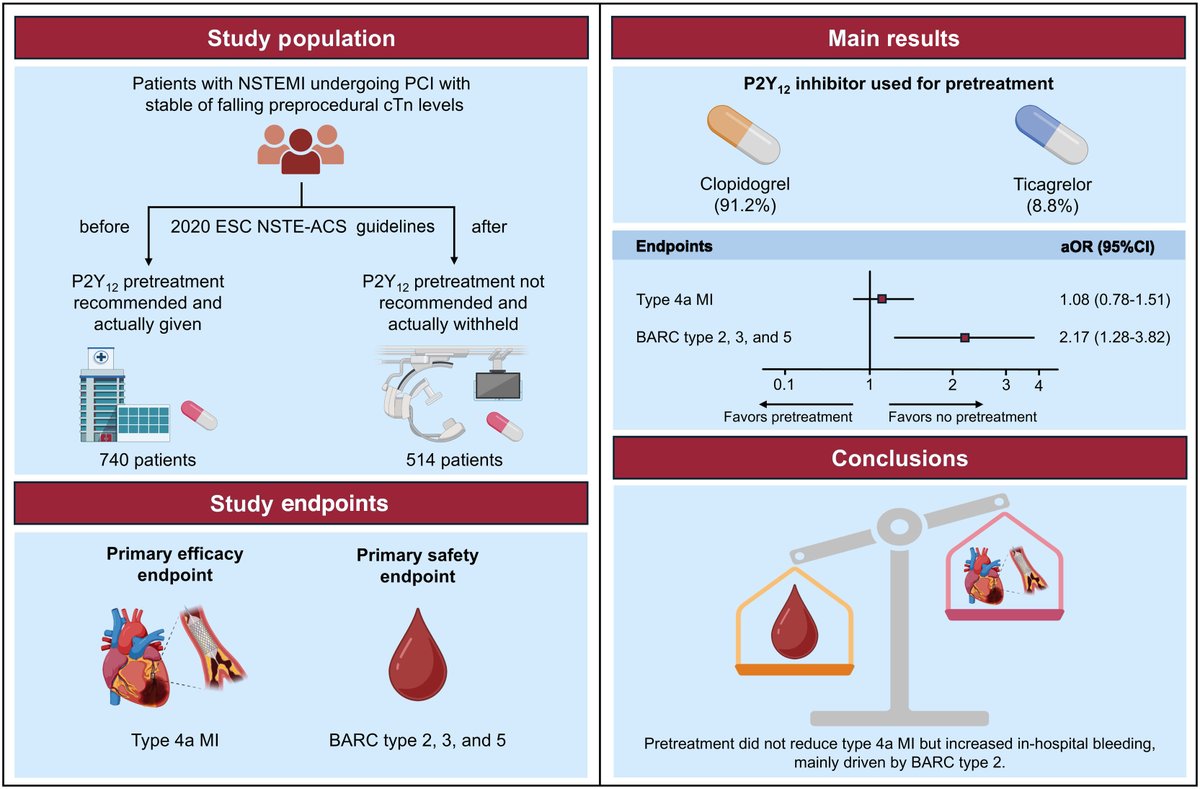
Impact of P2Y12 inhibitor pretreatment on periprocedural (type 4a) myocardial infarction and bleeding in NSTEMI #REC#Aheadofprint https://t.co/O1IsElpEC3
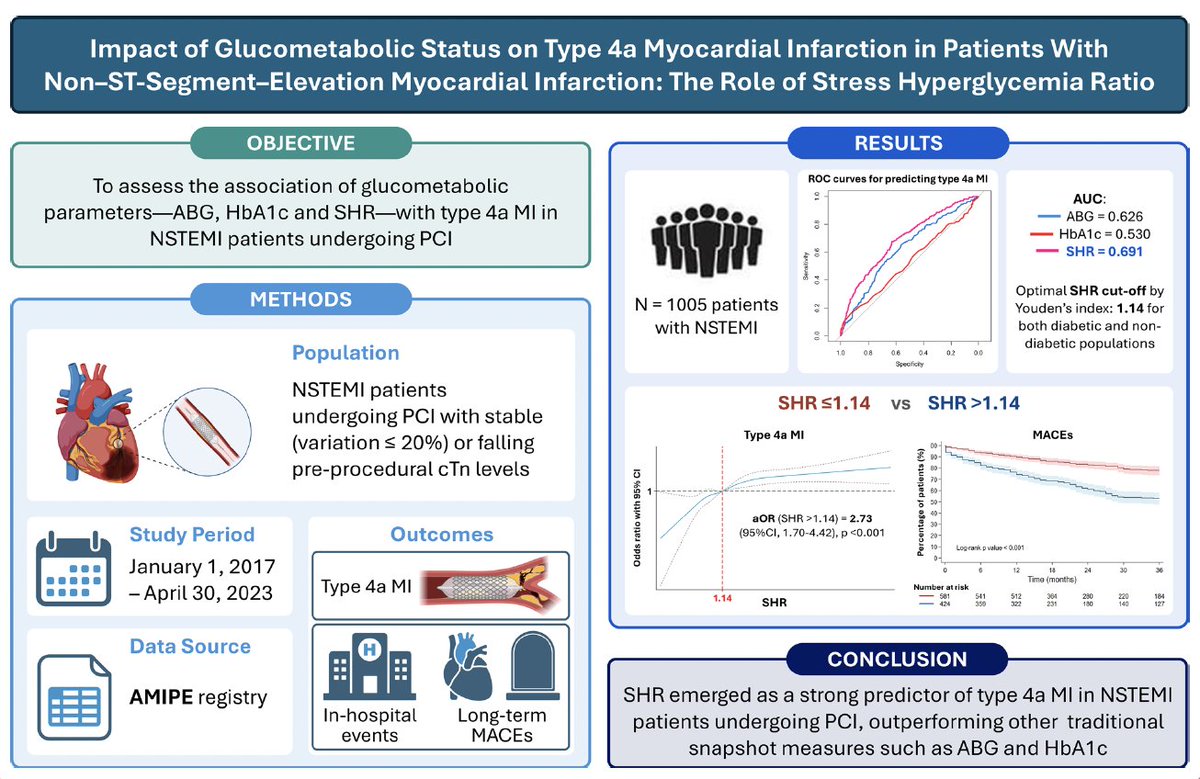
🎯 To assess the association of glucometabolic parameters w/ T4aMI in NSTEMI pts undergoing PCI.
🩸Admission blood glucose (ABG), glycated hemoglobin (HbA1c), and stress hyperglycemia ratio (SHR) were tested.
👥 Consecutive NSTEMI patients undergoing PCI from the AMIPE registry (NCT03883711) with stable or falling pre-procedural cardiac Tn levels were analyzed.
📊 1005 pts (age 70±12yrs, 25% females), 46% T2DM.
- SHR showed a significantly ⬆️accuracy (AUC 0.69, 95% CI 0.65-0.73) in predicting T4aMI compared w/ ABG and HbA1c (p<0.001 - optimal cut-off of 1.14)
- SHR > 1.14 was independently associated with T4aMI (aOR=2.73; 95% CI 1.70-4.42; p<0.001).
📨SHR emerged as a strong predictor of T4aMI in NSTEMI pts undergoing PCI, outperforming other glucometabolic markers.
SHR could be easily integrated into routine risk assessment to identify NSTEMI pts at higher risk of T4aMI and adverse outcomes.
Read more on #CardiovascularDiabetology 👇@BioMedCentral
https://t.co/hTJEFrduM0
🎯To evaluate the impact of #SGLT2i on the risk of acute kidney injury (AKI) in #T2DM pts w/ severe #AS undergoing #TAVI.
👥 Multicenter Registry of consecutive pts stratified by the presence of CKD and anti-diabetic therapy (2021-2024).
🔥Our main findings were:
- SGLT2i did not impact renal function in pts without CKD.
- Among CKD patients, AKI occurred more frequently in no-SGLT2i users compared to those receiving SGLT2i (19.8% versus 8.5%, p=0.027).
- Only in the CKD group, the use of SGLT2i was identified as an independent predictor of a ⬇️rate of AKI (OR 0.70, 95%CI 0.42–0.91, p=0.014).
📌Take home message: In T2DM pts w/ CKD undergoing TAVI, SGLT2i therapy was associated w/ ⬇️occurrence of AKI, suggesting a potential nephroprotective effect in this high-risk population.
Read more on #CardiovascularDiabetology @BioMedCentral 👇
https://t.co/XRxER768P0
🩺 Non perdere il Journal Club del Gruppo di Studio SIC Fisiopatologia coronarica e microcircolazione!
📅 Giovedì 8 maggio
🕜 13:30 – 14:00
🔗 Link per iscriversi: https://t.co/GVseooDb9m
@SIC_CARDIOLOGIA
💊SGLT2i pleiotropic effects have demonstrated efficacy across various cardiovascular conditions, ranging from acute to chronic coronary syndromes and extending to arrhythmias, valvular heart disease, cardiomyopathies, cardio-oncology, and cerebrovascular disease!
🔍Our review provides an overview of the current literature on the potential mechanisms underlying the effectiveness of SGLT2i across a wide range of cardiovascular diseases, beyond HF.
@ELS_Cardiology @ElsevierConnect@matt_armi@CarminePizzi@L_Bergamaschi
#Pharmacology #ClinicalPharmacology #DrugDevelopment #SGLT2i
Cardiovascular therapeutic targets of sodium-glucose co-transporter 2 ... https://t.co/5ahjNjywSA
📢 Periprocedural myocardial injury and infarction are common in NSTEMI patients undergoing PCI and are associated with worse outcomes.
🔎 Learn more in @CircAHA@American_Heart@HeartNews 👉 https://t.co/ATHi38haNl
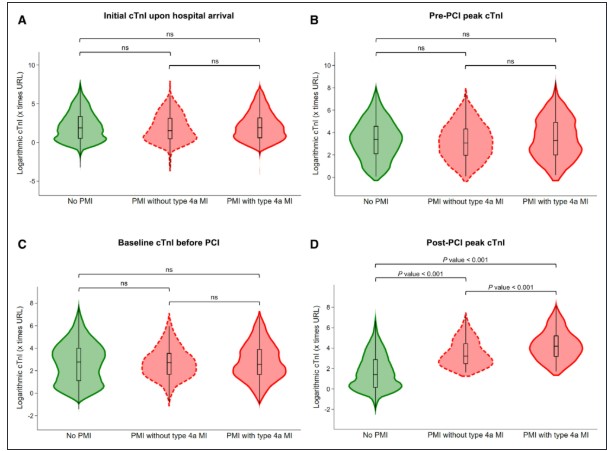
The optimal threshold for defining prognostically relevant PMI in patients w/ #NSTEMI was found to be a post-#PCI change in cTnI of >40%, along w/ an absolute postprocedural value of ≥5-times the 99th percentile of the upper reference limit.
➡️ https://t.co/RYKXFxPNmx #CardioX
🚨 First study to investigate the prognostic relevance of Type 4a MI and PMI in #NSTEMI patients undergoing #PCI.
🚀 Excited to see our findings published in @CircAHA@American_Heart !
Read more 👉 https://t.co/9uG5iKaOZd
Main findings:
🔹 Type 4a MI & PMI are frequent and linked to a higher of all-cause death & MACE.
🔹 Post-PCI ΔcTnI >20% but ≤40% showed similar outcomes to patients without PMI.
🔹 Post-PCI ΔcTnI increase >40% emerged as the best threshold for prognostically relevant PMI.
Our State-of-the-Art Review on Multimodality Imaging in the Diagnostic Work-Up of Patients With Cardiac Masses is now out on @JACCCardioOncology @JACCJournals 👇
https://t.co/LLGnybKSVd
Role of current multimodality imaging and future directions for their applications:
👥For whom and when?
🔎What to look for?
💪Strengths and weaknesses
💥Latest advances
🔥Tips and tricks
📨Key Message
🟢Echo is typically the initial imaging modality
🧲CMR is recognized as the diagnostic gold standard.
🔁CCT provides complementary.
☢️PET serves as a 3-level imaging option.
#echofirst #WhyCMR #Multimodalityimaging #Cardiology #CardiologyNews
Non-invasive vs. Invasive Approach to Cardiac Allograft Vasculopathy Surveillance: The Role of Coronary CT Angiography (CCTA-HTx Study) 👉 is now out on @CircImaging !
Our main findings were:
🔥The combination of CCTA-derived coronary DS (DS>35%) and plaque morphology (plaque burden at MLA>42% and percent atheroma volume>23%) showed the highest accuracy in predicting CAV
🔥FFRCT was feasible in all patients, showing a mainly diffuse pattern of disease in CAV+ pts.
🏡Take home message📨
2. A noninvasive strategy based on CCTA is accurate for managing HTx pts.
1. CCTA might be considered the preferred imaging modality for annual CAV surveillance after the 1 year post-HTx.
https://t.co/Txe5AVqPDL
#Cardiology #Cardio #Multimodality #CCTA
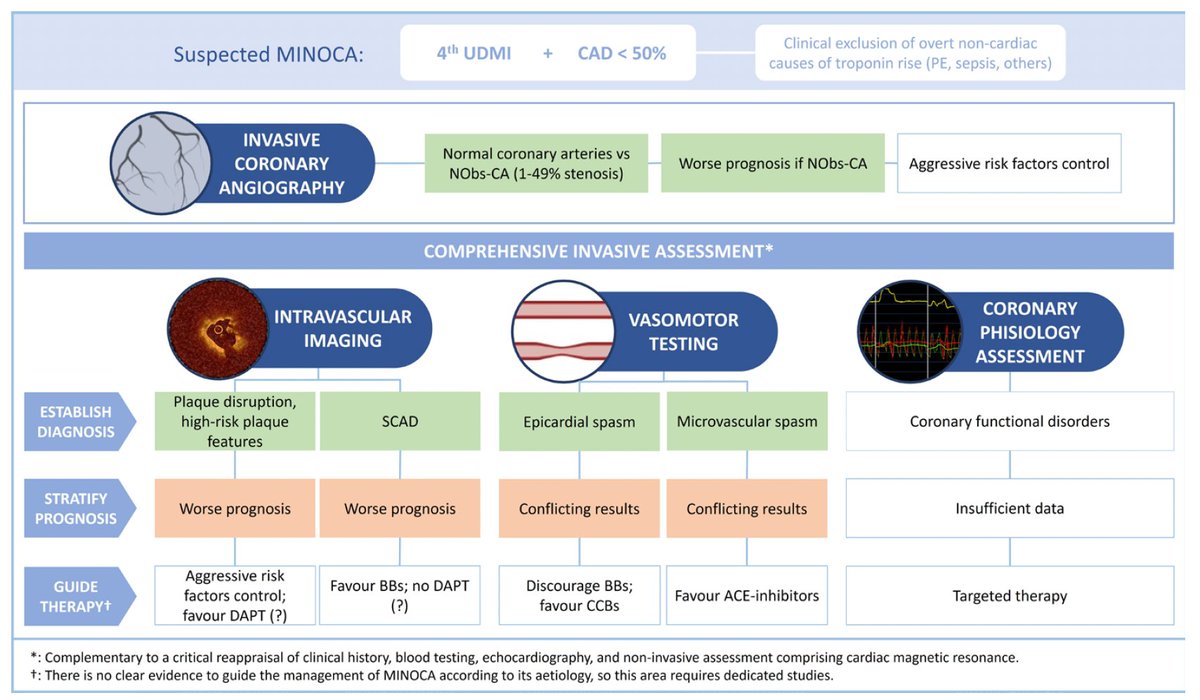
📢 Our meta-analysis on pathological findings at invasive assessment in MINOCA is out on @Heart_BMJ
🔍 53% have non-obs CAD, with an ⬆️risk of all-cause death or MI at 1-yr and long-term FU compared w/ pts w/ normal coronary artery, mainly due to a ⬆️risk of MI.
🔬 OCT & vasospasm testing: critical diagnostic tools! OCT identifies a possible explanation in 62% of pts; vasospasm tests are positive in 49% of them.
📈 A comprehensive invasive assessment should be pursued to determine the etiology, stratify prognosis and guide management.
Read the full paper here: 👇https://t.co/ptKTDWbkiY
#Cardiology #MINOCA @Heart_BMJ
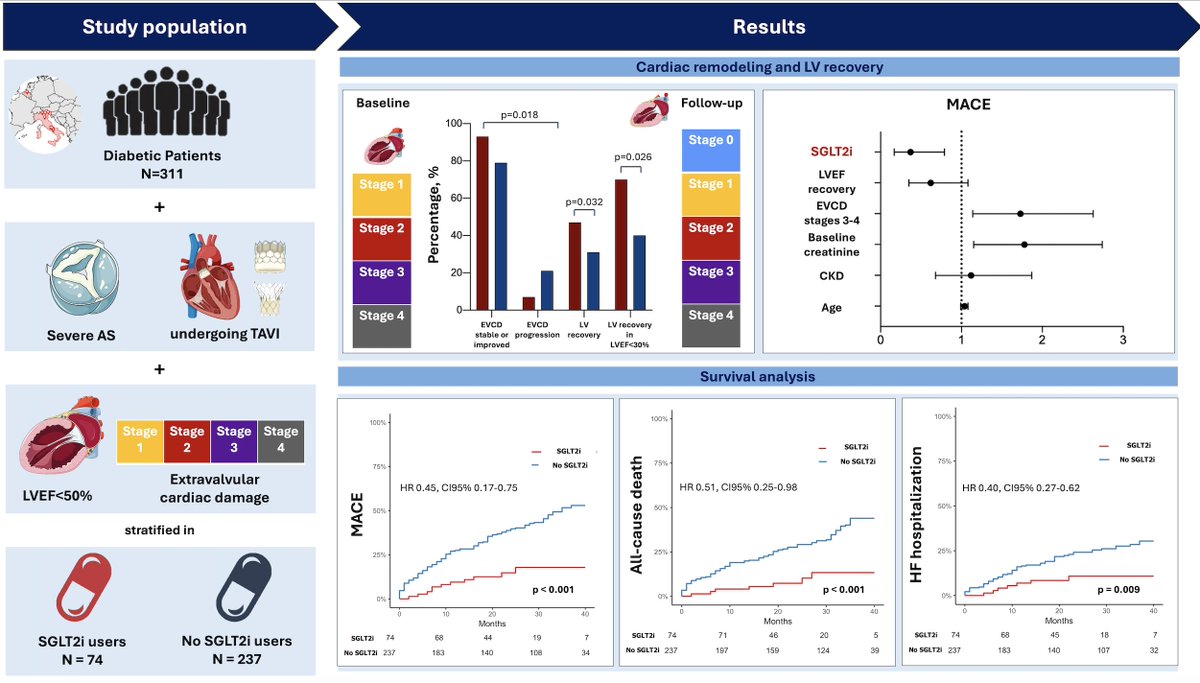
First data of SGLT2i in AS pts - PART 2
🔥In T2DM pts w/ severe AS, LVEF<50%, and cardiac damage undergoing TAVI, the SGLT2i use was associated w/ a more favorable cardiac remodeling and ⬇️risk of MACE @2-year FU.
Read more on 👇#CardiovascularDiabetology
https://t.co/IGzthWTNl7
🔥In HTx recipients, FAI was an independent predictor of MACEs and allograft rejection.
🎯FAI assessment could be part of CCTA analysis in routine surveillance of HTx recipients!
Read more of our group's simultaneous publication during #ESCCongress2024 in @JACCJournals#JACCIMG
The CMR Mass Score:
🎯A CMR-derived model, including mass morphology and tissue characterization, showed excellent accuracy, superior to echo, in predicting CMs’ malignancy, with prognostic implications.
Read more about our results on 👇@CircAHA
https://t.co/XXo4kvY0fj