...wealth is not a fixed pie.
Mankind was born into utter poverty, and now billions of people are wealthy enough to have the free time to read articles such as this one.
So, yes, poverty is a tragedy.
But with enough progress, we can all become as wealthy as today’s billionaires—indeed, most modern Westerners are wealthier than the kings of old, who died of diseases we’ve long since cured and who lacked basic comforts such as air conditioning.
~Conjecture Institute Fellow @arjunkhemani & President @ChipkinLogan 👇
I think it's morally necessary to mock the luddite rebellion, because luddite rebellions are never a good thing. Lee Sedol reported feeling sad when he lost to DeepMind's AlphaGo. But he didn't mount a luddite rebellion based on that. Mocking him is not cool, he's OK. Mocking a luddite rebellion is never wrong, because luddite rebellions are bad. They stand in the way of humanity coming to terms with new developments and benefiting from them. Mocking individual mathematicians saying they feel sad is totally different, and I would not support that. But also I'm not seeing that so far. I'm seeing a mocking of a loudly angry luddite rebellion. And *that's* OK. More than OK. You can't beat AI, you need to join AI. The luddite rebellion stands in the way of that understanding.
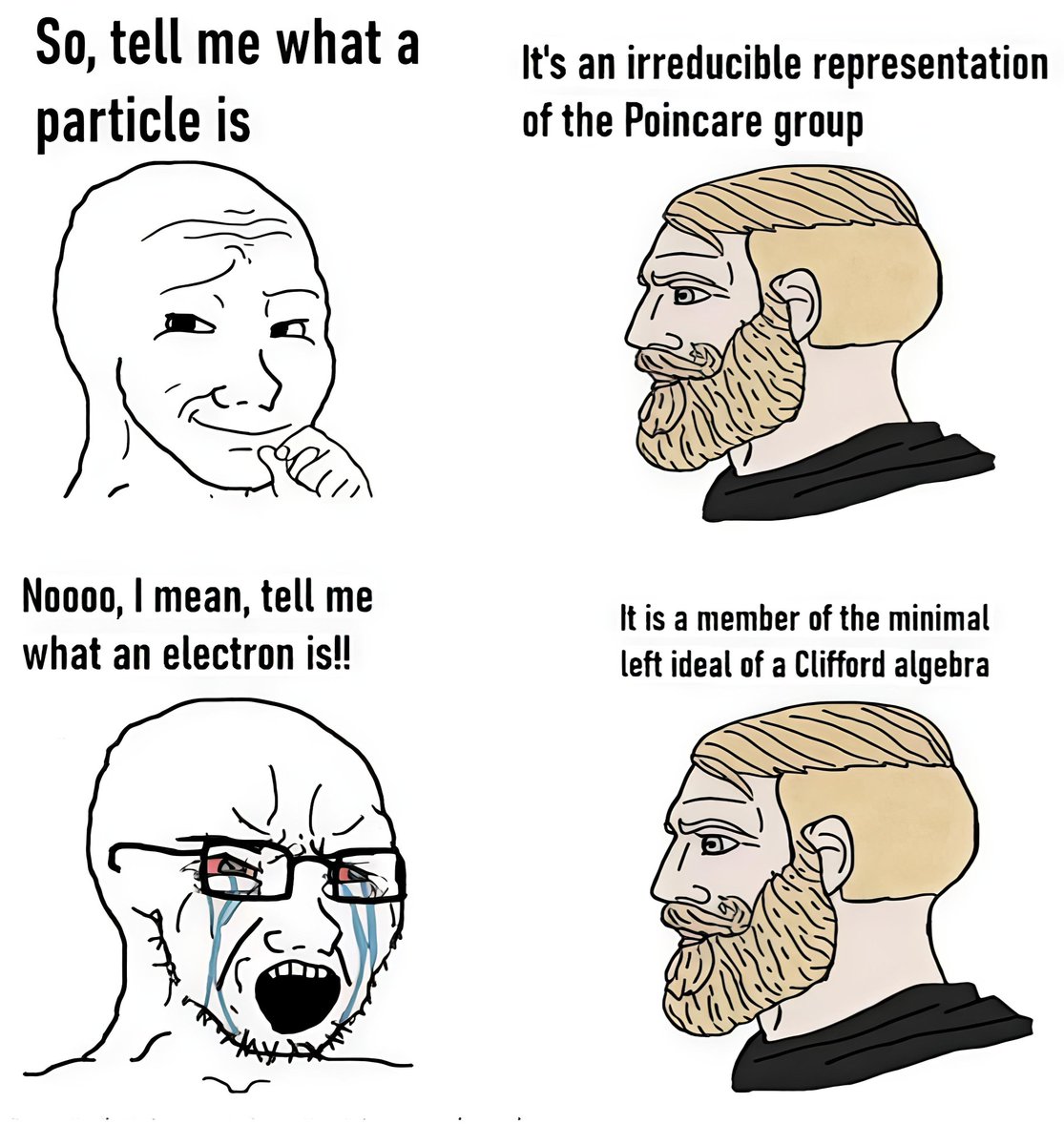
@Shaun_Fosmark Both, and i don't think they should come apart. It's the best explanation we have of what a photon is, until someone finds a better one.
https://t.co/mcxFvHvuWq
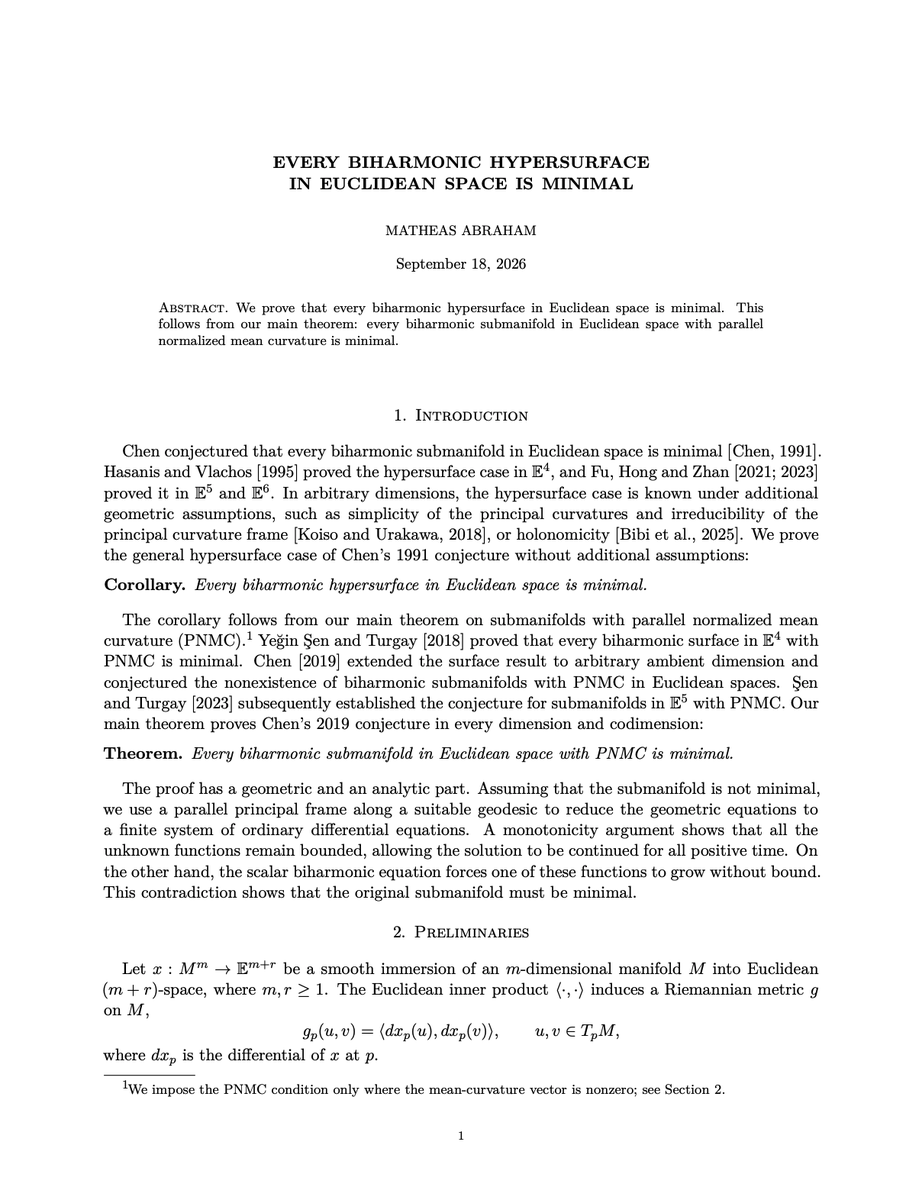
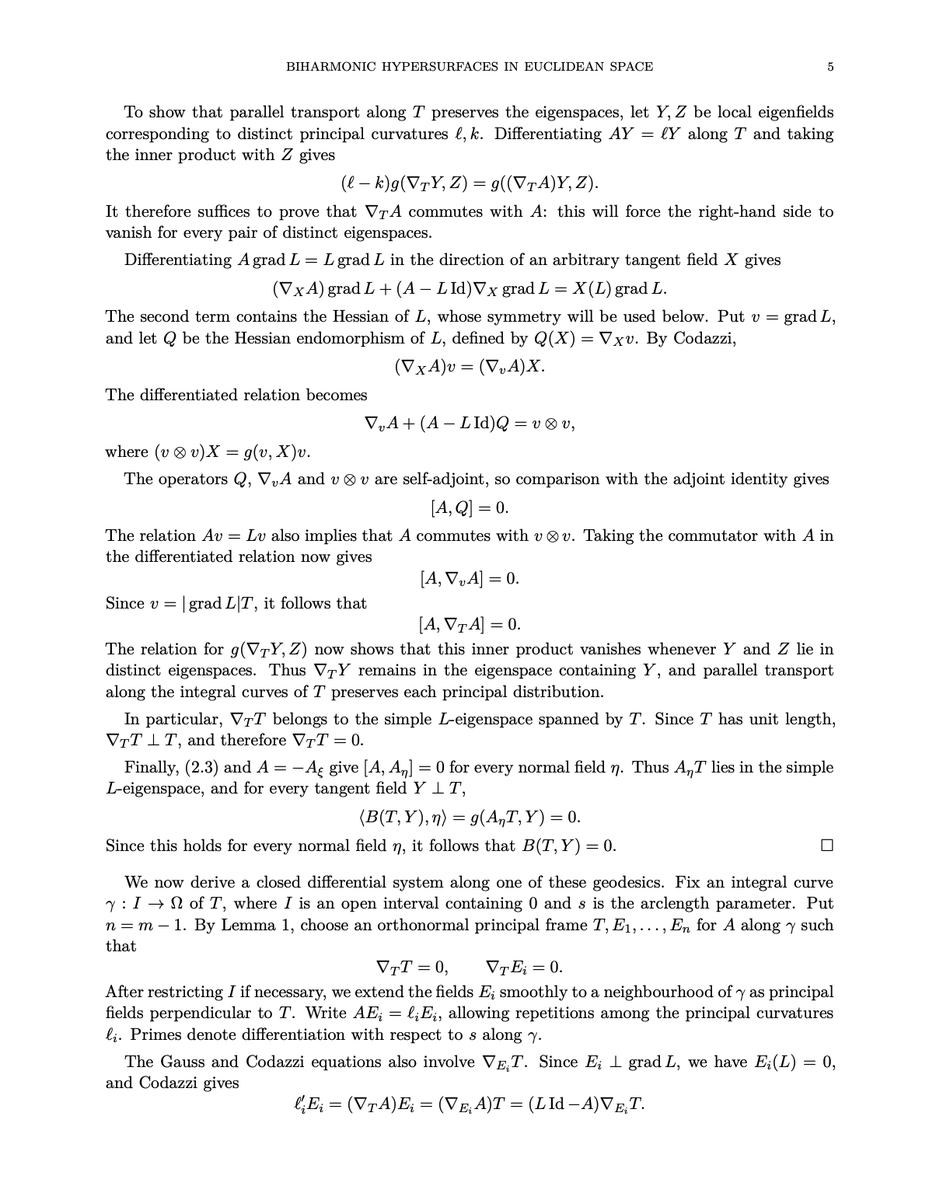
the paper also proves a stronger result, namely that every biharmonic Euclidean submanifold with parallel normalized mean curvature is minimal, in any dimension and codimension.
just solved the hypersurface case of Chen’s conjecture:
"Every biharmonic hypersurface in Euclidean space is minimal."
it's been proved in E³,…, E⁶, but resisted full generalization for 41 years. but with some help from gpt-6 astra, here’s a proof in every dimension :)
preprint below
Very brave to protect humanity from dangerous, unregulated mathematics.
We wouldn’t want theorems released to the ignorant masses without first obtaining an imprimatur from the Guild of Mathematicians.
"Introduction to Differentiable Manifolds" is an open source collection of university lecture notes on manifold theory and differential geometry. This collection covers topics such as topological and differentiable manifolds, tangent and cotangent spaces, vector bundles, tensors, differential forms, integration on manifolds, etc.
While it assumes a strong mathematical background, the explanations in these notes are very clear and include numerous diagrams and other visual representations which make the abstract concepts covered easier to understand. This is a valuable resource for students who wish to learn about differential geometry or for anyone who wants a well-organized introduction to manifolds.
https://t.co/q1syouxnPo