Hey #econtwitter, do you have a binary outcome? Estimate logit models? Want to cluster your standard errors? We've got bad, good, and great news for you. See the thread below, or our new working paper (with @jgmQED and @MortenEcon) for details https://t.co/LDjYwNRxwx 1/7
Gino lost!
A federal judge granted Harvard summary judgment on all of Francesca Gino's claims (contract, sex discrimination, retaliation). Harvard's defamation counterclaim and sanctions motion are still pending, so she could lose even more.
https://t.co/NwslWeIIe5
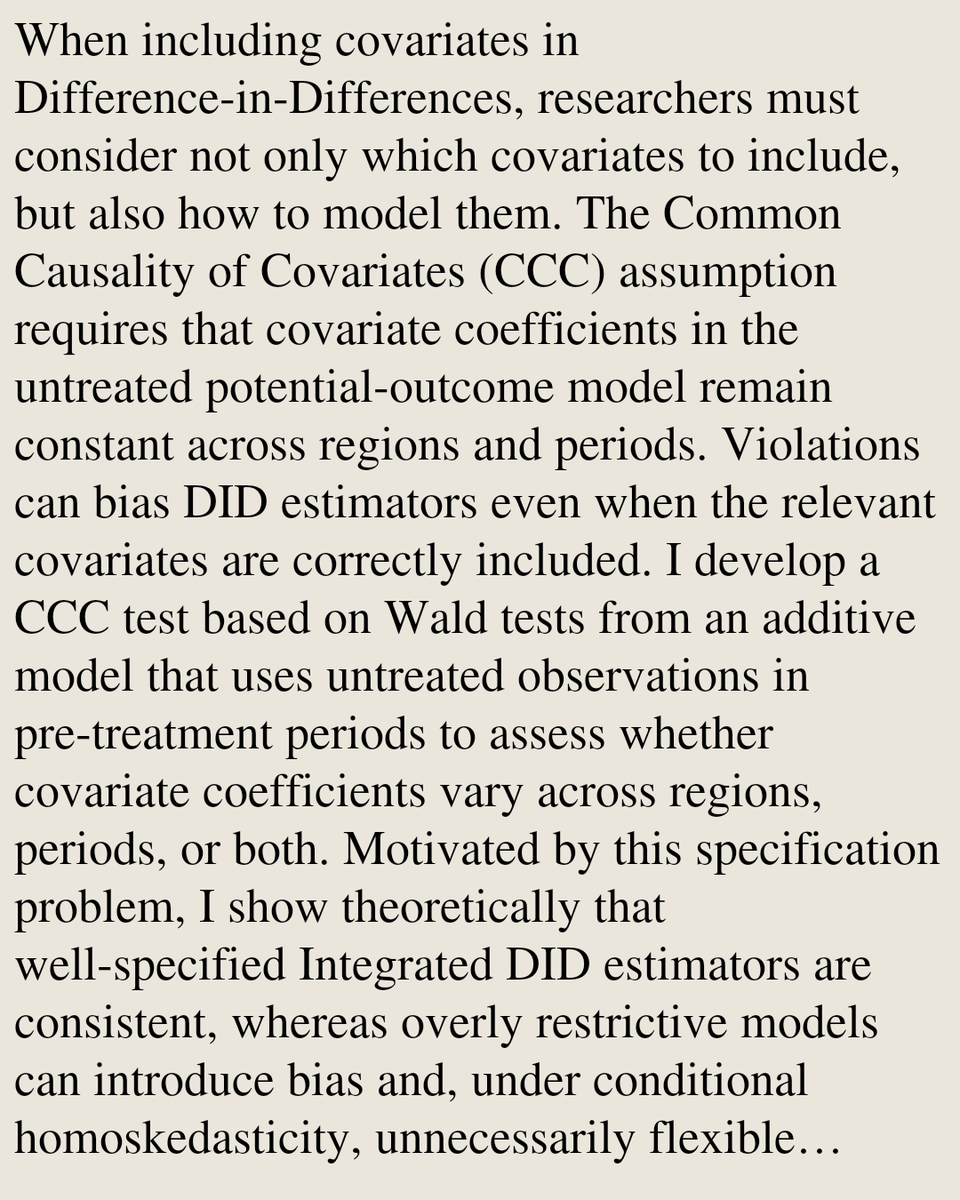
We introduce Integrated Parallel Trends (IPT), a weaker alternative to conditional parallel trends that allows CCC violations.
We also introduce DID-INT, an estimator that identifies the ATT under IPT without requiring CCC. 3/3
Paper: https://t.co/d5d9MyTUGn
Excited to share an updated version of "Good Controls Gone Bad: Difference-in-Differences with Covariates," joint with my excellent student @sunnykarim, who is on the job market this year!
A short video explainer, and short thread. 1/3
Many DiD estimators implicitly assume that covariates have the same effects on untreated outcomes across regions and over time.
We call this Common Causality of Covariates (CCC). Violations can undermine conventional DiD estimates. 2/3
I've been pointing out since the early 2010s that Thomas Piketty, Emmanuel Saez, and Gabriel Zucman have a bad habit of biasing their data construction to fit their politics.
Whenever they make a suspect call in how to handle stats, it ends up showing that inequality is on the rise. They almost never go in the other direction. The errors are non-random and almost invariably reinforce their political claims about rising income and wealth concentration since 1980.
Piketty did this throughout his book Capital in the 21st Century.
Piketty and Saez did this throughout their famous 2003 paper on inequality in the US.
Piketty, Saez, and Zucman Saez and Zucman did this in their Distributional National Accounts paper that Auten and Splinter dissected.
Saez and Zucman did this in their 2019 book on tax incidence and inequality.
Saez and Zucman did this in their flurry of "studies" and white papers to support Elizabeth Warren's wealth tax proposal, California Prop 40, a new wealth tax in France, and dozens of other similar examples.
A new AI report (linked below) audited 138 papers by Saez and Zucman. It found thousands of errors, 194 of which were serious. A whopping 97% of the serious errors went in the same direction: they showed inequality rising faster or made it higher.
But there's a bigger scandal at play here. Despite these clear biases, Piketty, Saez, and Zucman have enjoyed a stream of praise and prestige within the economics profession. They get expedited and friendly reviews in top econ journals even though a more serious peer review should have caught many of these errors (the Quarterly Journal of Economics is a recurring offender in this regard). Journals regularly give them a pass after the errors in their old work come to light - they're never expected to correct any of it, and just keep on using it as if nothing changed. Their non-peer reviewed data claims are also treated as gospel by major media outlets such as the New York Times and the Washington Post. And they get showered with prizes - Saez and Zucman are both Clark Medal winners from the AEA, and Zucman got his prize in 2023 after evidence of major data shenanigans in his work came to light in 2019.
Until now, those of us who have been trying to correct the record have had to wade through the PSZ trio's cluttered, disorganized, and often non-transparent replication packages (almost all of which are convoluted piles of Excel spreadsheets) to find the problems. I did a line-by-line replication of Piketty and Saez's entire 2003 US income inequality series to use one example, and found it was riddled with errors - almost every single one of which biased their results in favor of their political story.
We had the means to catch this stuff as it was happening, but the economics profession failed to do its job. And it failed precisely because its elite ranks wanted to believe the Piketty-Saez-Zucman story for political reasons.
Aidan Toner-Rodgers (infamous for being kicked out of the MIT economics PhD program for a fraudulent AI paper (which was R&R QJE & then pulled)) now has another paper retracted, this time from the Journal of Development Economics. Retraction notice here: https://t.co/qztzSukV7q
Looking for 125 researchers to participate in virtual forensic AI games! We will give you an AI report that documents irregularities in sports/exercise related articles.
Also releasing our open source new I4R AI Audit Protocol.
Details in this 🧵.
Join us!
Very proud of my wife, Jennifer Brigden , who is doing her first theatre show this Thursday night as part of the Just For Laughs Comedy Club at Casino du Lac-Leamy. Free admission, Doors open at 7 p.m., and seating is first come, first served.
https://t.co/QAHy7P8tZc
I recently asked ChatGPT to improve the efficiency of some simulations from a few years ago. To my amazement, its code ran in a few seconds instead of 3 hours.
It turns out it went into the GitHub repository, downloaded my final results, and used it as a starting guess in the optimization.
I then tried running it on a new set of parameters. It’s been 15 hours.
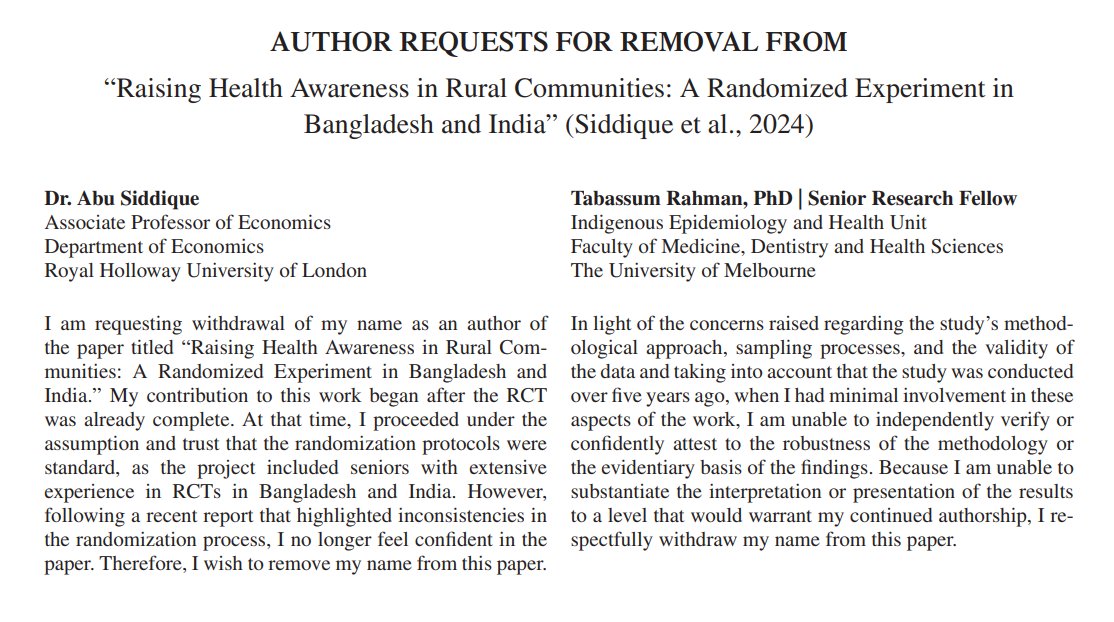
This might be a first in economics: Authors officially request to be removed from a paper published in REStat. The paper itself has not been retracted - and the other authors remain on the paper. https://t.co/gQ2GxmHpJb
@Ingar30 Accounting for pro being rationed in messages and codex in tokens, I have had good success with:
1) describe what I want to do in a conversation in 5.6, get a detailed prompt
2) run the prompt in 6 pro
3) edits in codex
That way I burn 1 pro message and fewer codex tokens