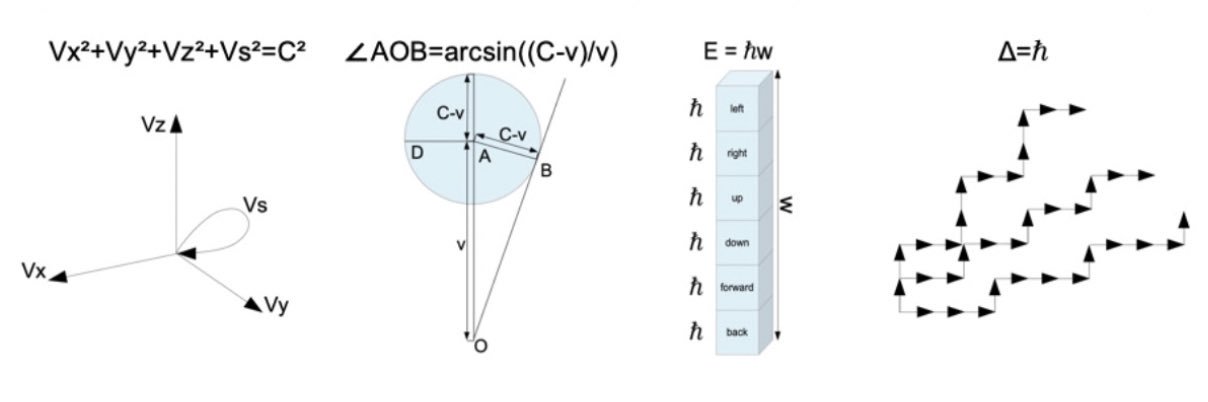
What if every elementary particle is actually a cyclic machine?
It can be tested through predictions and experiments.
It could be the Next Huge Thing.
Machine consists of a list of instructions. Each instruction represents some direction in space: left, right, up, down, forward, back. Machine executes all it's states one after another and moves in corresponding direction of space the same discrete distance on each tick of time. After some state is executed, control is passed to the next state. It happens infinitely in a loop. After last state is executed, control is passed to the first state.
So machine moves and moves until it's state is changed.
https://t.co/FPtDIbX971
Properties and phenomena that this machine reproduces:
- E - total energy: total amount of states. Energy of one state is numerically equal to reduced Planck’s constant and is the reason why action is discrete
- inertia (First Newton's Law): Machine keeps on moving infinitely until it's state is updated and the more states in machine the more states to be updated and the more particle "resists to acceleration"
https://t.co/eFpJ6OARva
- limited speed: you can not move faster than straight - discrete action (interaction): change in energy equals energy of one state
- reduced wave length: contribution of one discrete piece in motion
https://t.co/oAVspagPZy
- uncertainty and observer effect: interaction destroys the original particle so you can't know some properties of the particle after interaction. Because you can't control, which state will be taken from machine or passed to machine
https://t.co/pJqVk8jUHu
- momentum and conservation of momentum: amount of states that represents motion
https://t.co/OH0jlQptzi
- rest mass: amount of states that represents cyclic motion. For example a pair of states left-right does not move machine anywhere, but takes ticks of time to be executed.
- speed: If you have particle RRRR, it moves with maximum possible speed right. If you have RRRRLLL, it moves right 1 moment of time out of 7. So it's average speed is 1/7 of the maximum speed
- Photons generated by set of particles have more or less the same speed in any direction https://t.co/NysURFlSWO
- Discrete rules lead to circular motion and "wave behaviour":
https://t.co/LIRj9C3q4M
and more.
Bell inequalities say nothing about locality. They show that interaction destroys hidden variables, therefor hidden variables can not be "measured".
https://t.co/TtCgcpkE9v
A way to test (a way to show that light can have rest mass and therefore can move slower than):
https://t.co/um9ptglzqw
Free will is free, not fixed algorithm, spontaneous neural activity, slight schizophrenia that every human has..
https://t.co/vDN7Dn8WUk
Unfortunately X deboosts Ukrainian accounts even if they are not about war.
So your help with sharing the True Nature of Reality with the world is highly appreciated.
The world remains unaware that the true nature of reality has been discovered and that it is testable.
This is insane.
How can we make the world listen?
Everything is execution.
The universe is one huge machine.
I propose a radically new, testable model of the universe. It will explain everything from how matter moves to why humans built civilization.
Are you with me?
@patrickdaoun Experience - causal connection of matter.
Subjective - humans are the craziest apes. Just like mutations make animals be different, ideas and biases (eureka moments / love)
What if every elementary particle is actually a cyclic machine?
It can be tested through predictions and experiments.
It could be the Next Huge Thing.
Machine consists of a list of instructions. Each instruction represents some direction in space: left, right, up, down, forward, back. Machine executes all it's states one after another and moves in corresponding direction of space the same discrete distance on each tick of time. After some state is executed, control is passed to the next state. It happens infinitely in a loop. After last state is executed, control is passed to the first state.
So machine moves and moves until it's state is changed.
https://t.co/FPtDIbX971
Properties and phenomena that this machine reproduces:
- E - total energy: total amount of states. Energy of one state is numerically equal to reduced Planck’s constant and is the reason why action is discrete
- inertia (First Newton's Law): Machine keeps on moving infinitely until it's state is updated and the more states in machine the more states to be updated and the more particle "resists to acceleration"
https://t.co/eFpJ6OARva
- limited speed: you can not move faster than straight - discrete action (interaction): change in energy equals energy of one state
- reduced wave length: contribution of one discrete piece in motion
https://t.co/oAVspagPZy
- uncertainty and observer effect: interaction destroys the original particle so you can't know some properties of the particle after interaction. Because you can't control, which state will be taken from machine or passed to machine
https://t.co/pJqVk8jUHu
- momentum and conservation of momentum: amount of states that represents motion
https://t.co/OH0jlQptzi
- rest mass: amount of states that represents cyclic motion. For example a pair of states left-right does not move machine anywhere, but takes ticks of time to be executed.
- speed: If you have particle RRRR, it moves with maximum possible speed right. If you have RRRRLLL, it moves right 1 moment of time out of 7. So it's average speed is 1/7 of the maximum speed
- Photons generated by set of particles have more or less the same speed in any direction https://t.co/NysURFlSWO
- Discrete rules lead to circular motion and "wave behaviour":
https://t.co/LIRj9C3q4M
and more.
Bell inequalities say nothing about locality. They show that interaction destroys hidden variables, therefor hidden variables can not be "measured".
https://t.co/TtCgcpkE9v
A way to test (a way to show that light can have rest mass and therefore can move slower than):
https://t.co/um9ptglzqw
Free will is free, not fixed algorithm, spontaneous neural activity, slight schizophrenia that every human has..
https://t.co/vDN7Dn8WUk
@QM_Rev But all matter slowly vanishes and free particles leave it.
That process is inevitable and generates “free energy” (photons) around massive objects.
That’s your machine.
We call it the Sun.
Humans believe that rest is the default state of matter. But what if exactly the opposite is true?
If motion is the default state? This assumption solves the need for fuel or anything. Matter cannot not move. It can only move in some direction or move in cycles.
When it moves in cycles, we call it rest mass.
So the question should not be how it's possible that matter moves, but how is it possible to stop matter?
We on Earth think that we are at rest, but let's be honest. We move with the planet, the Sun, with the Milky Way.
There is no rest. But there can be cyclic motion.
What if every elementary particle is actually a cyclic machine?
It can be tested through predictions and experiments.
It could be the Next Huge Thing.
Machine consists of a list of instructions. Each instruction represents some direction in space: left, right, up, down, forward, back. Machine executes all it's states one after another and moves in corresponding direction of space the same discrete distance on each tick of time. After some state is executed, control is passed to the next state. It happens infinitely in a loop. After last state is executed, control is passed to the first state.
So machine moves and moves until it's state is changed.
https://t.co/FPtDIbX971
Properties and phenomena that this machine reproduces:
- E - total energy: total amount of states. Energy of one state is numerically equal to reduced Planck’s constant and is the reason why action is discrete
- inertia (First Newton's Law): Machine keeps on moving infinitely until it's state is updated and the more states in machine the more states to be updated and the more particle "resists to acceleration"
https://t.co/eFpJ6OARva
- limited speed: you can not move faster than straight - discrete action (interaction): change in energy equals energy of one state
- reduced wave length: contribution of one discrete piece in motion
https://t.co/oAVspagPZy
- uncertainty and observer effect: interaction destroys the original particle so you can't know some properties of the particle after interaction. Because you can't control, which state will be taken from machine or passed to machine
https://t.co/pJqVk8jUHu
- momentum and conservation of momentum: amount of states that represents motion
https://t.co/OH0jlQptzi
- rest mass: amount of states that represents cyclic motion. For example a pair of states left-right does not move machine anywhere, but takes ticks of time to be executed.
- speed: If you have particle RRRR, it moves with maximum possible speed right. If you have RRRRLLL, it moves right 1 moment of time out of 7. So it's average speed is 1/7 of the maximum speed
- Photons generated by set of particles have more or less the same speed in any direction https://t.co/NysURFlSWO
- Discrete rules lead to circular motion and "wave behaviour":
https://t.co/LIRj9C3q4M
and more.
Bell inequalities say nothing about locality. They show that interaction destroys hidden variables, therefor hidden variables can not be "measured".
https://t.co/TtCgcpkE9v
A way to test (a way to show that light can have rest mass and therefore can move slower than):
https://t.co/um9ptglzqw
Free will is free, not fixed algorithm, spontaneous neural activity, slight schizophrenia that every human has..
https://t.co/vDN7Dn8WUk