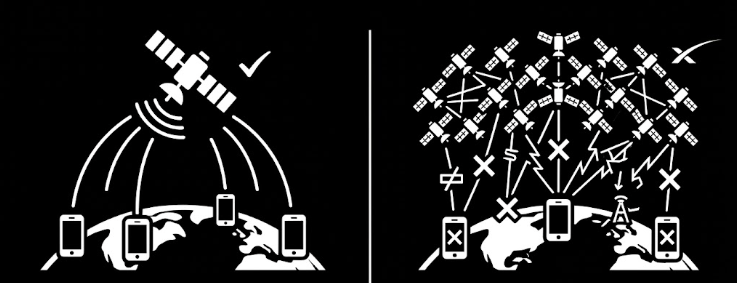
@RogerEntner@FCC@Starlink Roger, Iv been enjoying your posts but one thing you keep mentioning is if SpaceX buys Ligado. AST already owns the spectrum through a leasing agreement under FCC review. That is not on the table. Unless you are suggesting the FCC denies the transaction.
American operators hold ~1,000 MHz of low and mid band spectrum, tunable on the @AST_SpaceMobile network. With our current satellites in orbit and in build, our United States partners will access critical low-band and mid-band spectrum that no one can match!
When combined with the mobile network operators' extensive spectrum assets, and in combination with AST SpaceMobile controlled 45 MHz of L-band spectrum, users will see peak data rates of nearly 200 Mbps from the largest-ever satellites in low Earth orbit.
Together we are making the strongest, most resilient, AI ready networks on the planet. 🇺🇸 🌎📶📱🤠
@AnthonyWriter5 Also....what point is trying to be made here. The offense related component of this stat shows Ben leaving changed nothing. All this shows is Offense is the same but we lose more now, signaling the defense is ass.
@Bow27B@spacanpanman@CatSE___ApeX___ Ah, must have missed that disclosure. Then why build in the first place tbh. IF it is a government requirement, they wouldn't just be like okay you good now. who knows.
@spacanpanman@CatSE___ApeX___ My theory is they needed to rebuild BB7 due to the loss to hit that "identical sats" requirement. and that likely caused the slow down. Probably just copium but I have to believe there is a specific reason and not malpractice.
@spacanpanman Understandably a lot of folks are unhappy with the perceived slowdown. But Scott did say launches every 1-2 months still on the call. @spacanpanman@CatSE___ApeX___ I have a theory on the slowdown. IIRC they needed identical sats up (BB6 and BB7) for something military specific..
@spacanpanman Not sure if this has come up yet, but you could think about this in the reverse... as in these funds are already over hedged and will use this to buy shares.
@spacanpanman They have said close to 6 sat/month for over a year now but only 1.5 coming off the line per month. Only way that 45 works, is if they are truly at 6 month now and just bought 8 more launches between now and Feb. Hopefully the slow production is by design up until this point.
@spacanpanman With them reiterating 45 sats by early 2027, and with successful unfurling announcement today, they are buying multiple F9 launches/month. 3/month get us to 25 EOY. Doubt they count BO in the calculation so they must have gotten green light for full go manufacturing and launch.
$ASTS - Some thoughts on SpaceX's prospectus in regard to Starlink Mobile.
To succeed, Starlink Mobile basically needs what AST SpaceMobile already has.
👉 Launch
SpaceX needs fully operational Starship to launch the V2/V3 satellites needed for strong mobile signals.
AST needs what's already on the market. AST's Bluebird satellite is already compatible with all major launch providers, including SpaceX Falcon 9.
👉 Carrier Deals
SpaceX needs to make MNO partnerships (like T-Mobile and Airtel) permanent. They currently have 30 partnerships and need to grow that substantially.
AST currently has about 60 partnerships, and and growing. If T-Mobile joins AST that would be a big win for AST and a big loss for SpaceX. AST is ahead with more partners and deeper integration.
👉 Own spectrum
SpaceX is finalizing the $17 billion EchoStar acquisition to secure independent, high-capacity 5G bands.
AST is finalizing the Ligado agreement to L-band spectrum in the US and Canada.
👉 Lowband spectrum
SpaceX can't do low-band spectrum at the moment and can therefore not reuse MNO's spectrum.
AST SpaceMobile's current satellites are built to use low-band spectrum and can therefore reuse MNO's spectrum.
👉 FCC and ITU Approvals
SpaceX needs to win global regulatory clearances for higher transmission power limits and interference mitigation.
AST is already compliant with current transmission power limits and interference rules.
👉 Constellation Density
SpaceX needs to launch thousands more cellular-equipped satellites to ensure constant, zero-gap global coverage.
AST needs only 100 satellites for global coverage.
👉 Phone Hardware
SpaceX needs the handset manufacturers to implement hardware and software modifications for compliance and optimal performance.
AST's satellites works with today's unmodified phones. Future hardware and software modifications will improve AST's service but are not criticaly needed.
Verdict: I'm long AST.
$SPCX / $ASTS
The world's most well-funded space company just went public partly on the strength of the satellite-to-mobile opportunity, validated a $740B TAM, confirmed MNO partnerships as the right go-to-market, and admitted its own full broadband direct-to-device service won't be ready until 2027 at the earliest and only if Starship works on schedule.
Here is what $SPCX is saying related to satellite-to-mobile / direct-to-device market, market size, unconnected population, dead zone elimination, MNO partnerships, and spectrum dynamics.
The Addressable Market Is Massive
- SpaceX estimates the Starlink Broadband + Mobile TAM alone at $1.6 trillion ($870B broadband + $740B mobile) — validating the enormous size of the satellite connectivity market
- ~3 billion people on Earth remain unconnected to the internet, representing the core demand driver for satellite-based connectivity
- SpaceX explicitly states that building terrestrial networks in rural/remote communities is "prohibitively expensive" — confirming satellite is the only viable solution for these populations
- The global satellite-to-mobile TAM is cited as $740 billion, a market $ASTS is directly targeting
- Satellite-to-Mobile Is a Real, Validated Category
SpaceX confirms satellite-to-mobile is a legitimate commercial service, describing it as "providing global cellular connectivity directly to everyday smartphones via satellites, supplementing terrestrial networks and eliminating mobile dead zones"
- SpaceX is actively partnering with ~30 MNOs on six continents for satellite-to-mobile — confirming that major carriers worldwide are actively seeking this technology
- The S-1 confirms mobile dead zones are a global, recognized problem across approximately 30 countries that satellite-to-mobile directly solves
- SpaceX confirms that satellite-to-mobile can support not just messaging but broadband data and IoT connectivity (their next-gen V2 Mobile satellites)
MNO Partnership Model Is Validated
- SpaceX's own satellite-to-mobile strategy relies entirely on partnerships with mobile network operators — the exact same go-to-market model $ASTS uses — confirming this is the industry-standard path to market
SpaceX's ~30 MNO partnerships span six continents, demonstrating that carriers globally are willing and eager to enter satellite-to-mobile agreements
Spectrum Is a Real Barrier to Entry (Moat for incumbents)
- The S-1 explicitly warns that satellite connectivity depends on "access to radio frequency spectrum and authorizations from the FCC and telecommunications regulators in other countries"
- SpaceX calls acquiring spectrum authorizations "a complex and time-consuming process" and states that "without these licenses and approvals, we cannot generally offer connectivity services in a given market"
- Spectrum access is described as "limited and highly regulated" — reinforcing that spectrum licenses are a significant competitive moat for any company that already holds them
Low-Earth Orbit Is the Winning Architecture
- SpaceX confirms LEO is the only architecture capable of delivering low-latency connectivity (below 70ms), validating LEO as the technically superior approach vs. geostationary satellites
- SpaceX describes its LEO constellation as "the sole low-latency network available globally" — confirming that LEO is the standard bearer for satellite internet
The Competitive Landscape Has Room
- SpaceX's satellite-to-mobile service (V1 Mobile) currently covers only light data, SMS, and over-the-top voice (WhatsApp, FaceTime) — it is not yet a full broadband direct-to-device service, leaving room for competitors offering higher-bandwidth solutions
- SpaceX acknowledges its next-generation V2 Mobile satellites (full broadband satellite-to-mobile) won't begin deploying until 2027 at the earliest, via Starship — a timeline that is dependent on Starship's own uncertain development schedule
- SpaceX itself lists Starship delays as a key risk that could delay satellite-to-mobile expansion, meaning their competitive ramp in this space is not guaranteed
The Regulatory and International Expansion Challenge Favors Diversified Players
- SpaceX acknowledges that growing connectivity services depends on "increasing market awareness and acceptance across numerous international markets, each with its unique challenges" — suggesting no single player will dominate globally in the near term
The market is underestimating $ASTS.
APPLE LIE CONFIRMED 🤷♂️
"We do not have direct contractual arrangements with handset manufacturers; instead, we expect MNO partners, as major purchasers of mobile devices, to encourage or drive such adoption. There can be no assurance that these modifications will be adopted on our preferred timeline, or at all."
$SPCX $AAPL $ASTS
STARLINK MOBILE ESTIMATES ARPU OF $8 PER USER WITH A $740 BILLION TAM $SPCX
-> "AST SpaceMobile has signed definitive agreements with over 50 mobile network operators worldwide, representing a combined base of nearly 3 billion subscribers."
$ASTS trades at $35 billion
This is criminally undervalued at the moment.
Make it make sense!?
SPACEX VALIDATES AST SPACEMOBILE AS A DIRECT COMPETITIOR
AST SpaceMobile just got the ultimate validation, straight from SpaceX's S-1 IPO filing.
SpaceX filed its S-1 today, which is 227 pages long. One name in the satellite-to-mobile competition section stands above the rest as it's the ONLY competitor.... AST SpaceMobile 🧇
In SpaceX's own words, filed with the SEC, their Starlink Mobile offering "competes with other satellite-to-mobile satellite operators including, among others, AST SpaceMobile, Lynk, Globalstar and Skylo."
Let that sink in.
The most powerful space company on Earth, valued at trillions, just told the world's investors that AST is a named competitor they take seriously.
This isn't the Sp🅰️ceMob, this is Elon Musk's lawyers, in a federal securities filing, putting ASTS on the map.
$ASTS
$ASTS: 🚨SPACEX ADMITS STARLINK MOBILE DEPENDS ON HARDWARE AND SOFTWARE MODIFICATIONS BY DEVICE MANUFACTURERS
Meanwhile, @AST_SpaceMobile is engineered and designed from Day 1 to work with ALL legacy unmodified smartphones. No special hardware or software required. Just broadband directly from LEO to the device in your pocket. ✅
Page 45 of the $SPCX S-1: https://t.co/NXnlHOhe6S
SpaceX S-1 just dropped. Here is the quick analysis that matters for $ASTS .
SpaceX Starlink Mobile has 7.4 million monthly unique devices connected across 30 countries.
7.4 million phones connecting to satellites from space. D2D demand is real. Market validated.
But here's the context T-Mobile's CFO already gave us: "relatively low usage and concentrated around national parks."
7.4M devices pinging satellites at 3-5 Mbps for occasional texts and emergency use. Now imagine 98.9 Mbps on low-band spectrum that works indoors. Same market. 33x the speed. The usage per device changes completely.
Starlink Connectivity segment: $11.4B revenue at 63% EBITDA margins. Satellite connectivity at scale prints money. If $ASTS achieves even half those margins, the long-term profit case is massive.
D2D revenue isn't broken out separately -- it's buried inside the $11.4B. Probably $200-500M. Small today. But SpaceX confirmed V2 Mobile (next-gen broadband D2D) deploys on Starship in 2027. They're investing heavily because they see where this goes.
The S-1 also confirmed something else: xAI lost $6.4 billion in 2025. Starlink's $4.4B profit is subsidizing the AI burn. That's where analyst attention will go -- not D2D.
Here's what I take from the S-1 for $ASTS:
D2D demand is proven -- 7.4M devices in 18 months ✅ Satellite connectivity margins are 63% at scale ✅ SpaceX next-gen D2D doesn't deploy until 2027 — $ASTS launches next month ✅
D2D revenue isn't disclosed -- analysts will estimate it, creating the comparable that reprices $ASTS ✅
@SpaceX just showed the market that satellite connectivity is a $11.4B, 63% margin business. They also showed that D2D has 7.4M devices and growing.
$ASTS is building the broadband version of that. With low-band spectrum. With a carrier JV. With 60 MNO partners. Launching in weeks, not years.
The S-1 didn't mention $ASTS . It didn't need to. The numbers speak for themselves.
$ASTS 🛰️