@SashaGusevPosts You're right that EA is the poster child for factors that bias GWAS. And that's exactly why we SHOULD continue to study it with GWAS. It allows us to develop models and approaches to quantify these issues much more easily than in traits less affected.
Horwitz & Keller preprint - a meta-analysis on assortative mating across 22 traits (https://t.co/UjoVB0ahDK) discussed in Psychology Today: https://t.co/jccqdYTNAq
Question about imputation software: Is there a way to ask the program to change existing SNP calls based on some threshold of (e.g.) posterior likelihood?
Assortative mating is known to bias twin/family heritability (h2) estimates, but how does it influence SNP-h2? See our paper in Nature Communications to find out: https://t.co/y8X6SjfJUr (Amazing work by IBG PhD Richard Border on this MS!)
@cathrynlewis Sorry Cathryn. I like your work but strongly disagree here. Nature doesn't care about budgets. Yet more small sample papers showing positive results for the "usual suspect" candidate genes isn't helpful to say the least. Plenty of work to do in large publicly avail GWAS datasets
It's pretty rare to read a review paper about your field and intended for people not in your field that you learn much from (or even that you think is worthwhile). Here is an exception, beautifully written by @kph3k: https://t.co/hQZNAfKWKJ
We will begin reviewing applications for Assistant Professorship at Institute for Behavioral Genetics CU Boulder ~ end of August!
Please help us spread the word!
https://t.co/4ESbsaGNDb
IBG graduate student, Richard Border, inteviewed on CBC about his recent
paper on the genetics of depression: https://t.co/Yd0h7umim7. Read the paper at:
https://t.co/AesoLO29gS
Our work showing historical candidate genes are unrelated to depression covered in the Atlantic (https://t.co/hjuXsEa7Pz). It's not enough to just say, "Oh well," and move along. What about the scientific process needs to change so that this doesn't happen again in the future?
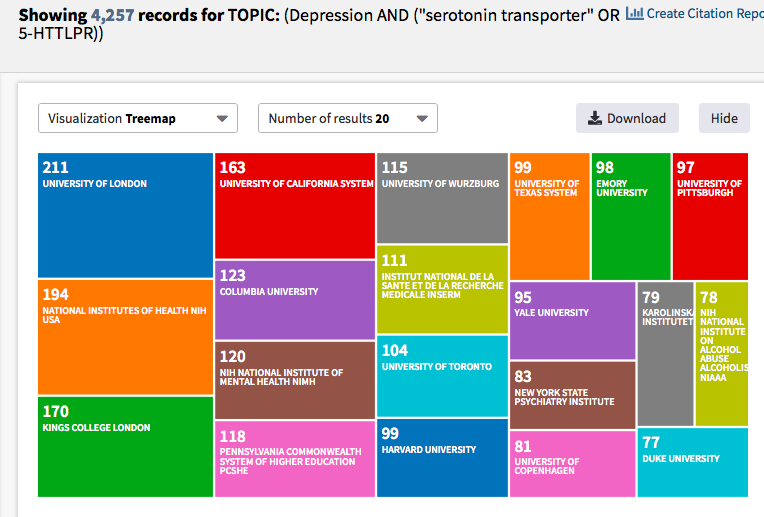
@matthewckeller Just out of interest, I did a Web of Science search to see where most studies of depression & 5-HTTLPR had been done. They tend to be elite institutions: I guess not surprising, but raises qu of why this persisted so long. #genetics#depression
New paper by ex-ibger @LaramieDuncan and colleagues explaining to the uninitiated why traditional candidate studies make no sense to do anymore (they also cost about a million times more per variant) https://t.co/Fy4HJPIIlE
I have never in my career read a synopsis of a paper I've (co-)written that is better than the original paper. Until now. I have no clue who this person is or what this blog is about, but this simply nails every aspect of the issue: https://t.co/NGGR4pV9dC
@EikoFried I do want to clarify that this MS in no way says anything negative about GWAS. It's an incredibly exciting time in genetics because of large-scale GWAS datasets! Our beef was with "candidate gene" studies only. See our response at end of the page here: https://t.co/15AST0uirP
I am recruiting a postdoctoral researcher with experience in programming, statistics, and/or genetics to help develop methods to elucidate the genetic architecture of complex traits: https://t.co/fh8TYWEFja. Spread the word!