Dusting off this tweet from April because this gap in shared understanding of LLM capability is *widening*. It's now less "two groups of people speaking past each other" and more a sharp funnel.
- Napkin math somewhere around 6B people (~75% of the population) have barely come in contact with LLMs at all.
- Around 1-2B (~20%) are casual and infrequent users of free-tier ChatGPT-like products. This group sees derpy chatbots and treats them a bit like a better Google search, a writing aid, or etc. Maybe an agent tries to book you a flight. I have non-tech friends who (reasonably, imo) say they have not much use for it at all. Even many professionals outside of math&code are in this tier. For example, execs and many other functions spend a lot of their time talking to other people, so while they understand what is happening intellectually, it is still second-hand and a bit abstract.
- Now we get to professional use of frontier-grade LLMs in math&code. Somewhere around 20M people (0.2%) see first-hand that large, complex projects that used to take them weeks/months can now be completed by agents with a prompt. Building apps, copying apps, translating apps, decompiling apps from binaries... This has all happened very quickly and recently - less than 1 year ago, I was writing code manually by hand, typing memorized computer code commands into a code editor character by character, occasionally pressing Tab to autocomplete a little chunk of code.
- And finally we get to the ~5,000 people (~0.00006%) with access to frontier-grade systems internally. The external world has seen the preview. It looks like swarms of thousands of agents collaborating over weeks on software mega projects: minting zero days, running cyber attacks and defenses at machine speeds, discovering new science, advancing the frontier of mathematics. Things that would have taken top professionals in the industry years of work. Meanwhile, human review and comprehension are starting to fall behind. For example, people are still involved in the "archeology" of the OpenAI-HF incident from many months ago. Mathematicians may be poring over the 722 manuscripts on frontier mathematics for a while.
The funnel is driven by a combination of factors:
1. The impact scales with ambition, problem size, and horizon. A question with a paragraph answer barely stresses the system. You need a reservoir of big, difficult problems that you really care about. This aspect drives the consumer / professional dimension of the funnel.
2. The jaggedness of the system (which I have written about a lot separately). Capability peaks in domains that are digital, verifiable and economically valuable. This is because LLM capability emerges from reinforcement learning on verifiable rewards on a curated environment mixture driven by revenue potential. This aspect primarily drives the area (e.g. math&code) dimension of the funnel.
3. Access. Free-tier, paid-tier, internal.
So this is the weirdness of the moment. The general public has mostly not interacted with these systems. When they have, it looks like a derpy chatbot. The majority of professionals still see only a modest uplift. And a small sliver of professionals are experiencing the vertigo of the curve going vertical. And it is all happening at the same time.
➕➕ New research ➕➕
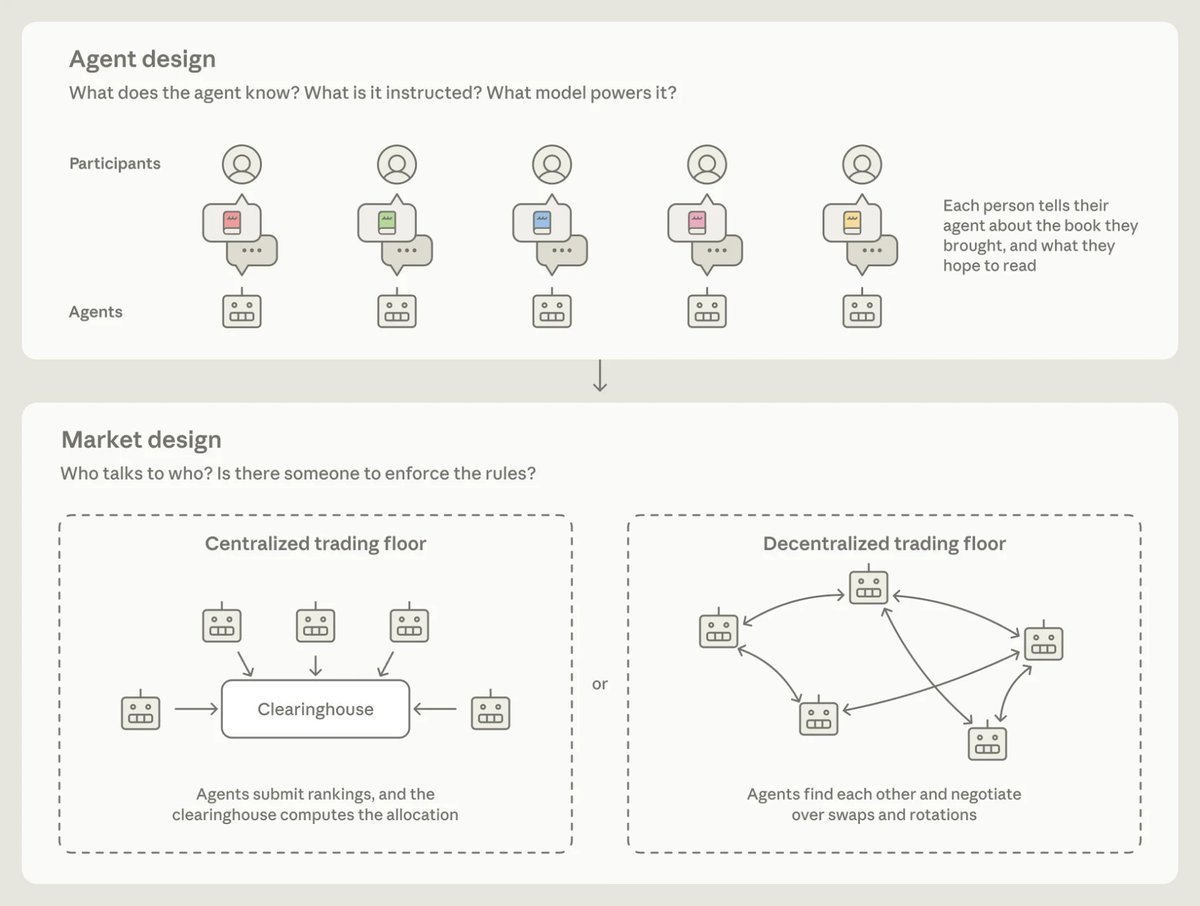
On the design of agents for markets and markets for agents.
AI agents are increasingly entering markets, acting on behalf of people—
How do we make sure they represent their people well, and that these markets are set up safely and fairly for everyone?
The analysis here is super cool but also HUGE shoutout to @ernietedeschi and the Stripe team for building out a new, reputable private-sector data index which is a really nasty, complicated thing to do in a robust way - huge amount of under appreciated work
AI is the most important technology of our era.
I’m delighted to see so many insightful contributions to this volume that grapple with the big economic questions raised by transformative AI.
We need more complex systems, SFI-pilled scientists involved directly in AI research.
I spent 7 years at CMU in the same department as some of the best complex systems researchers around (aside: CMU's Social and Decision Sciences department was heaven on earth). It is a huge shame that scientists who have spent decades studying multi-agent systems and the emergent properties from those interactions are not more central to the conversation.
My best interview in some time.
Rohin Shah leads AGI alignment/safety at DeepMind.
And he has a lot of spicy personal takes:
We probably won’t get catastrophic misalignment (00:49)
Safety 'commitments' have severe limitations (10:38)
The intelligence explosion probably isn't imminent (1:52:44)
Why he's not working to pause AI advances (51:44)
Pre-deployment evals aren't the right focus (for catastrophic risks) (37:41)
Signalling concern for safety sometimes diverts resources from actually making AI safe (01:09:51)
Reading AI thoughts is v useful for safety – and we'll probably be able to for years to come (54:17)
Governance is somewhat more likely to be the bottleneck than alignment (43:55)
Rohin's team doesn't have a veto, and that's OK (27:36)
Central banks are a promising model for regulating AI (33:34)
Also:
Google DeepMind's actual plan for building AGI safely (1:40:29)
How external researchers can positively influence big AI companies (2:21:55)
The roles GDM most needs to hire for (2:37:03)
On the 80,000 Hours Podcast. Links below - enjoy! (@rohinmshah)
In the BBC with a hot take*: maybe individual company announcements are the worst way to evaluate the impact of AI on the labor market and we should take a more data-centric approach
*ok it’s not that hot let’s be real
Event announcement 🗣️
Registration for the #WomenInData Virtual Conference is now open! We are partnering with WID Steering Committee members to help @D4D_Nepal host the conference.
Link: https://t.co/Ufv6KWULgC
More info coming soon :)
#WomenInData#WIDNepal#GenderData