@DeItaone Neocloud credit shouldn't rest on any single balance sheet. A clearing price and a clearinghouse let lenders spread and hedge that risk across the market. That's part of what we're building @ComputeDesk
8 months ago, I DM'd @SenorScience. No reply.
4 DMs, an article and a GPU cluster model later, I joined @ComputeDesk as Chief of Staff
Today, we announced a $45M seed round led by @lightspeedvp
Moral of the story: you should double-text more
Announcing @ComputeDesk raised $45M, led by @lightspeedvp, to solve compute risk.
I left Meta last year to build a team of quants and GPU infrastructure engineers to build the clearing infrastructure for compute.
One of the more interesting developments in AI infrastructure is that older GPUs are gaining pricing power. the thing is, depreciation schedules assume hardware loses value with age. here, scarcity changes that calculation. A GPU's economic life increasingly depends on how long operators can keep it productive
New episode of Where Capital Meets Compute: @andrawesbahou, founder and CEO of Compute Desk, on why the off-take contract may be the wrong hedge for compute.
His argument: an off-take mainly protects against idle GPUs, but it also locks in price. Operators who signed three-year terms six months ago have since watched prices rise roughly 40%, with no way to reprice.
We get into phantom capacity ("the hopes of a cluster"), why Compute Desk scrapped its first index built on on-demand prices, and who is now willing to buy price, utilization and counterparty credit risk.
This episode is sponsored by @ComputeDesk, building financial infrastructure for compute traders.
Their Compute Indexes publish daily reference prices for GPUs including the H100, H200, B200 and B300, and their platform helps teams price, procure, hedge, finance and settle compute from first offer to final agreement. Learn more at https://t.co/Ohcj2ux9Vw.
Two weeks ago in SF, I heard about an AI startup raising a round extension solely because compute prices had gone up.
Makes you wonder why VCs are still funding compute entirely through venture equity, rather than securing capacity separately and investing it in kind.
Lenders have been underwriting the offtakers, not the GPUs. There are only so many IG balance sheets to go around. This is where the need for sophisticated capital markets come in. Price discovery, hedging and instruments that let investors trade and redistribute compute risk could unlock an entirely new pool of capital
@RealNickMugalli The biggest constraint in this market isn't demand for compute. It's finding enough investment-grade offtakers to finance the buildout.
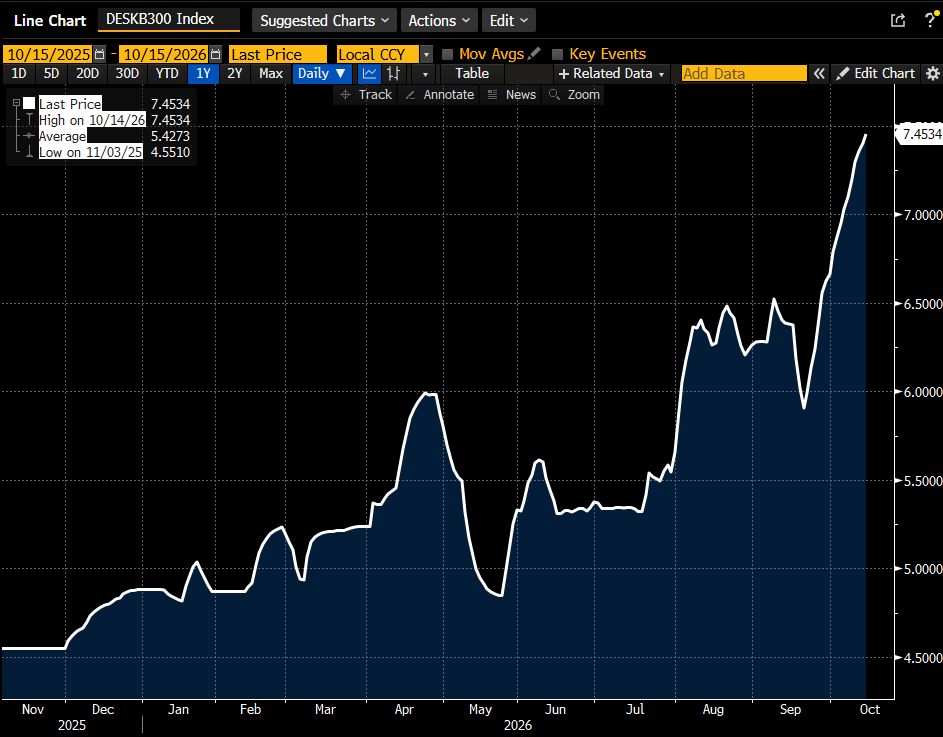
Blackwell Ultra (B300) GPU rental prices up 17 consecutive days to a new all-time high, according to Compute Desk's index of verified transactions from U.S. neoclouds.
The GB300 GPU rent premium over B300's is interesting @ComputeDesk. Growing demand for large MoE models, which benefit from rack-scale architecture, could be an explanation
Nvidia hardware is an appreciating asset, with B300 value up 40% in 3 months.
"The B300 Summer". In July, @Kimi_Moonshot released KimiK3, expanding B300 demand and value. By late September @Supermicro "Gold SKU" supply on 4-week lead time was depleted, triggering a continued value increase, with no sign of slowing down.
Residual value for Nvidia hardware is increasing.
@NVIDIAAIInfra@JensenHuang