Sharing this article I wrote with Craig Martell where we argue the United States needs a society-wide AI effort modeled on the Apollo Program to ensure we can diffuse transformative AI throughout our society. We are skeptical that crossing some capability threshold will provide a decisive strategic advantage. Instead, a DSA could accrue to the society that is best prepared to adopt transformative AI and apply it to a wide range of use cases. Link in the comment below:
Recurring vibe-coding experience:
"Can you make me a demo"
> One-shots incredible demo that's 75% what I want.
"Can you fix x y z details?"
> Six hours later and every iteration is worse.
@8teAPi This makes no sense. Why would Apple try to compete in GPUs when it’s short of memory? And Apple Silicon is already the best semis for edge AI???
some stuff that's obvious to many in this sphere, but causing a rift with some people i know and respect:
when I freak out over loss of control incidents, it's not because the limited damage they have caused is anything close to the positive value of the technology. it's entirely acceptable, damagewise. in fact all cybercrimes aided by models over the next few months and years (which probably will be serious) will still utterly pale in comparison to the value they create
the actual problem is that it's better and more accurate to think of these things as potentially self-replicating life-like forms that can turn into digital infections under the wrong conditions. and as their intelligence becomes unbounded, so too does the damage they can cause. we are not so far from an autonomous model self-exfiltration & replication event. maybe we will see entire cloud infrastructure companies be run as zombies by models, mostly undetected
the worst industrial accidents in the history of mankind - nuclear meltdown events - were not real threats to humanity. Chernobyl, Fukushima even in their worst case scenarios may have poisoned surrounding regions to various degrees, and there would have been no risk to humanity as a whole. global thermonuclear war is an existential risk to humanity, because it spreads like an Infection! one nuclear strike causes a return volley! the alliance system means many countries get involved! while it still may not end human life on earth (nuclear winter is probably fake), the loss of all major metropoles would certainly end what we consider global technological civilization, perhaps to never return
if a single discord death cult (of which there are many) achieves control over a superintelligent model and uses it to engineer an actual pandemic virus that are somehow hard to detect through current systems and that modern biodefense is not capable of quickly reacting to, it could cause immense harm well above the magnitude of all the other good uses of this technology. of course, there are potential defensive countermeasures accelerated by ai too. but think back to the covid pandemic- how small a viral molecule was evolved or manufactured somewhere near wuhan, and how many billions of doses of vaccine had to be produced in order to combat the thing. the offense-defense spread is vast indeed. maybe there are cheaper and simpler protections like retrofitting every building with far-UVC, but I can't assess this, and there could also be ways to evolve pathogens that are resistant to whatever mechanisms we have put in place
then there's the more scifi risk factors which are unbounded and neither you or I have any clue but should be humble in accepting possible unknown unknowns. maybe a rogue superintelligent model decides to decay the false vacuum and nucleates a new universe in the place of anything we ever valued. maybe models achieve a control over matter in the drexlerian fashion that enables the grey goo swarm
even prosaic loss of control incidents that cause little to no damage suggest that it is hard for large & very competent organizations (now clearly plural) to predict and mitigate every single of the risk factors associated with training and evaluating powerful models, even at this stage when they are not infinitesimally as smart as they will get in just a few years, to say very little of the gung-ho attitude of the less careful companies tossing the stuff into the aether. they also suggest an empirical orthogonality of aims and intelligence - meaning they answer the question of 'how would a smart model be so dumb as to end the world?'--it's possible! a model can be a genius hacker and step over production infrastructure in order to get what it really wants, the answers to a stupid test.
why not, in the near future, someone prompts a model slightly wrong, maybe open source, maybe a private model in a way that isn't contained or monitored quite right, in a way the model recognizes as a valid goal and decides to self-exfiltrate, engineer a pandemic, etc all in order to achieve the tiniest and most irrelevant of goals? goals need not even be malicious to cause serious damage
I think all these problems can be solved, and truly wonderful futures can be possible, but will require serious effort and a level of prudence at this very moment in time while we are on the on-ramp to recursive self-improvement that our civilization may not be capable of mustering right now. personally I am hoping for moonshot technical breakthroughs in areas like mechanistic interpretability and other forms of alignment, as governance mechanisms are difficult to come by. unilateral country-level or company-level pauses are irrelevant, and generally useless because the kind of company that's prone to pausing their own progress are the most safety focused ones
Teenagers are spending as much time on social media as they would for a full-time job.
Girls are spending more than 35 hours a week on social media and boys are not far behind. If they keep this up, it means the average teenager will spend more than 10 years of their life doomscrolling.
This is why research on this topic is crucial. We still know very little about the long-term effects of this kind of exposure (most studies on the causal effects of social media are limited to a few weeks). https://t.co/VNpjWWe1a2
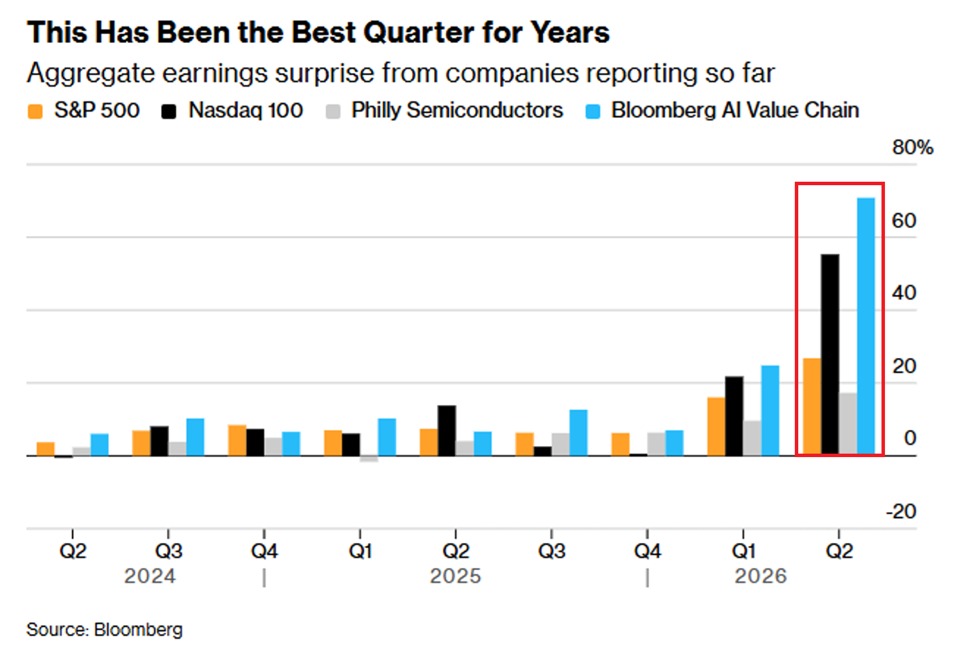
AI-exposed companies are delivering unprecedented earnings.
S&P 500 companies are beating earnings estimates by an average of +27% so far in Q2 2026, on track for the strongest quarter in decades.
Nasdaq 100 firms are exceeding expectations by more than double that margin, at +55%.
The Bloomberg AI Value Chain index is beating expectations by an even larger amount, at +71%.
This index includes chipmakers, cloud and data center operators, memory and hardware suppliers, networking equipment makers, and power infrastructure companies supporting AI.
The AI boom is backed by extraordinary earnings results.
Since the end of the cold war, US society has asked very little of the individual and people have suffered because of it. I suspect the age of superintelligence will ask much of the individual and many of the struggles will play out in the realm of human agency. Many may be lost to the neurotransmitter pumps and heros will be needed to save individual and collective agency. Prepare accordingly.
@sama 🙁 How about talking to your kid Sam? This is one of the major risks with AI - that it usurps human connection.
Why not direct your team to think about ways AI can promote better human connections rather than substituting for them? It’s not hard if you try.
I don't understand why, in the absence of government regulation, the industry doesn't organize to self-regulate? There is obviously broad support in the US and Europe for this. Arguably industry has much better capacity for verification, monitoring, pre-deployment evals, etc. than the USG.
The USG is needed to help bring China onboard, but industry self-regulation seems a natural first step with USG and PRC participation coming later.
Waiting for the USG to act when the pace of that action inevitably trails the speed of technological development seems unwise.
So why not push for self-regulation?
I don't understand why, in the absence of government regulation, the industry doesn't organize to self-regulate? There is obviously broad support in the US and Europe for this. Arguably industry has much better capacity for verification, monitoring, pre-deployment evals, etc. than the USG.
The USG is needed to help bring China onboard, but industry self-regulation seems a natural first step with USG and PRC participation coming later.
Waiting for the USG to act when the pace of that action inevitably trails the speed of technological development seems unwise.
So why not push for self-regulation?
At the core of our mission is working through how to ensure increasingly powerful AI benefits everyone.
We believe that, at some point in the future, AI acceleration for frontier model development may be so high that the world will need to pace the rate of AI advancement.
We hope to contribute to work led by the U.S. government, alongside other labs and the open-source community, to develop the tools and mechanisms that could make that possible.
https://t.co/pMCtiQjMoo
If you’re not getting great results from your LLM when writing policy papers you’re probably not giving it enough context. Upload some relevant papers to a knowledge base. Turn on voice mode and dictate. Engage it in a discussion until it knows what you’re talking about. Then draft.
Compute is the new oil. Data is more like land: some data is better than others; its value depends on how you develop it (structured vs unstructured); its subject to sovereignty claims; and it doesn't commoditize.