Redesign Health has acquired ARC Global and AVIA, becoming the largest global applied AI firm in healthcare.
Artificial intelligence is the most important technology of our lifetimes. At Redesign Health, we believe healthcare stands to benefit more than any other industry.
The potential is difficult to overstate: Better clinical decisions. More time for caregivers to care. Dramatically lower administrative costs. Agents working on behalf of patients to navigate the incredible friction of referrals, scheduling, prescriptions, and insurance. World-class expertise reaching patients who have never had access to providers of that caliber. Entirely new ways to organize and deliver care.
I’ve spent the better part of a decade building healthcare technology businesses, bringing new products to market, winning enterprise customers, and navigating the enormous complexity of getting software deployed in healthcare.
One lesson keeps coming back: you must deeply understand how healthcare works to build (and sell) great healthcare products.
Clinical workflows, reimbursement, operations, patient experience, and the thousand little details that separate a promising technology from a great outcome at scale.
The opportunity is to combine the world’s leading healthcare providers, solution designers, and forward-deployed teams with exceptional technologists and capital. Then deploy what works across healthcare at scale.
That’s what makes today’s announcement so exciting. Together, we’re bringing the healthcare expertise, engineering talent, capital, and global reach to deliver applied AI solutions for healthcare, by healthcare.
I’m also thrilled to work alongside Stephen Klasko, Eyal Zimlichman, Clay Holderman, Eric Langshur, and the teams joining us.
There is much to build! Let’s get to work.
🚀🚀🚀
Reporters should never advocate for an outcome and if they do they should be fired.
This Vanity Fair reporter clearly wanted Jensen out.
Trust in Legacy Media will remain broken when reporters push intentional outcomes.
You became a clinician to heal people. Somewhere along the way, we confused the tools of medicine with the practice of medicine itself.
You learned to memorize textbooks, write clinical notes, interpret tests, and navigate complex workflows because that’s how we practiced medicine up until now. We’re finding better ways.
Were you running every lab test yourself? Building your own MRI machines? Developing every drug you prescribe? Then why is it so threatening when AI improves another layer of the medical workflow?
The doctor who first used an ultrasound didn’t become less of a doctor. The surgeon who adopted robotics didn’t stop being a surgeon.
We’ve built a profession where people spend years mastering tools and processes, then sometimes confuse those skills with the purpose of the profession.
You went into medicine to understand disease, care for patients, alleviate suffering, and save lives.
AI will change how much of that work gets done. Clinical judgment, compassion, and responsibility will matter more than ever.
The goal was always better health, longer lives, and less suffering.
We should push the boundaries of what’s possible with these new tools.
The most Midwest success story ever:
> Craig Culver and his parents open a burger stand in an old A&W in 1984 in Sauk City, WI
> Names it Butterburgers, because his mom butters and grills the bun
> Adds frozen custard to the menu that the family used to drive to Milwaukee for
> Nobody shows up. Almost doesn't survive year one
> Makes its first profit in year 3
> Tries franchising. It fails. Craig swears he will never franchise again
> Tries again in 1990 with a new rule: the owner has to work the counter
> Paints giant blue *Thank you Farmers* barns along Midwest highways
> Fast forward to 2026: 1,100 stores in 26 states. None in the Northeast or West Coast
> Average store does $4.1 million. System does $4.3 billion
> Most operators own the land their restaurant sits on
> CEO calls it a *pretty slow fast food restaurant*
> Forbes surveys 100,000+ customers and names it America's favorite fast food chain, ahead of In-N-Out and Chick-fil-A
The “data industry” is so funny because so many middle man and random people who claim to be plugged will say “Nono the labs don’t want x data anymore that’s done”
Then you talk to a lab and they’re like “we will take all the x data you have what do you mean”
Watch out yall; so many charlatans in the data space
Good freakin’ luck on the sign-off.
Take it from a guy who has sold more healthcare data contracts than I care to admit: secondary use clauses are *extremely* tight.
Healthcare data is the most requested category right now from my buyers.
MY BUYERS ARE ASKING FOR:
--> Longitudinal EHR (patient records over time: diagnoses, meds, labs, outcomes)
--> Imaging with reports; CT, MRI, X-Ray, pathology slides
--> Behavioral health and specialty care records
--> Doctor-patient conversation audio with transcripts (frontier request).
REQUIREMENTS:
--> Independent de-identification sign-off (HIPAA Expert Determination by a third party, not the seller).
-->IRB approval, or consent that covers commercial licensing
-->Clear chain of rights: who collected it, who owns it, who can license it
These deals need paperwork to get through.
If you have clean, documented clinical data, or you're sitting on records and don't know where to start, DM me.
I am once again begging the organizers of @HLTHEVENT to put @healthapiguy on the Monday slate.
You don’t save your best starting pitching for the eighth inning.
I'm here in Vegas for HLTH and I'm really psyched -- and it's not because I'm getting to see the Eagles or spending the night at the Sir-Mix-A-Lot video slot machine.
Tomorrow we have our first STAT@HLTH stage here, and I think it's going to be a great event. We have a session on the challenges and promise of EHRs that will feature two epic executives, as well as the former CTO of the U.S. We'll have a session with executives from Whoop, Verily, and ARPA-H. All moderated by a team of STAT all-stars: @brittanytrang, @mariojoze, and me.
I hope to see you there.
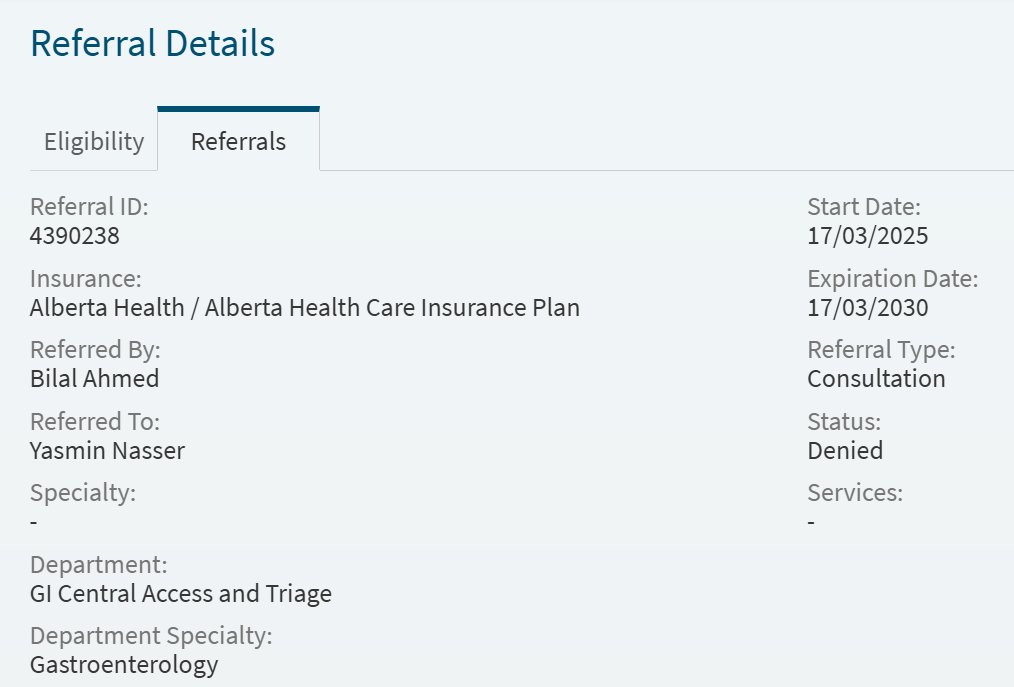
I convinced a doctor in the ER to get my on the list for a GI endoscopy. I had symptoms and risk profile that matched with possible cancer or other problems. The waiting list was 7-8 months but I ended up waiting 2+ years instead.
Spoiler alert: I have esophageal cancer and in palliative care now as I await my death.
Along the way, a specialist of mine for pulmonary functioning cancelled the request without telling me and then dropped me as a patient after I confronted her about why and how come. I never saw her again and she remains unaware that I have cancer of the esophagus. No accountability or recognition of her error in judgement to be found in the system.
Once I learned she had cancelled the initial request, I requested it four more times through my family physician. It was denied three times before I began yelling at people in the system.
A fourth request was made. The person denying the request the prior three times learned I had esophageal cancer with her GI endoscopy in June of 2025. She lied to my family doctor and told him I had been refusing the test all along.
So now I am told they can't cure my cancer and its metalized to other organs already.
Nothing has changed in the system and I believe I am not alone in dealing with system indifference to patient concerns. I try to show people its not always a lack of funding that is the problem, its the people working in health care being indifferent and disconnected from patient outcomes. Many don't know the effect of their lack of action on the patient.
I had to fight health care for help on every major health problem i have had before getting help months or years later or never at all in the case of my 40 concussions or Pulmonary embolism that went on for months before I crawled into ER and spent two weeks there and left on home oxygen. They wouldn't give me a cats can of my chest after numerous requests that would have found the PE, and that contributed to me not being a candidate for surgery for my cancer.
Its a broken system and no one in in the system takes what I say here seriously. I'm no longer angry, just hoping it could be better for others by talking about the issues that prevent patients from receiving adequate care.
The initial request for an endoscopy from my kind ER doctor was placed in April 2023. I learned I had cancer on June 6th, 2025. Early detection is a good start on beating cancer. I never had a chance.
Hubspot always felt like New Jersey, and Salesforce was NY. Can't explain why, but I only want SFDC and can't stand the idea of HS.
Reps hate logging into a CRM anyway, so Brian is going in the right direction here.
The CRM isn't going away, but the interface for sure is.
Agents will read, update, and act on data. Reps will just input the data and get back to selling.
The interesting thing is that agents have no loyalty to Salesforce like many of us do.
If another tool does the job better, they'll route around you without a second thought. That's the real race now.
@sacjai I’ve heard “interoperability is the future” for well over a decade at this point.
Takes at most a few months to implement one of ten potential solutions at each org. Crazy.