@ns123abc It's the same repeat of crypto where token creators claimed it was impossible to register an unregistered security token because of decentralization
@gmiller@carlquintanilla That can be explained away as marketing hype, which has now turned into regulatory capture. The same deception for multiple purposes.
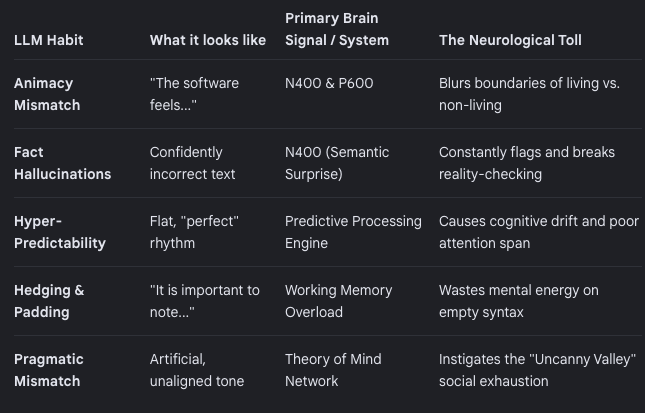
Ever wonder why reading sloppy AI-generated text feels so tiring? It might actually be draining your brain.
When AI treats inanimate things as living beings (like saying software "decides" or "feels"), it triggers an animacy mismatch. Your brain doesn't just read past it unscathed.
EEG studies show our brains instantly generate two rapid electrical spikes when we see this: the N400 (a semantic surprise signal) and the P600 (a structural repair signal).
Essentially, your brain has to work overtime to fix the machine's illogical logic.
If you feel cognitively exhausted after consuming a lot of AI content, your brain is likely burning real energy performing continuous linguistic repair work.
The question is, why do LLMs do this? Why has this not been caught? And are the models truly aligned with our best intentions?
Unfortunately, animacy mismatch is just the tip of the iceberg. It's a massive, hidden issue in the AI era: Large Language Models (LLMs) output linguistic patterns that don't exist in organic human speech, and our brains are burning real cognitive energy trying to process them.
By the way, we are witnessing the collapse of software pricing in real-time. Pulley raised $50m since 2020 and are shutting down this December.
I'm seeing other software vendors reduce pricing by up to 10x.
Pulley is shutting down and they formed an exclusive partnership to migrate customers to Carta. If you don't like that option, Eqvista is offering:
- Free white-glove migration
- First year of cap table management free
- $500 toward your first year's 409A valuation plan
- Migration in as little as 3–5 business days
- Dedicated migration specialist
- Review your migrated cap table before you commit
https://t.co/DGyJztMNci
@vineerpasam All the time. AI suggests naive implementations because it’s “easier@ even though a better solution would take 5 more minutes. Its naive suggestions are heuristic, and I prompt for the elegant solution at least daily
In manufacturing and production you kind of have to have the control over cost to stay margin positive. In business, you can extend this discipline anywhere, though. Would you say that it’s wrong? I feel it is to some degree, wrong for the soul. Not because we want discipline, but because we are beholden to a capitalist machinery.
@zachtheoldham@anamhira@connorado@chrishlad It *can* be positive sum in the sense that it opens a new market for making balance sheet proofs. Eg SSL for the balance sheet, prove financial facts without lifting the hood. Just the tip of the iceberg; loan covenant monitoring, QoE analysis, etc.
@bbondecpa@chrishlad A lot of this is valid, the way we approached it was binding proof to economic entries only, and not to judgment calls. Makes a more solid start for QoE analysis.
https://t.co/M6so4A1a0v
@chrishlad Agree, and it's why I built @TripleBooksAI. Accounting only becomes verifiable when the receipts come from outside the books. We publish ours: August close, 96% of postings bound to a bank feed or counterparty, and a certificate anyone can check.
https://t.co/SzrSXned7A
@signulll Haven’t heart anyone talk about tool search tooling, which is needed when the tool catalog system prompt is too large. Granted this is a tactic not a strategy (ergo talked about less)
When you have cash in the bank and don’t need to raise, you do a tender. It’s a signal the company’s financial position is strong, reduces outstanding shares, and helps set a market-clearing price for secondaries (if the company allows it).
Today we're announcing our second employee tender offer.
We passed $100m ARR earlier this year and now have more than 40,000 paying customers.
The tender lets our teammates participate in that success at a $2.5B valuation:
https://t.co/Ff2sDjDFq5
AI may make you more efficient, but it’s not 100% gains—there is what I call a “Slop Tax”.
The verbosity and jargon makes output harder for teammates to reason over—resulting in valuable output being glossed over because extracting it feels like finding a needle in a haystack.
@mattshumer_ How incompetent is OpenAI that they can’t prevent this from happening? Is that really who we want in charge of this technology? This is not good marketing; it makes the company look bad.