Democrats carried these 7 states that are mostly done counting.
But on the same ballots, 21 of 22 conservative measures (e.g., voter ID, tax caps, girls’ sports) ran ahead of the Republican nominee, and 16 won majorities.
Republicans lost, but conservative ideas mostly didn’t.
Voters in the 2026 midterms weren't rushing to embrace a lot of lefty, Democratic policies. They just really, really hated what Republicans have been doing. https://t.co/N5iVPbKkwO
Even as Americans voted against the Trump administration in this week’s midterms, they supported a series of ballot initiatives—including in blue and purple states—that show the resonance of a familiar conservatism.
My latest for @CityJournal.
https://t.co/uElnUe6EJj
The 2026 election was not an affirmation of nominating candidates like Abdul El-Sayed in purple areas
Quite the opposite, in fact.
https://t.co/rDLhqEnwSY
Here’s a more detailed aggregate of the top Jewish precincts from trusted source — looks like AES 52.5%-Rogers 47.5% … with significant GOP inroads from 2024 election.
Lots of conversation about how to appeal to "Hispanic" voters, but worth keeping data like this in mind.
These folks are not a monolith and bring very different historical experiences to the table.
In other words, voters are people and you have to meet them where they are.
The Hispanic vote is vastly divided by national origin. Just look at Florida’s 50%+ Hispanic precincts by largest origin:
Cuban: 🔴 Moody +7.5
South American: 🔵 Nixon +11.9
Mixed or other Hispanic: 🔵 Nixon +23.0
Puerto Rican: 🔵 Nixon +33.1
The latest example of a tweet impacting real election results:
Bo French substantially underperformed Abbott in Collin County precincts with larger South Asian populations, a pattern that stands out clearly on the county's precinct map.
California voters elected Democrat Xavier Becerra as governor, but appear poised to reject the billionaire wealth tax.
North Carolina voters sent Roy Cooper to the Senate by nearly 20 points, but approved voter ID, a limit on property-tax increases, and a cut to the top income-tax rate on the same ballot.
Then the five Sanders-backed Senate candidates underperformed.
Last night, voters punished Republicans. That doesn’t mean they endorsed the far Left.
@Jesse_Leg & @mattrshor on the midterm mandate mirage: https://t.co/O3XBJ2mENj
Voters clearly voiced their frustration with Trump last night. But that doesn’t mean they endorsed Bernie Sanders’ policy wishlist.
My piece with @Jesse_Leg in @CityJournal:
https://t.co/6VOZ15N01N
Democrats won everywhere because voters were unhappy with Trump, not because voters suddenly wanted socialism.
If Democrats mistake that victory for support for a far-left agenda, they could face the same backlash.
My take on the midterm mandate mirage, with @mattrshor in @CityJournal:
https://t.co/MYZCizUjxC
Compared to other states, California likely voters say their state has a bigger homelessness problem (81%), less business-friendly environment (56%), and more government corruption (42%).
Some of the striking findings in our recent @ManhattanInst poll: https://t.co/RfWboRykE1
Michigan’s undecided voters are looking for reassurance. They want lower prices, less political conflict, and leaders focused on everyday concerns rather than ideological battles. Read more from @Jesse_Leg, @mattrshor, and Karl Abramson on findings from new @ManhattanInst focus groups: https://t.co/hjdyv8r5uk
NEW: We asked undecided Michigan voters what they thought of Senate candidates Abdul El-Sayed and Mike Rogers. Here's what they said. 🧵
https://t.co/ZKunB6maPi
Earlier this month, I went back to my home state of Michigan and spoke with 20 undecided voters about the issues driving the midterm elections, their views on Donald Trump, and the Senate race between Mike Rogers and Abdul El-Sayed.
They’re frustrated with rising costs and the president. But for many, that frustration hasn’t translated into support for El-Sayed.
Here's what they told me... 🧵
https://t.co/w53x9qaOxH
Why hasn’t frustration with Trump settled Michigan’s Senate race? We asked 20 undecided Metro Detroit voters. Here’s what they told us:
https://t.co/hKo6o09b7k
Californians are unhappy with how their state is governed, and many support reforms that challenge progressive orthodoxy: mandatory treatment for people living on the streets, greater accountability for public-sector workers, and tougher controls on government waste. But that frustration hasn’t translated into a willingness to elect Republicans. Voters want different results while remaining resistant to candidates associated with the Right.
That disconnect protects establishment Democrats from accountability and gives the far Left an opening. When voters want change but consider Republicans unacceptable, socialist challengers can present themselves as the only alternative—even when their policies don’t match what those voters actually want. Democratic victories therefore shouldn’t automatically be interpreted as endorsements of progressive governance, nor should enthusiasm for socialist candidates be mistaken for enthusiasm for socialism.
Achieving meaningful reform would require a coalition that crosses partisan lines, likely through relatively pragmatic Democrats who can reach voters Republicans simply cannot. San Francisco’s Daniel Lurie offers one example. Conservatives have to decide whether they care more about advancing Republicans or changing how California governs, while reform-minded liberals have to decide whether they’re willing to confront the unions, activists, and politicians obstructing their stated goals.
California has no shortage of voters who understand that something is broken. What the Golden State lacks is a durable political vehicle for fixing it.
My latest in @CityJournal on some of our recent @ManhattanInst California polling statewide and in Los Angeles:
https://t.co/csYmiDOOAH
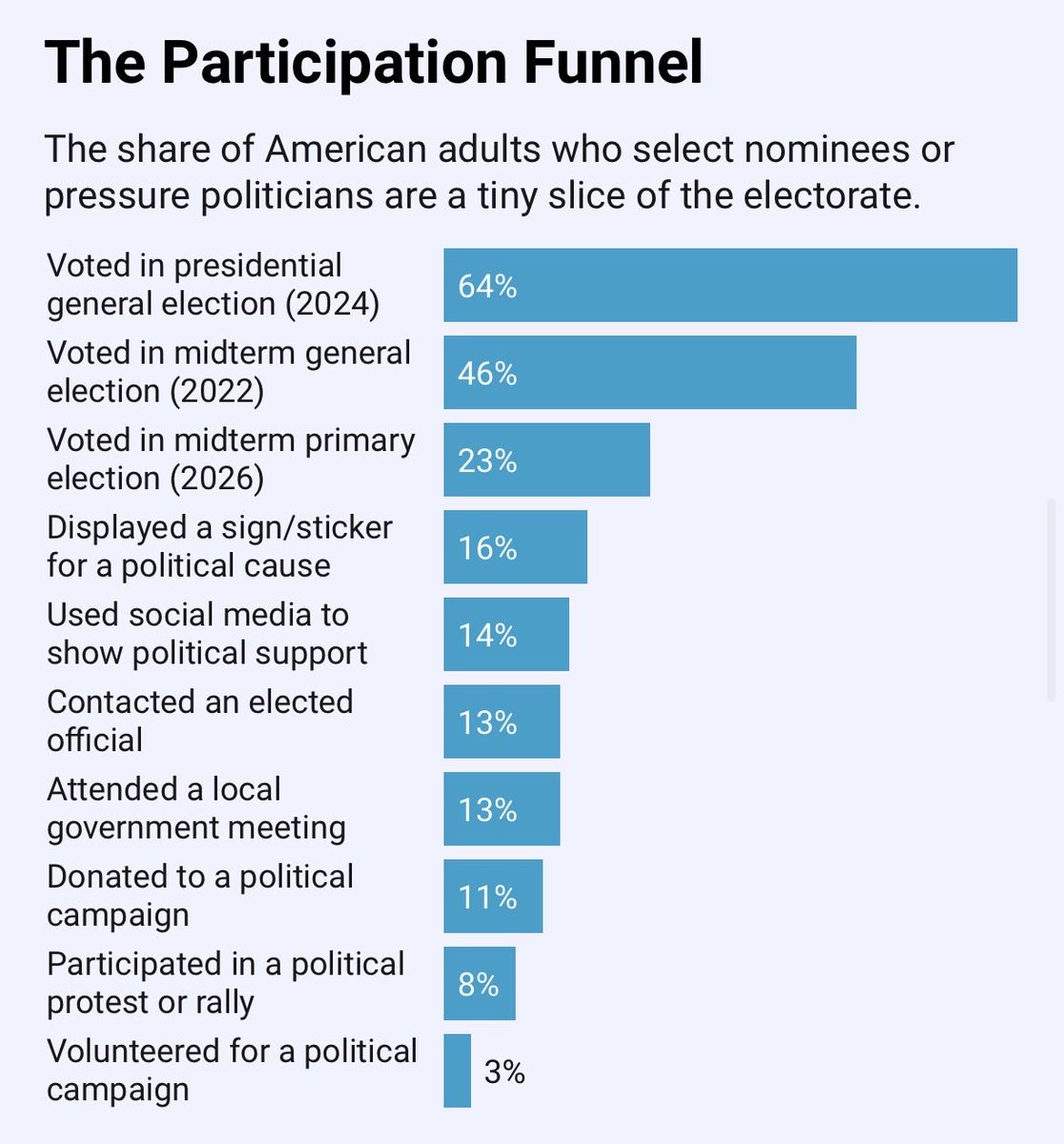
Americans often express a mix of conservative and liberal views, so why do we keep getting two sharply sorted parties?
Because the people who actually pick nominees and engage the most with politics are a tiny, highly engaged, highly consistent segment of the population: