I’d love to meet more fractional CTOs on here. If that’s you, say hi and tell me what you’re working on. And if you ever want to exchange notes over Zoom, feel free to schedule a call.
Anyone here done technical diligence for a PE deal and then stayed on with the PortCo? I’m curious how you scoped the work once you had to put a timeline and budget behind the findings.
If the founder’s real question is whether to rewrite the app, I’d start with an assessment. Once we know what’s making changes slow and what a rewrite would cost, it’s easier to tell if there’s a CTO job there.
Don’t just jump in with a sale. Help them find direction first.
I list my fractional CTO retainer at $10k/month. Other fractionals, what are y’all seeing for a monthly retainer these days? I’m curious what’s included at that rate and what you’d scope separately.
The few software consultancies I talked with are all pivoting (or have pivoted) to building as AI-native + helping companies become AI-native.
Reminds me in the 2000s when top software consultancies did TDD + taught their customers TDD
@AaronDelz Nice, yea I’ve been running some more complex workflows and just watched things go off the rails enough that I’m putting in more of the code enforcements you’re talking about. There’s plenty in these workflows that can actually be deterministic.
For the fractional CTOs doing technical diligence for VC or PE, how did the first engagement come your way? Was it through a founder, a deal team, or an operating partner you already knew?
In technical diligence, “the codebase has debt” tells a buyer very little. If one engineer is the only person who can deploy the product, that’s something the buyer can plan for before close. It changes who they need to retain and what they fund first.
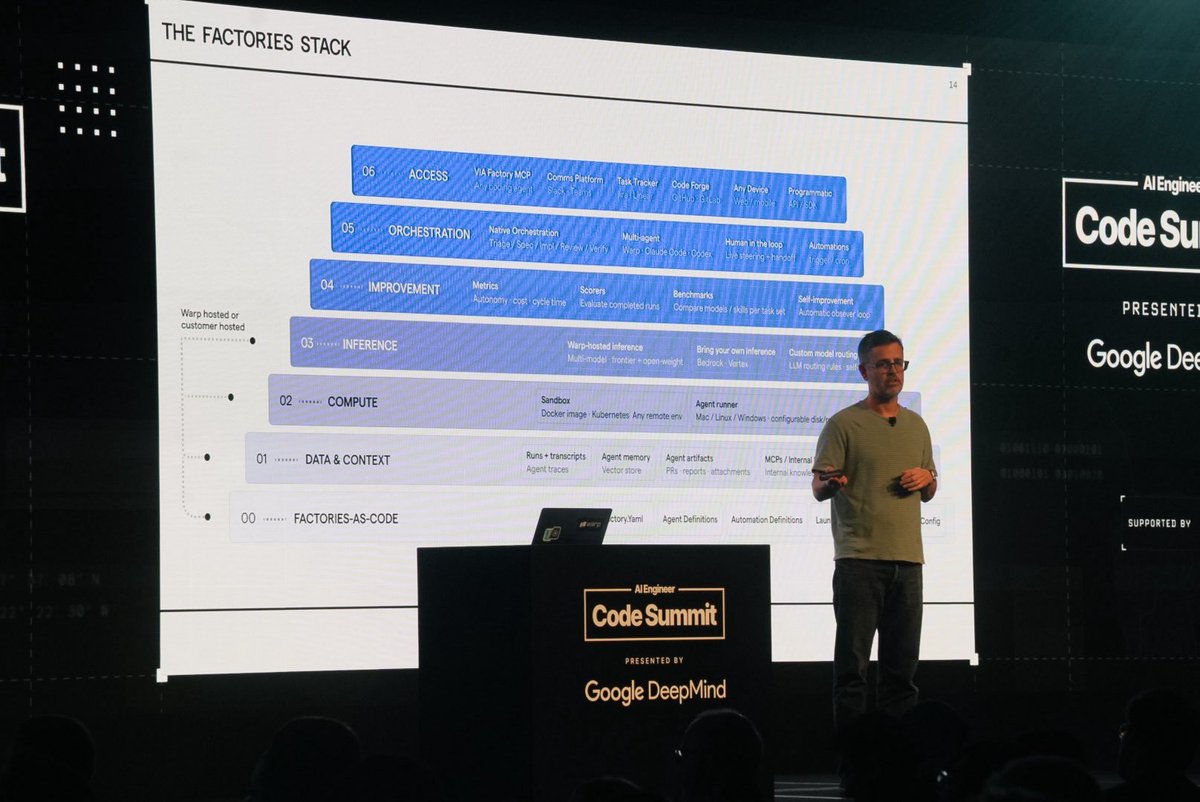
Speaking at @aiDotEngineer Code Summit SF, the "software factory stack" seemed to resonate. Here's a breakdown of the components:
00 – Factories-as-code. Every aspect of the factory (agent workflows, access permissions, cloud sandbox configuration, and so on) should be version-controlled code that humans and agents can modify.
01 – Data & Context. You should own all of the data your agent interacts with on your own infrastructure. Your internal skills and MCPs, agent traces, access logs, telemetry... everything.
02 – Compute. Agents should have their own computer, with controlled sandbox permissions and support for multiple operating systems. This should be self-hostable.
03 – Inference. You should have access to any model and any harness to benchmark the right match for your setup. Don't lock in to any one model provider.
04 – Improvement. You (and agents) need tools to measure and improve your factory. This means observability over cost-per-PR, cycle times, latency, and other DORA metrics. It also means self-improvement, with agents scoring output quality, proposing changes to the factory, and re-measuring in a loop.
05 – Orchestration. You need a runtime to launch agents, track work, and recover from failures. It should also handle message passing between agents in a multi-agent system.
06 – Access. You should be able to connect the factory to any external system. You'll want an MCP server and REST API to access the factory itself, and integrations with where your team works (Slack, MS Teams, Jira, Linear, etc). We don't recommend an "ADE" or web interface that's tightly coupled to the factory.
@BradleyrJacobs Agreed. I had my first client prior to leaving but then I had a 45-day gap before my next client and it was a lower cost engagement. So I agree with more effort up front here to build a client funnel.
For those who went from a full-time engineering leadership role to fractional work, did you line up a client before leaving or give yourself a few months to find one? I’m curious how people handled that gap.