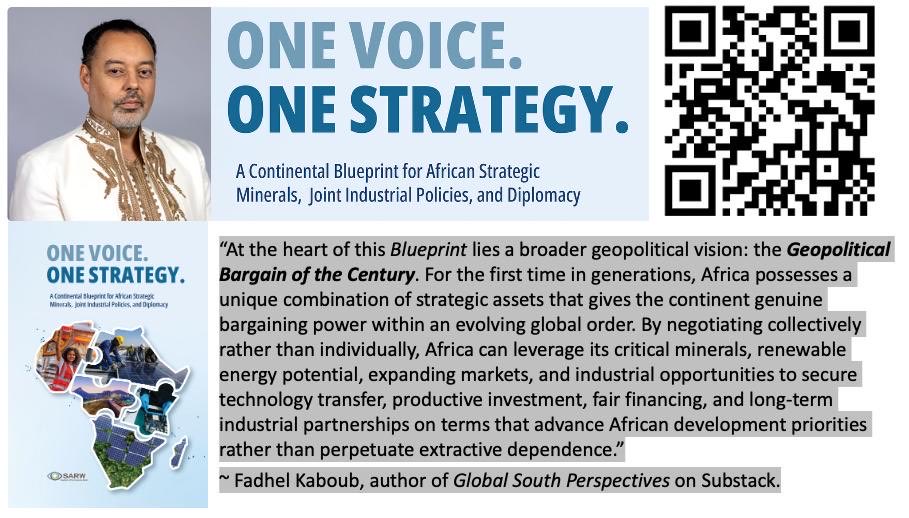
@FadhelKaboub’s latest publication: “One Voice. One Strategy. A Continental Blueprint for African Strategic Minerals, Joint Industrial Policies, and Diplomacy.” https://t.co/1cCp9ZODBt
https://t.co/0gM1tA2Vja My interview with Pulse of Africa on the sidelines of the Tana Forum in Bahir Dar, Ethiopia. We discussed debt, energy, food, development, Pan-African industrial strategies, and what I call the Geopolitical Bargain of the Century. @poaenglish
"Sectoral balances don’t establish causality on their own, but they impose accounting constraints that any causal interpretation of macro dynamics must respect." 💯%
"In high-reliability engineering, absorbing the cost and complexity of backward compatibility is considered non-negotiable precisely so you never have to bet the entire network on a single simultaneous switch."
.@liamcunningham1 endorses the BDS@20 Europe Conference.
Between 18–20 November in Barcelona, the BDS@20 Europe Regional Conference will feature some of the most influential figures advocating across Europe and beyond in the struggle for Palestinian liberation today.
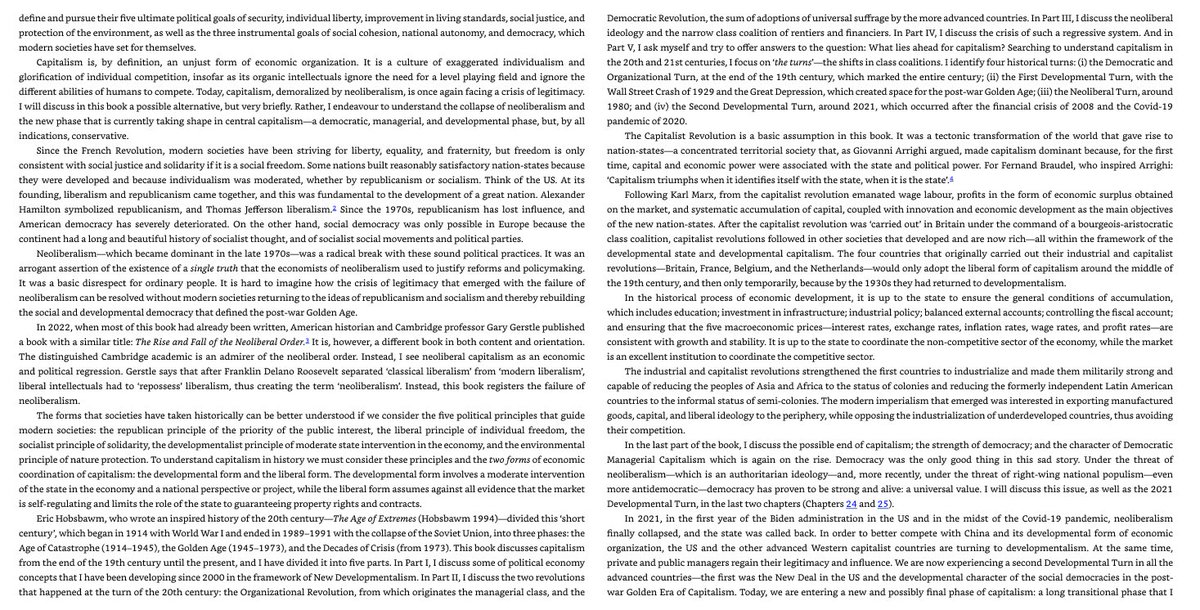
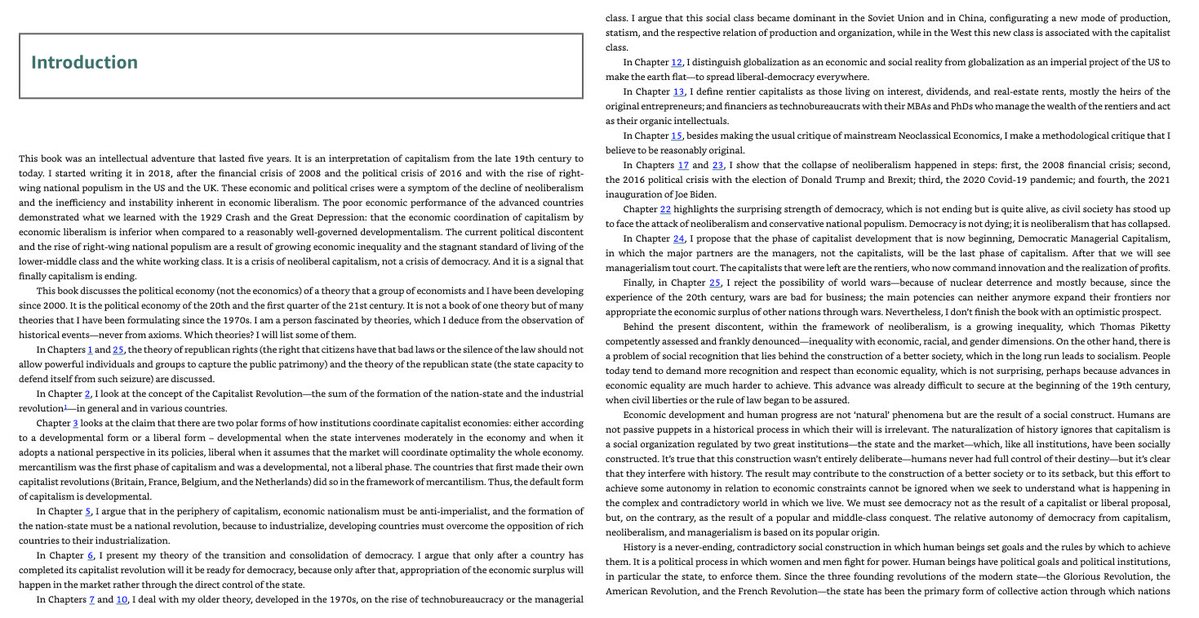
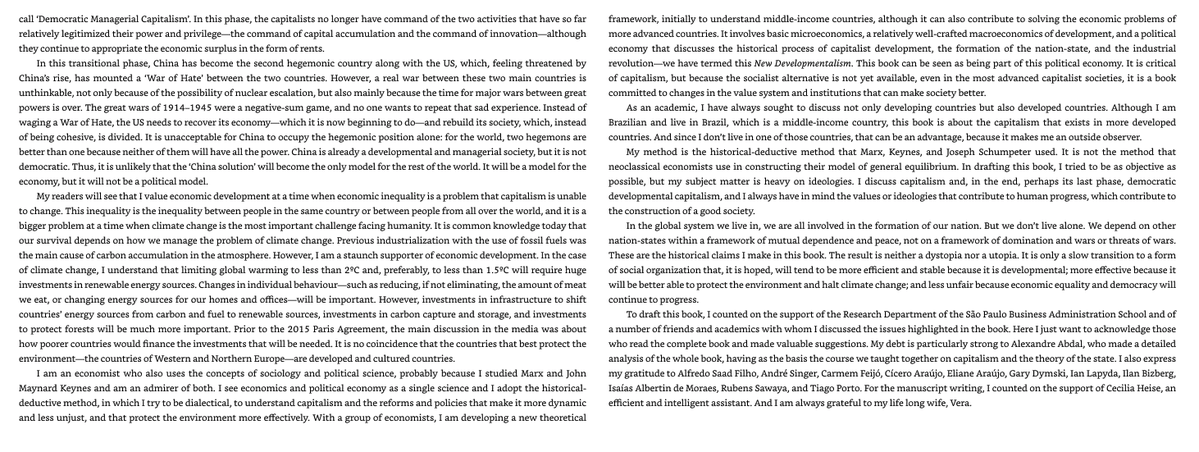
I just picked up Brazilian economist Luiz Carlos Bresser-Pereira's 2024 "Rise and Fall of Neoliberal Rentier Capitalism". Its intro doesn't have an ounce of fat on it and spells out his theory of political economy and its view of history.
"The current political discontent and the rise of right-wing national populism are a result of growing economic inequality and the stagnant standard of living of the lower-middle class and the white working class. It is a crisis of neoliberal capitalism, not a crisis of democracy. And it is a signal that finally capitalism is ending."
"There are two polar forms of how institutions coordinate capitalist economies: either according to a developmental form or a liberal form - developmental when the state intervenes moderately int eh economy and when it adopts a national perspective in its policies, liberal when it assumes that the market will coordinate optimality the whole economy. Mercantilism was the first phase of capitalism and was a developmental, not a liberal phase. The countries that first made their own capitalist revolutions...did so in the framework of mercantilism. Thus, the default form of capitalism is developmental."
"In the periphery of capitalism, economic nationalism must be anti-imperialist, and the formation of the nation-state must be a national revolution, because to industrialize, developing countries must overcome the opposition of rich countries to their industrialization."
"I define rentier capitalists as those living on interest, dividends, and real-estate rents, mostly the heirs of the original entrepreneurs; and financiers as technobureaucrats with their MBAs and PhDs who manage the wealth of the rentiers and act as their organic intellectuals."
"I propose that the phase of capitalist development that is now beginning, Democratic Managerial Capitalism, in which the major partners are the managers, not the capitalists, will be the last phase of capitalism. After that we will see managerialism tout court. The capitalists that were left are the rentiers, who now command innovation and the realization of profits."
"I see neoliberalism as an economic and political regression."
"The modern imperialism that emerged was interested in exporting manufactured goods, capital, and liberal ideology to the periphery, while opposing the industrialization of underdeveloped countries, thus avoiding their competition."
"In order to better compete with China and its developmental form of economic organization, the US and the other advanced Western capitalist countries are turning to developmentalism...We are now experiencing a second Developmental Turn in all the advanced countries - the first was the New Deal in the US and the developmental character of the social democracies in the post-war Golden Era of Capitalism."
"Today, we are entering a new and possibly final phase of capitalism: a long transitional phase that I call 'Democratic Managerial Capitalism'. In this phase, the capitalists no longer have command of the two activities that have so far relatively legitimized their power and privilege - the command of capital accumulation and the command of innovation - although they continue to appropriate the economic surplus in the form of rents."
NEW EP!! 🏦
The Loop is political education as much as fiscal design. @videotroph and Tyler Suksawat join @sdgrumbine to talk public banking, monetary silencing, and how to puncture the ideological chokehold on what a city can afford.
https://t.co/dCIBKUpO6M
@foscaecon If we accept these are identities, which I do, then the questions concern causality. If causality runs from right to left, then aggregate private domestic investment and the government budget deficit determine aggregate profits. Ceteris paribus.
A Dutch Marxist has created an index of over 6000 articles from the Chinese Academy of Social Sciences and summarized and categorized them. Find them here at https://t.co/khCFmwiyrv
@GrkStav@TherynDArnold I was taking a look at Marx's Economic Manuscript of 1864–1865 edited by Fred Moseley (and supposedly Volume 3 as Marx envisioned it?) The parts I found incredible were passages about accidents and deaths in factories, how firms refused to use safety measures due to their costs.
@foscaecon Minsky called his approach Financial Keynesian, which is not on the list. And speaking of varieties, Minsky liked to say there are as many varieties of capitalism as Heinz has pickles.
@foscaecon These are reasons the Pasinetti model is so attractive, in my view, it includes effective demand and technical change, has a heterodox value basis. Likewise the Adolph Lowe model. They are both investigating issues of structural change. The traverse from1 growth path to another.
@dudeyobq@foscaecon@grok An interesting take could be: both Post Keynesians and Institutionalists have a solid theory of pricing (how firms set prices) but not a theory of value (which might be Marxian or Sraffian). Pricing can be mark-up or cost-plus prices, but costs are prices so that is not enough.