Thread
The CBO is at it again with its new Primer on the Federal Debt https://t.co/sxCKCDWUWX
Below is a thread but for a fully developed counter argument see this: https://t.co/xnq6op9A2V
A podcast to accompany the working paper on Global Imbalances Reconsidered.
https://t.co/PJwtH45pwX
https://t.co/nNLLSpcIz8
Global imbalances reconsidered - we upacked the root causes of the imbalances, the risks and the remedies. Comments are welcomed!
A pleasure to appear on @FT's "The Story of #Money" Podcast, with Gillian Tett and Robin Wigglesworth. We exchanged on @Fpigeaud and I’s book “Africa’s Last Colonial Currency: The #CFA franc story”. Below the link to the episode "Colonialism by Currency"
https://t.co/CdIfCdjnJ3
Whatever the #Election2026 results, this by @IsabellaMWeber will be just as important tmr. One theme close to my heart is that unemployment, precarious work, econ insecurity make fascism possible. Ending them + putting essentials under public control is step#1 to reversing course
Just for the record, I did not call anyone "stupid" (even though such name calling might have happened on econtwitter before).
This is a terrific review of Anti-fascist Economics! Thanks so much @AaronRegunberg
Die gegenwärtige Krise der Bezahlbarkeit erleben wir nicht nur aufgrund von Knappheit, sondern auch weil der Staat seine Verantwortung für ein bezahlbares Leben aufgegeben hat.
Im Interview mit dem @derStandardat habe ich erklärt, was das mit Neoliberalismus und dem Aufstieg rechtsextremer Kräfte zu tun hat.
Shedding a new light on the global imbalances: saving-investment imbalances due to distorted policies are only symptoms of the defected international monetary and financial system.
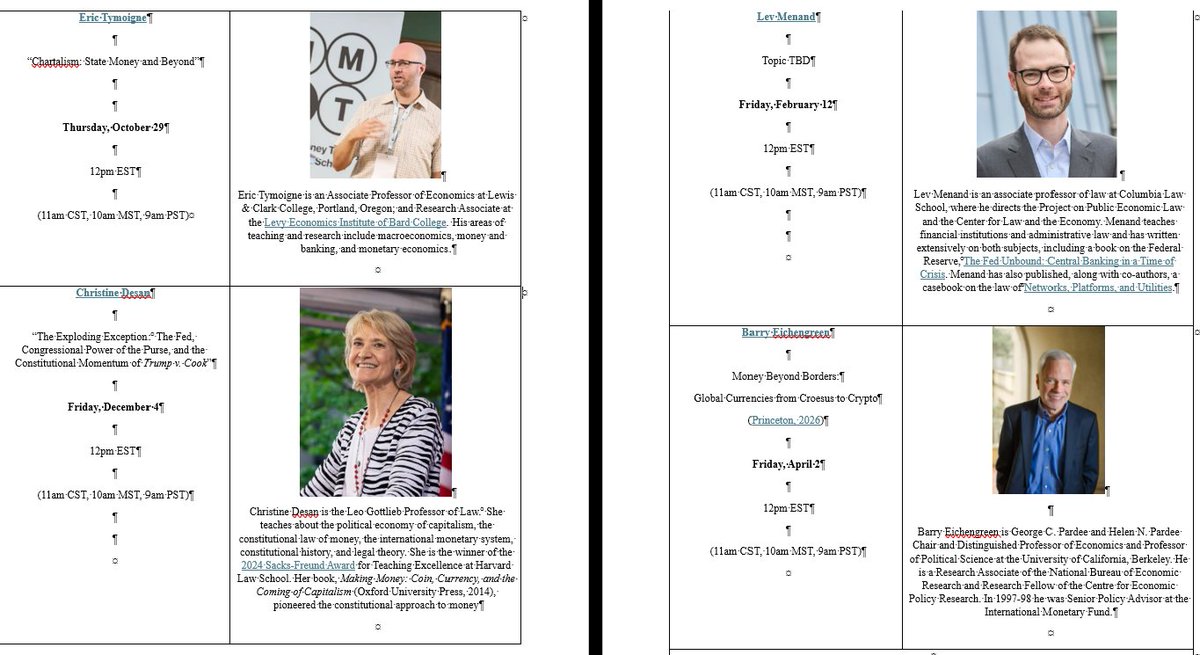
Levy @LevyEcon Fall Speaker Series - Éric Tymoigne (@tymoignee)
Private debt and equity markets have been a funding source for nascent and credit-constrained businesses for several decades.
https://t.co/xfIDjmaPKL via @YouTube
My presentation "Chartalism and Money Theory: State and Beyond." Main point: Charta means token not state + old historical roots + has methodological and practical implications for the analysis and set up of monetary systems.
https://t.co/6FiLekki6k
A lot of ink has been spilled on GPU financing lately. I spent over a decade trading ABS on Wall St, and structured over $2B+ of debt financings as an operator (including at @tryramp). Figured I'd try to make sense of this market, so I went back to a framework I knew well: aircraft ABS and aircraft engine ABS.
My take: a GPU neocloud runs on airline economics, and the debt behind it looks a lot like aircraft engine ABS.
The parallels:
• Perishable inventory. An empty seat after the door closes is gone forever. So is an idle hour on an energized H100 rack.
• 85%+ of cost is fixed (servers, 10-year rack leases, 10-14% debt service). One more hour of compute costs pennies of power.
• Utilization is everything. Airlines break even around 80% load factor, a levered GPU cluster around 65-75%. The returns live in those last 25 percentage points.
• NVIDIA is Boeing and Airbus rolled into one. Powered shells and grid interconnects are the new airport slots.
• Wall St copied the aircraft financing playbook: take-or-pay contract plus servers in a bankruptcy-remote SPV, 70-80% LTV.
Part 1 of my blog post goes into a lot more detail:
https://t.co/0fghWVnGOU
@GeorgeSelgin Given that L can move differently depending on the relative strength of the income and substitution effects, the impact on the wage bill is indeed uncertain. Analytically there are three possibilities (less, same, more). Empirics needed here => wage-led profit led lit.
No. Keynes noted that downward wage rigidity was not the problem of unemployment. Income effect:lower wage lowers consumption and so profit. MPL is not the marginal revenue, marginal sale is and that falls with lower w. In a wage-led economy Un may rise with lower wages.
I agree. But Keynes’ GT is intellectually incoherent when viewed through the lens of General Equilibrium theory … it has no intelligible answer to the question: When faced with persistent unemployment why don’t firms offer lower wages and why don’t unemployed workers accept those offers?
When the N. American Keynesians ... based in Cambridge Massachusetts … accepted Friedman’s argument that high unemployment is caused by a temporary deviation of wages and prices from their equilibrium levels … they gave up the Keynesian Baby with the Monetarist Bathwater.
The Cambridge England Keynesians resisted but they did not have a coherent explanation for the persistence of long-term unemployment as an equilibrium phenomenon that could answer the questions of the General Equilibrium theorists.
My entire body of work has been devoted to providing an answer to the question: How can high unemployment persist? that reconciles General Equilibrium Theory with the Keynesian proposition that Walrasian Equilibrium is one of many potential resting points of a dynamical system. The answer is what I call Keynesian Search Theory. https://t.co/bJH8cWMjO0
On Oct 29th at 9am PST/12pm EST I will present online my recent regarding monetary theory and history of thought. The event is hosted by Money Working Group of the Philosophy, Politics, and Economics Society. Zoom link is: https://t.co/1owwkqqpsV
@GeorgeSelgin we are talking wage rate here. Point is that w impacts both MC and MR at the AGG LEVEL with effect on agg emp uncertain (depends on relative strength of effects). This does not apply at the firm level where MR does not depend on w paid by firm. Keynes explained this through Z,D.
On Oct 29th at 9am PST/12pm EST I will present online my recent regarding monetary theory and history of thought. The event is hosted by Money Working Group of the Philosophy, Politics, and Economics Society. Zoom link is: https://t.co/1owwkqqpsV
On Oct 29th at 9am PST/12pm EST I will present online my recent regarding monetary theory and history of thought. The event is hosted by Money Working Group of the Philosophy, Politics, and Economics Society. Zoom link is: https://t.co/1owwkqqpsV
On Oct 29th at 9am PST/12pm EST I will present online my recent regarding monetary theory and history of thought. The event is hosted by Money Working Group of the Philosophy, Politics, and Economics Society. Zoom link is: https://t.co/1owwkqqpsV
NAIC has given up on strengthening the reliability of credit ratings under the push back the industry (and SEC push for retailization) 1
https://t.co/wRMveNPUSz
The Office of Credit Ratings of the SEC (2025, 7) also notes that “the statutory limitation on the SEC’s authority to regulate the substance of credit ratings […] may result in ‘blind reliance’ on credit ratings without any process to assess whether such ratings are reasonable.”