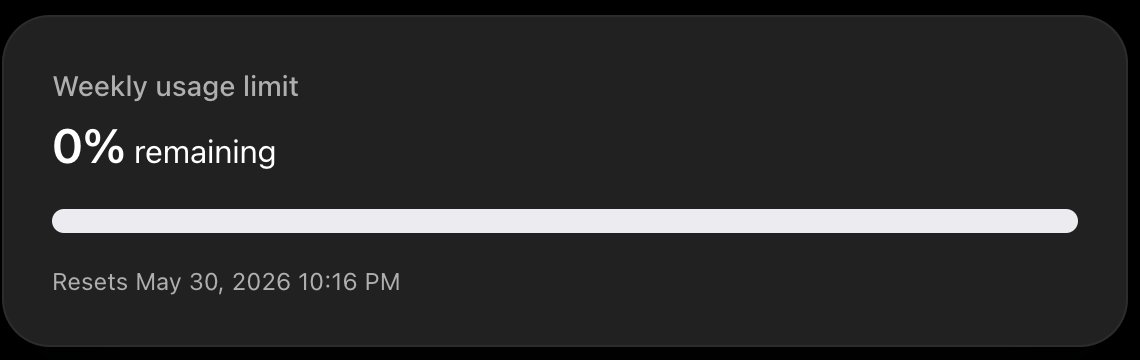
@Chobot Nemá to nejaké limity? Mne Codex podla plánu dokáže makať bez zastavenie kľudne i hodinu (spúšťa testy, buildy, managuje docker,... v rámci jedného behu).
@kr0der After each run, two subagents are automatically launched for code review. While 5.3-Codex performs better in certain areas, neither is better at everything they complement each other well.
@TVranka Mám elektrický gril. Skôr mám problém kde kúpiť zrelé mäso. V lidl je napr 21 dní, a to mi príde ako shit, ale obcas majú aj 29 dní a to už stojí za to.
@Dimillian The main thing I’m missing in the Codex App is visibility into when agents are spawned and whether the app is waiting on them. Without that, I can’t effectively optimize prompts for the orchestrator, so unfortunately I’m going back to the CLI.
@noobvestorCZ Model si v chatu naplnil kontextovú pamäť a model už v nej nemá pôvodný zdroj a tak začal halucinovať. Riešenie, začať nový chat, zdroj nahrať znova ale ideálne len od tej časti, kde chcete začať pokračovať. Alebo v aktuálnom chate nahrať zdroj znova.
@VxalCZ Nechápe, že si naplnil kontextovú pamäť a model už v nej nemá pôvodný zdroj a tak začal halucinovať. Riešenie, začať nový chat, zdroj nahrať znova ale ideálne len od tej časti, kde chce začať pokračovať. Alebo v aktuálnom chate nahrať zdroj znova.
NEW: Dutch Parliament Member Michel Hoogeveen explains how the 36% unrealized capital gains tax, just passed by the House of Representatives, will work.
Here is a more detailed example:
Step 1. Starting position
You own 500 shares.
Value on Jan 1, 2028: €50,000
Value on Jan 1, 2029: €100,000
So the paper gain is:
€100,000 − €50,000 = €50,000 unrealized profit
You did not sell. But for tax purposes, that €50,000 is treated as income.
Step 2. Apply exemption
You are married, so you get a €3,600 exemption.
€50,000 − €3,600 = €46,400 taxable amount
Tax rate: 36%
€46,400 × 36% = €16,704 tax bill
That bill is due in May, even though you never sold anything.
Step 3. Market falls before you pay
Now suppose by May the shares drop in value.
New total value: €60,000
So your portfolio is no longer worth €100,000. It’s worth €60,000.
But the tax bill is still €16,704, because it was calculated based on the January 1 valuation.
Step 4. You must sell shares to pay tax
To raise €16,704, you sell part of your shares.
After paying the tax, you’re left with:
€60,000 − €16,704 = €43,296
Originally you had 500 shares.
Now you have 360 shares left.
You were forced to sell 140 shares.
140 ÷ 500 = 28% of your shares gone.
Step 5. What happened economically?
Before the correction:
Paper gain was €50,000.
After the correction:
Portfolio is worth €60,000.
Original cost basis was €50,000.
Real gain is only €10,000.
But you paid €16,704 in tax.
So instead of being up €10,000, you are now:
€43,296 − €50,000 = €6,704 below your original starting value.
You turned a €10,000 real gain into a €6,704 net loss.
And you lost 28% of your shares permanently.