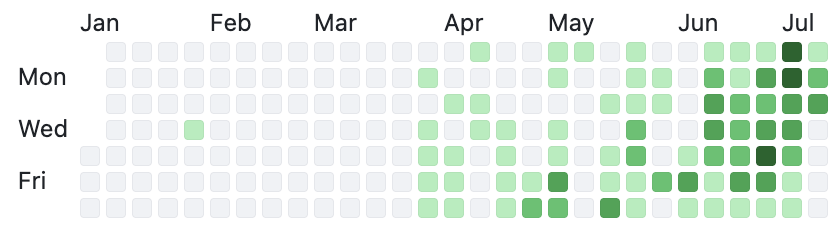
lot of my business decisions come from intuition. i feel something should go a certain way, and only afterwards do the rational arguments catch up. the more i trust my gut, the better things tend to work out. that’s of course true in other parts of life too. somehow, it might still come as surprising in business.
something is cooking!
just spent the last 3 hours using Claude Design for the first time.
i’ve never done much design work beyond building BI tools or telling someone how i wanted something to look. my standards are pretty high, so getting a design exactly where i want it has always been a painful process.
this feels like freedom.
i can describe what i want in great detail, have Claude render multiple options, pick the best one, and keep refining it until it’s just right.
i was surprised by how fast it is and how well it responds to my ideas. it didn't just execute. it pushed my designs further.
there are still a few rough edges. alignment and spacing sometimes take multiple attempts, and a couple of times Claude thought an update was done even though the design hadn’t rendered.
overall, really impressive work @claudeai !
Can we get Anthropic models in the Codex app?
I started playing around with this little buddy again, and I have to say.. the app is great.
Better than the terminal. I can SSH into my VPS and easily keep track of multiple agents running across different projects.
The only downside? I feel like I’m betraying Claude..
What I learned betting on geopolitics on Polymarket
Geopolitical markets were among the first I explored.
Betting on them manually was a great exercise in estimating the probability of an event. And putting money behind that estimate. I had both hits and misses around the US–Iran conflict.
The biggest risk is obvious: you never have the full picture or know what is happening behind the scenes.
One pattern that seemed repeatable was betting against sharp moves driven by trending news. Prices spike, but often “nothing ever really happens,” and they eventually revert.
Skilled human forecasters have beaten markets over time, so an LLM-consensus strategy seemed worth exploring. I kept it in the backlog because these events are often unique, historical base rates are weak, small details in the resolution criteria matter, and fresh news can change the probabilities abruptly.
I started building with Claude Code in April ’26. The first playground I chose were prediction markets.
Why? Fast feedback loops, pure problem-solving, the challenge of estimating event probabilities, and a long-standing fascination with algorithmic trading.
Along the way, I explored several market types and strategies: geopolitics, crypto, weather, tweet counts, smart-money signals, LLM consensus, and arbitrage.
I learned a lot about AI-powered coding, probability, and weather forecasting.
Since then, I’ve moved on to building other things too. But somehow, I never shared what I learned from the journey.
Time to fix that. More in the next posts.
@signulll agree.
often think about thiel’s thesis that monopolies can drive more innovation than competition.
not convinced either a cartel or a monopoly would do much good for ai development.
ai may help us solve many problems. but technology alone rarely makes us more human. social media promised connection and often left us more isolated, distracted, and unhappy. no model can replace being outside with people you love, sharing a meal, moving, building, or simply being present. ai can create more space for humanity. but we still have to choose what to do with that space.
@theo the only thing that pulls me back to the local macbook now is training a ml model. everything else runs on an 8gb vps.
used to be the exact opposite. rent the servers for training, build at home.