Most indians think investing abroad means investing in U.S. stocks and ETFs.
That doesn't really diversify geographic risk, and it isn't prudent.
Here are some ETFs that will give you exposure to global geographies and businesses outside the U.S🧵
Some banks in Middle East are offering 6% in USD terms on FDs.
1) You deposit 100 units money at 6%.
2) Write 1 year puts, get another 6-7%.
3) All tax free. In USD/AED terms.
Any rich person/FIIs will be playing this game.
Risk? well, you get assigned your puts on high quality tech firms. That too at least 10-15% cheaper.
Unless Indian equities can offer at least 15% in INR terms, there is no reason for FIIs to invest.
This is just math. Whenever the return potential for Indian equities expand, FII money will return.
Till then, we are likely to undergo valuation correction.
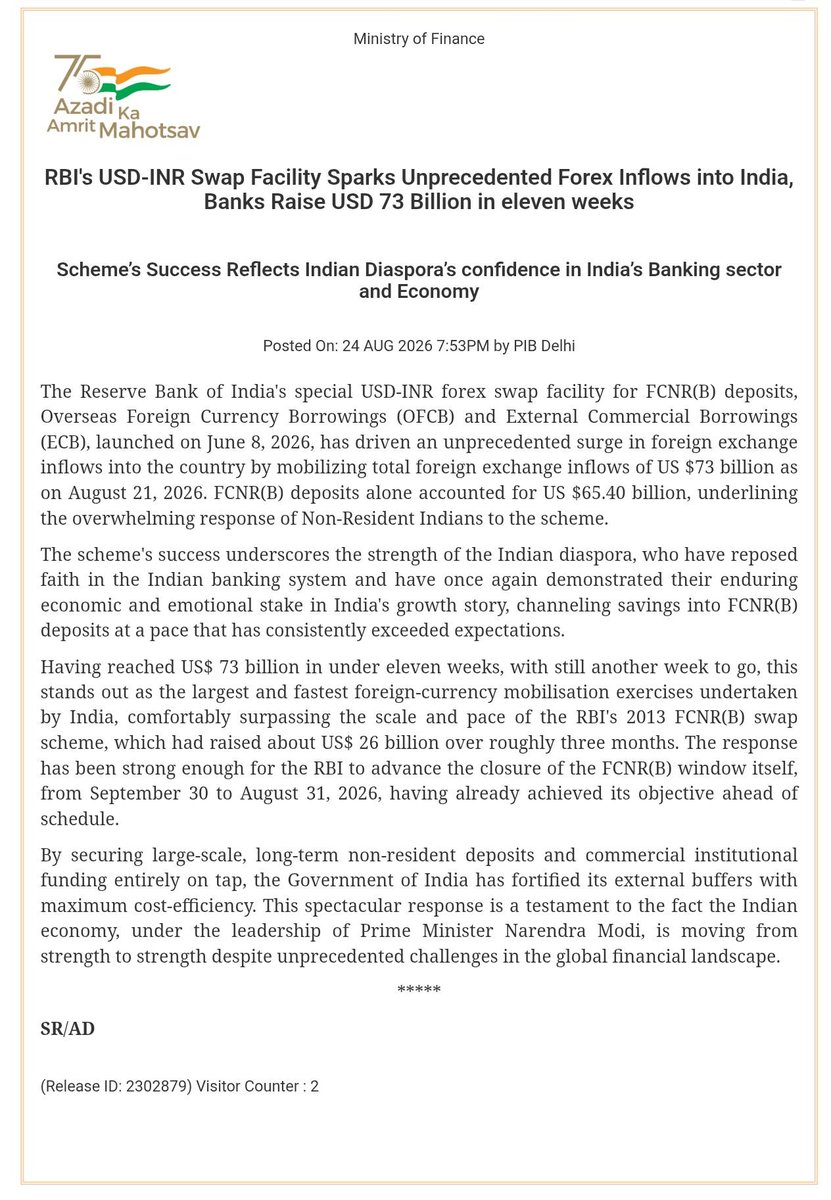
After reading thru FCNR things - my view is now changing - RBI has played a smart punch this time ( its not gonna be sgb like shock)
Rbi received $ from Indian banks who received it in FCnR. RBI will pay the same dollar back to indian banks at the same rate at which banks parked
Most Indians own zero global equity.
Not because they don't want it — because researching foreign companies from India requires bandwidth and access to information.
Global ETFs solve that.
The best way to get access to global equities while doing minimal research is investing in Broad Market ETFs.
Here is the breakdown of the Top Broad Market ETFs to initiate exposure to the global markets 🧵
One of the most basic steps in personal finance is making sure you and your family have adequate health insurance. This is especially important for parents, many of whom bought policies years ago and have kept renewing them even as hospital costs have gone up significantly.
@joinditto has put together a simple checklist to help you review your parents’ health insurance and figure out whether the cover they have today is actually adequate. It covers the key things to look for in a policy, the clauses that can hurt during a claim, and when it may make sense to upgrade or switch.
The Income Tax Department has launched a nationwide verification exercise into suspicious foreign remittances. The exercise follows data analysis and ground intelligence indicating significant overseas remittances by entities with little or no reported business activity.
The Department has emphasised the importance of exercising due diligence and sound judgment by professionals while issuing cerfiticates in Form 15CB/Form 146.
Details in the Press Release:
If you are rich, you're wasting your money investing in PMS in India.
I work with several investors each year: they all get surprised when I tell them you can simply-
1) Buy QQQ
2) Expose 30% of your portfolio to writing covered calls/puts
3) Save this 30% on T-bills.
4) In case you are writing a secured put. And, if the option gets triggered, move money from T-bills to stock.
5) Play the cycle again.
You will outperform 95%+ PMS in India by 2x.
Not because you are some genius: but because PMSs in India have a very limited scope of operation. They face restrictions on:-
- What they can buy
- Exposure to options
- Exposure to leverage
On top of all this, crazy high fees.
No PMS guy, can compete with a nimble system that is structurally 10X better.
If you are rich, spend some time learning money management. It might be the biggest alpha you're missing.
The biggest financial cope of the Indian upper middle class is pretending ₹40 LPA equals $190,000 in the US because of purchasing power parity.
PPP is a metric for groceries, not wealth.
Easiest way to understand this: Gold was about ₹28,623 per 10g in India in 2016. Today it is around ₹1.43 lakh means 400% return. Gold rose from about $1,250 to $4,100 means a roughly 228% return.
Did the Indian investor become a better gold investor? No. The rupee bled from around ₹66 to over ₹95 against the dollar. You celebrate currency depreciation as wealth creation.
If both save 20% of income:
• You save ₹8 lakhs.
• The US guy saves $38,000 (₹36 lakhs).
In a decade his globally portable asset base is 4.5x larger. Currency value is absolute, not relative. Markets ignore local PPP when you buy global assets, travel abroad or send a child to an international university.
Keep bragging about cheap full-time maids and drivers. That cheap domestic labor is just a comfortable distraction. It gives you a false sense of pride while your actual wealth gets locked into hyper inflated ₹3 Crore matchbox flats, endless 20 year EMIs and overpriced gated communities that trap you in speculative local bubbles.
This is not high quality of life. Keep enjoying cheap food delivery while your global net worth is left behind.
"I'm a US NRI. I know for certain I'm moving back to India in 10 years, and I'm holding my Indian mutual funds the entire time without touching them. Does the PFIC rule still apply?"
"Even if you don't sell, you're still required to report these holdings every year you're a US tax resident. There's a specific form for it, 8621, and it has to be filed properly each year. The compliance burden doesn't disappear just because you didn't sell."
"But here's the actual relief. If you genuinely hold without liquidating while you're a US resident, and only sell it after you've moved back to India, you save yourself the tax. The reporting stays, the tax doesn't hit."
CA Naman Gangwal on Should NRIs Invest in Mutual Fund
Watch Full Podcast : https://t.co/lyF3QJ8mxL
If you're an NRI trying to map out exactly when and how to time your India investments around this, Book a Call here : https://t.co/Vah5j3yIit