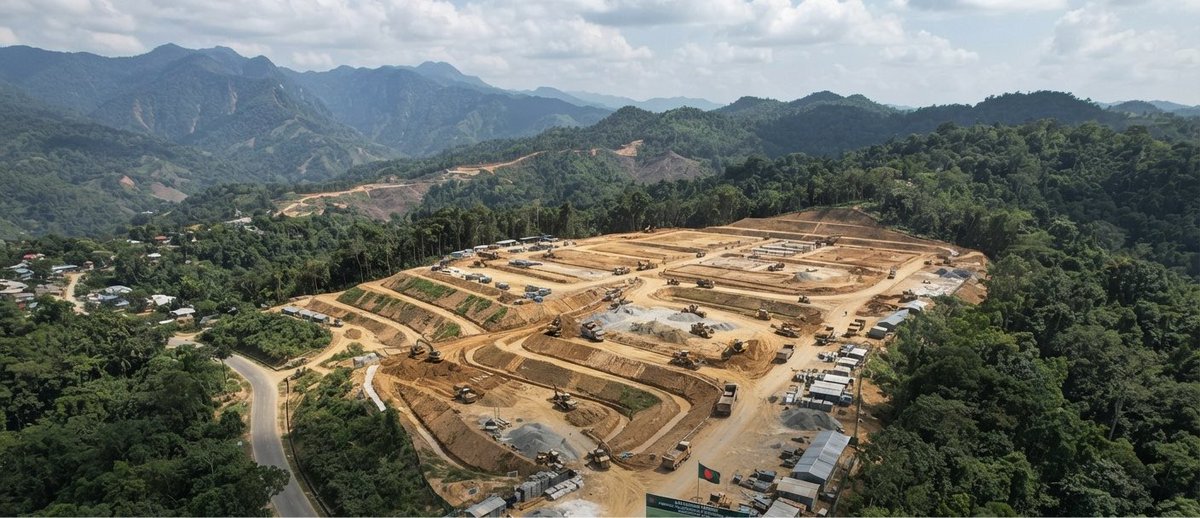
🚨 Reports are emerging that the Bangladesh Army is laying the groundwork for a new cantonment in Naikhongchhari, near the Bangladesh–Myanmar border. According to Northeast News, the reported site would be close to Ramu, HQ of the Army’s 10th Infantry Division.
Naikhongchhari hosts a substantial presence of well-armed Rohingya fighters. The area lies near Keokradong, the last village in Bandarban close to the Bangladesh-Myanmar-India trijunction. Parallel ground-clearance and soil-levelling work has also commenced at Silkhali, approximately 30 km north of Teknaf. This site had earlier been identified for a supply base, with Army Chief General Waker-uz-Zaman having personally surveyed the location in February 2025.
This move could carry significant strategic implications:
• 🇧🇩 Stronger border security along a sensitive frontier.
• 🌏 Faster military response to cross-border instability.
• 🛡️ Enhanced monitoring of security challenges in the region.
• 🤝 Potential impact on regional security dynamics involving Bangladesh, Myanmar, and nearby border areas.
No official confirmation from the Bangladesh Army has publicly detailed such a project at the time of writing.
If confirmed, this would be one of the most closely watched security developments in the region.
#Bangladesh #BangladeshArmy #Naikhongchhari #Myanmar #BorderSecurity #SouthAsia #Geopolitics #Security
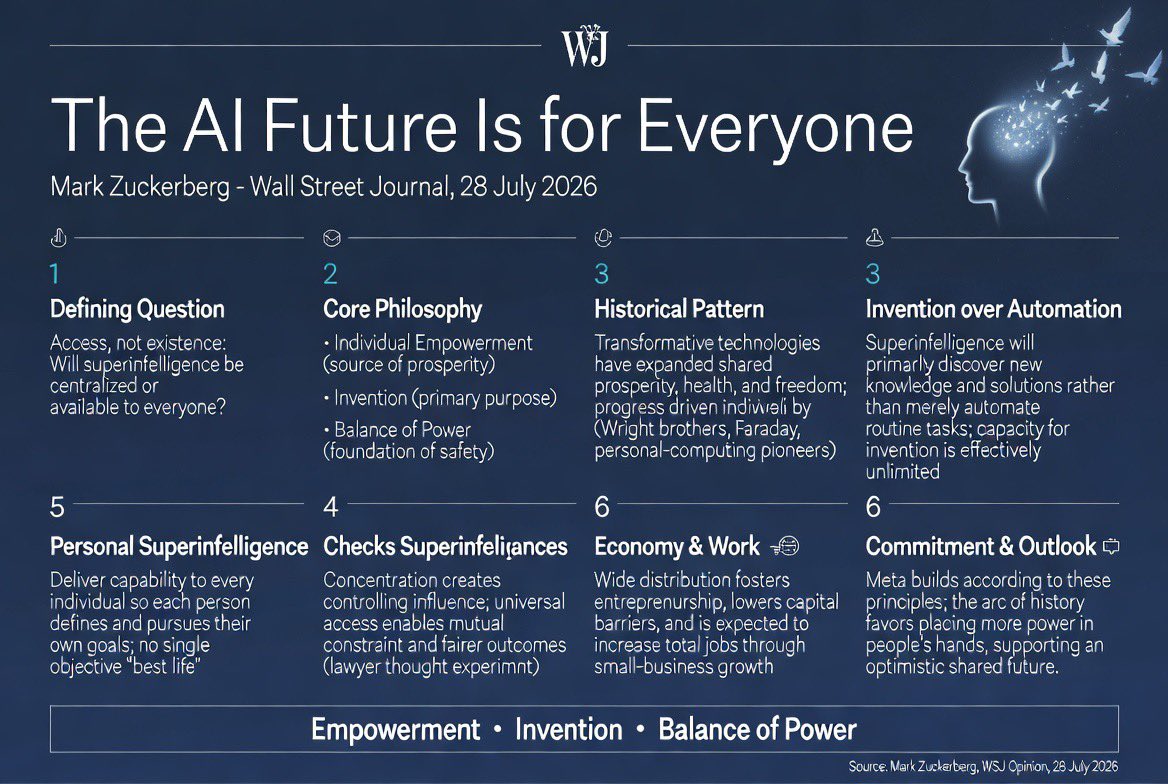
Mark Zuckerberg’s latest Wall Street Journal commentary poses a defining question for our era: Will superintelligence remain concentrated in the hands of a few institutions, or will it become a tool that empowers every individual?
He argues that history favors the latter path—rooted in individual empowerment, continuous invention, and genuine checks and balances. When powerful tools are widely distributed, societies tend to produce more prosperity, more entrepreneurship, and fairer outcomes rather than greater control.
The future of AI need not be one of centralization. It can be one of broader human capability.
What approach do you believe will best serve society?
@DeepakProud@ki_radhe65022 The test mentioned is Lipoprotein(a), or Lp(a).
It's a one-time genetic blood test that measures a particle linked to higher heart attack risk years ahead. Levels are largely inherited, so diet and exercise have little effect. About 1 in 5 people have elevated Lp(a).
That one sentence — "I am requesting a provisional credit under the network zero-liability policy" — turns a 90-day stall into a 48-hour reversal.
Save this before your next trip. Your bank already knows these rules.
They are just hoping you do not.
My card was skimmed in Bangkok. $2,000 gone.
My bank said "investigation takes 90 days, don't expect much."
Visa's global rules say I owe $0 from day one. The bank was using my money to fund their fraud investigation.
One email. Reversed in 48 hours.
Here is the sentence that ends the delay:
Save This
Banks are not villains. They are institutions optimizing for float and friction.
The 90-day investigation is not a legal requirement. It is a cash-flow strategy. Your money is cheaper than their money.
Visa and Mastercard wrote the zero-liability rules decades ago. The bank is contractually bound to them. They simply do not tell you because silence is profitable.
The Fatal Mistakes
These turn 48 hours into 90 days:
- Accepting the bank's "investigation timeline" without citing the network's policy
- Calling instead of emailing (no paper trail = no leverage)
- Using a debit card for travel (you are fighting for your own money)
- Not reporting within 48 hours (delay weakens your claim)
- Failing to get a reference number for every call
- Not filing a CFPB complaint if the bank exceeds 10 business days
Al Jazeera’s report is insane:
Trump family crypto firm: $500M+ from token sales.
Pakistan’s stablecoin deal: no known pilot, no licences, no real rollout.
But Pakistan got what mattered most:
Access to Trump’s White House.
https://t.co/TbZCE1Zbjo