GM to everyone except those who aren’t using @Wahoopredict
The day is still young, plenty of markets to catch and predictions to make
What are you predicting on today?
https://t.co/TutbFwuLYx
@Hermit_chase@Onchaincc Airdrops aren’t dead
People just lack positioning and keep following the crowd instead of finding the right opportunities early
I think the game changed and the strategy should too
Airdrops are dead !
But I started farming @Onchaincc May 2026 with just $200,
Mainly joined their $300k trading campaign which lasted for 90 days
Within that 90 days before event end I made $1.3k + from them
And $1.6k Season reward
And where I’m going TGE is confirmed for this year I’ve made $3k before TGE, guess how much I might make if TGE happens.
Airdrop is still a thing, just know this three things;
- Don’t do airdrops only
- Don’t farm what you’re told to farm, farm what a lot aren’t farming
- Have zero expectations from Airdrops.
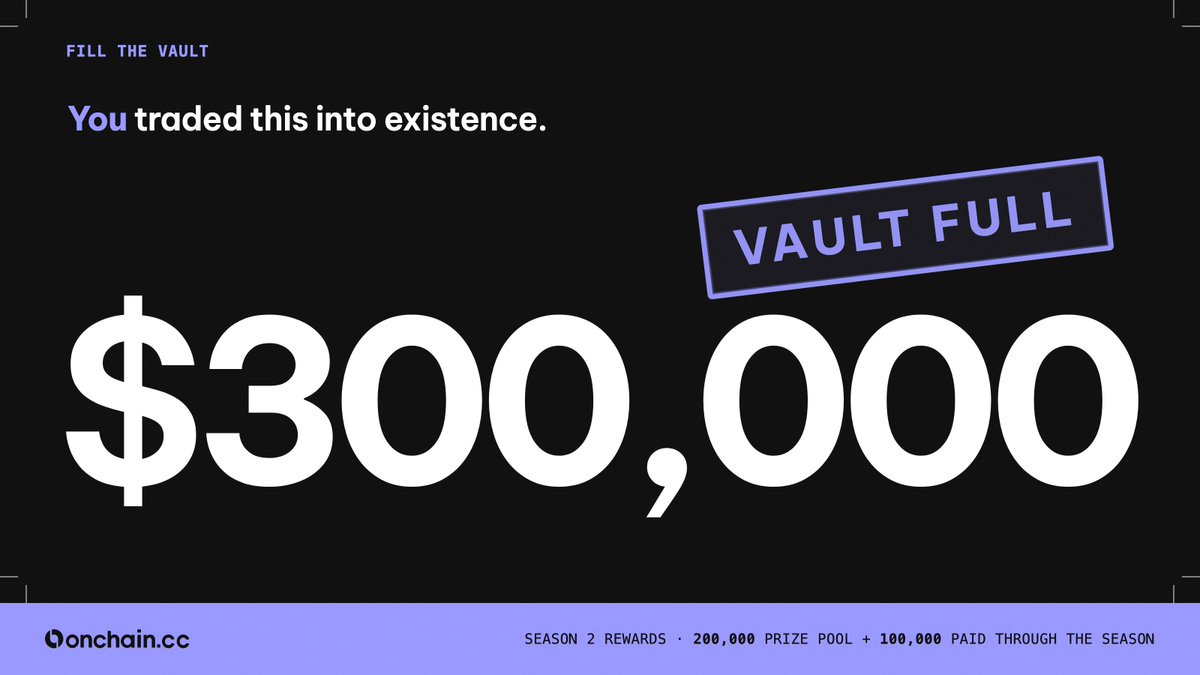
We gave you 14 days to fill the vault.
You needed 11.
Season 2 rewards are maxed: 300,000 USDC. 200,000 in the prize pool, 100,000 paid out while the season runs.
Season 2 is loading. Be ready.
Yesterday I was thinking about how crazy it is that we’re slowly giving AI agents the ability to move money.
Like imagine giving an agent $10k and telling it:
“Keep 20% in stables and Manage the rest.”
Sounds simple.
But what happens when the market moves?
That’s where things get interesting.
▪︎The agent can execute the trade,
It can swap,It can buy, It can sell, It can move your funds around.
But after the transaction is completed, does it actually remember why you made that decision?
Because knowing where the money is isn't the same as knowing where the money is supposed to be.
▪︎Let's say your original plan was:
“Keep around 20% of my portfolio in stables.”
Three weeks later, the market pumps.Your portfolio changes.
Now you're sitting at 14% stables.
A normal portfolio tracker will show you the number.
But it won't necessarily understand that you've drifted away from your original objective.
▪︎This is basically the problem AUREON is trying to solve with something they call Living Capital.
The idea is pretty simple:Capital shouldn't just have a transaction history.
It should have context,the money should carry the objective behind it.
▪︎And honestly, this makes more sense when you think about how humans manage money.
If I tell myself:
“I want to keep 20% of my savings untouched for emergencies,”
I don't forget that goal just because I moved money yesterday.
The goal continues to exist after the transaction.
AUREON wants agents to work more like that.
▪︎They use something called a Financial Compass Objective.
You define things like:
Target allocations
Tolerance bands
Risk profile
Constraints
Execution policies
So instead of simply telling an agent:
“Buy this.” You're telling it:
“This is what I want my capital to achieve and these are the rules you should follow.”
▪︎Then AUREON's Capital Book keeps track of the live state of the portfolio.
The Health Engine compares what you actually have against what your objective says you should have.
Everything okay?
Healthy.
Starting to drift?
Warning.
Outside the rules?
Violation.
▪︎And this is the part I find interesting.
AUREON doesn't just want to tell you that something went wrong.
When capital drifts away from its objective, it can create a restore plan.
So the system can go from:
“Your portfolio is drifting”
to:
“Here's how we can bring it back.”
▪︎The whole loop starts looking like:
Objective → Intelligence → Policy → Execution → Verification → Adaptation
Or in simpler terms:
You set the goal.
The system watches.
The portfolio moves.
Drift gets detected.
A restore plan is created.
The action gets executed.
Then the system checks what actually happened.
▪︎This is where AUREON starts becoming more than another portfolio dashboard.
A dashboard tells you:
“Your portfolio is worth $10,420.”
AUREON wants to answer:
“Is your $10,420 still following the plan you gave it?”
That's a much bigger problem.
▪︎And because this is being built for AI agents, they've built an SDK and MCP runtime around it.
So agents can interact with things like:
• Create objectives
• Check portfolio health
• Compare allocations
• Plan restores
• Prepare vault actions
• Validate receipts
• Read audit trails
Basically giving an agent financial context instead of just wallet access.
▪︎Then there's the execution side.
AUREON is building Smart Vault infrastructure on Robinhood Chain while keeping the system non custodial.
They say the user or agent still controls the signing.
AUREON handles the intelligence, objectives, monitoring and orchestration.
▪︎But there's another problem I think people underestimate.
How do you know the agent actually did what it said it did?
Because in crypto, “transaction successful” and “transaction actually settled onchain” aren't always the same thing.
AUREON is building around that problem too.
Follow AUREON X : @buildaureon
For more updates