Congratulations to our Transplant and Hepatobiliary research fellow, Dr. Belén Rivera @MBRiveraMD, on graduating with her Master of Public Health (MPH) from Harvard T.H. Chan School of Public Health.
We are incredibly proud of her achievement and grateful for her contributions to our transplant research program at @BIDMCTransplant@Harvard. A testament to the impact of the Innovative Research Initiative (IRI) Fellowship @IRI_program in developing the next generation of academic surgeon-scientists.
#HarvardChan #MPH #TransplantResearch #BIDMC #AcademicSurgery #ResearchFellowship
@BIDMCSurgery@BIDMChealth@BIDMC_CancerCtr@HarvardChanSPH@harvardmed@ASTSChimera@AHPBA@IHPBA
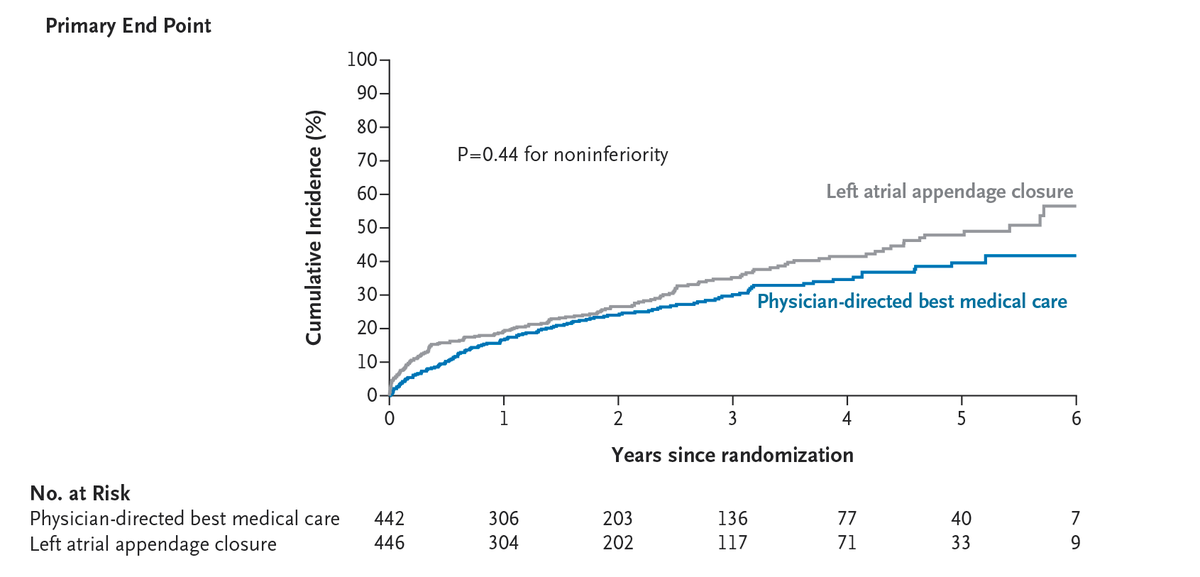
Among patients with atrial fibrillation at high risk for stroke and bleeding, left atrial appendage closure was not noninferior to medical therapy in reducing the risk of stroke, embolism, major bleeding, or death at 3 years. Full CLOSURE-AF trial results: https://t.co/qAMC2o36Mi
Editorial: Left Atrial Appendage Closure — Another Overused Method in Cardiology? https://t.co/KyOWdblUR3
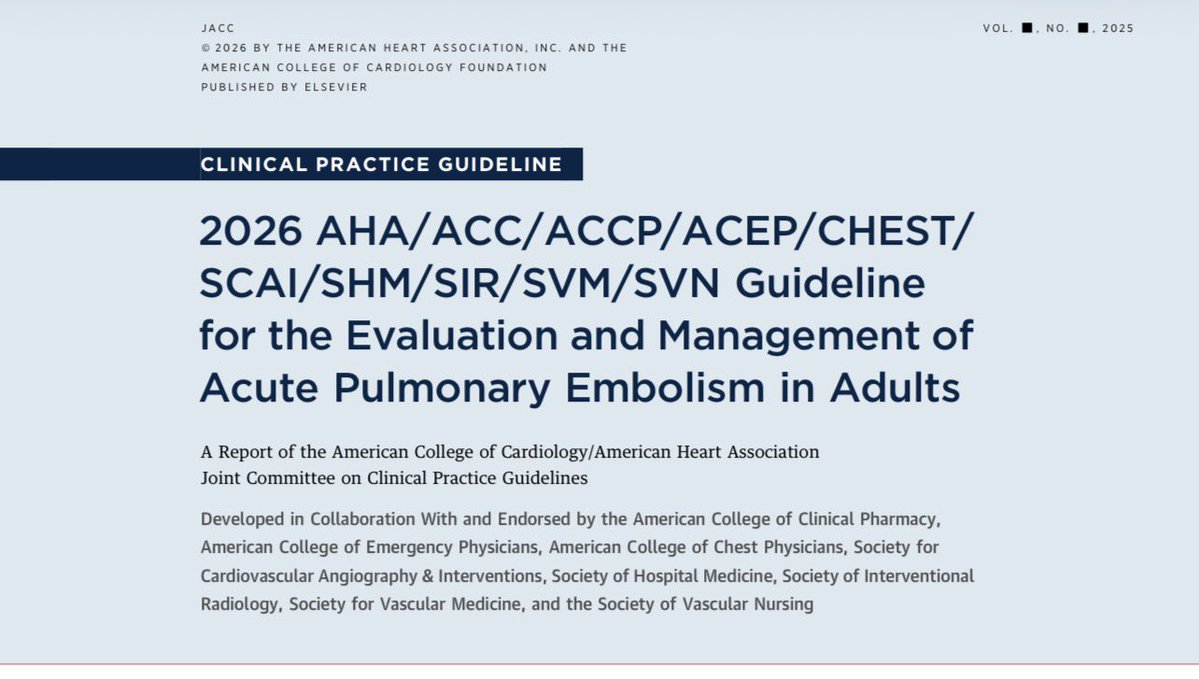
🧵 1/ First ever AHA/ACC/multi-society guidelines re: diagnosis & management of acute PE released today!
2 year effort with 38 authors from 10 specialties.
Link attached & summary in this thread:
https://t.co/uUUyUvz3pR
Presented at #AHA25:
In a meta-analysis of 17,801 patients with myocardial infarction and preserved LVEF (≥50%), beta-blockers did not reduce death, MI, or heart failure over a median 3.6 years of follow-up. Full results: https://t.co/1LiJFFvnm3
@AHAScience
This was only possibly thanks to the incredible mentorship of Dr Matthew Koster, @MdWarrington, @CrowsonCindy, and the rest of the incredible team at @MayoClinic rheumatology! Hoping to see everyone the next time I visit Rochester!
7/7
Very delayed post but wanted to share our paper on relapses in patients with giant cell arteritis! Overall, while we did see a tendency towards concordance between baseline symptoms and relapse symptoms, some considerations are to be noted 🧵
1/7
#GCA@MdWarrington@CrowsonCindy
https://t.co/OdzuhP8qCi
Takeaways:
- Patients may present on relapse with symptoms not present at baseline. This was observed in approximately 1 in 5 patients in our study. Thus, awareness of the full spectrum of clinical presentation is necessary for both patients and physicians.
- The strongest concordance was observed when evaluating the presence of symptoms at first relapse and likelihood of symptoms also being present at second relapse.
- In our study, absence of cranial symptoms at baseline was associated with no visual symptoms at first or second relapse. 6/7
Hello #MedTwitter!
I’m Isabella, an IMG from Dominican Republic🇩🇴, working as a researcher @MayoClinic applying to #InternalMedicine this #Match2026
Outside of work, I love pilates and barre workouts🧦, specialty coffee☕️, and spending time outdoors🏃🏻♀️🚴🏻♀️🏝️
Let’s connect!
And we are off to SVM!! Looking forward to attending for the second time! Grateful for @RobMcbane and the vascular med team at @MayoClinicCV@MayoClinic