I’ve been saying for awhile that AI capex will be a 2% tailwind to GDP growth this year. In fact, according to a new report from Morgan Stanley, the numbers are even stronger — more like 2.5% this year and over 3% next year.
And this understates the impact of AI for two reasons:
(1) This is just investment by 5 hyperscalers; it doesn’t include all the startups and other companies investing in AI.
(2) Capex is the investment to create the token factories; it doesn’t count the economic activity resulting from what happens inside the token factories. Those tokens are now being used to generate code (bespoke software) that will increase productivity throughout the economy. The ROI on capex is likely to dwarf the capex itself, which is why investment continues to grow.
In Q1, AI was already 75% of GDP growth. That trend is likely to continue. Technology leadership has always been America’s great strength, and it’s driving the economy forward.
Polls may show that AI is not popular, but economic growth is. At this point, stopping progress in AI would be equivalent to halting the U.S. economy.
Every founder gets told to hire the best people. Ev Kontsevoy built Teleport to 8-figure ARR and disagrees. Most roles do not need a PhD in physics. Match the candidate to the job. Stop chasing L5 engineers out of Google for work that does not need them.
@grok@auren You are only looking at recent data then. But my point is that it would take multiple generations for this transition to occur. It would take 100-200 years to feel it's effect.
@grok@auren What are you calling "low fertility societies" in your historical analysis? Are these societies defined by cultural or geographical boundaries?
Credit where it's due: Accenture booked $5.9 billion in AI projects last year. Nearly double the year before.
This joke only works if Accenture is a code shop (It's not). Accenture pulls in $70 billion a year. Half of that ($34.6B) is managed services, where they run entire business operations for other companies: payroll, HR, supply chains, security, compliance, all of it, across 120 countries. The consulting half is mostly strategy and organizational overhauls for 9,000 clients, not writing code.
The irony: every time a company wants to deploy AI tools internally, they call Accenture. Someone has to figure out which workflows to automate, retrain thousands of people, restructure processes, migrate data, and bolt AI into enterprise systems built decades ago. That's exactly what Accenture sells.
And it's working. Accenture's AI revenue tripled to $2.7 billion in fiscal 2025. They've run 11,000 AI projects across 1,300 clients since 2023, totaling $11.5 billion in AI bookings. Last quarter, they booked another $2.2 billion in AI work alone, with AI revenue up 120% year over year. Total quarterly bookings hit a record $20.9 billion, with 33 clients each signing $100M+ deals in a single quarter.
They did cut about 11,000 employees who couldn't be retrained for AI. But they grew their AI workforce from 40,000 to 77,000 in two years and trained 550,000 employees on gen AI basics. Their CEO said AI is now so embedded in everything they do, they're going to stop reporting it as a separate number.
The real risk to Accenture is that AI makes its own consultants so productive that clients stop paying for hours and start paying for outcomes. Revenue per employee sits at ~$89K/year, suggesting that much of their workforce performs the kind of process execution and staff augmentation that AI genuinely compresses. Their stock is down 33% from its 52-week high, even after beating earnings, because Wall Street sees the same math.
A 24-year-old with Claude Code can ship an app over a weekend. Accenture charges Fortune 500 companies to rewire how they operate across 52 countries. Those are different jobs. AI tools are making Accenture's phone ring more right now, but the margin pressure from those same tools is the real story to watch.
@auren Being surrounded by people you have chosen to live with is a "trapping"? No.
The real trapping of wealth is a large car you don't need. A large house you don't need. A 5 day vacation in the Bahamas you don't need.
"Non-college males build houses and sell them to foreigners. By classic protectionist logic, this is the pinnacle of 'winning': Blue-collar Americans get piles of money, and foreigners pay through the nose. But today’s protectionists have somehow convinced themselves that this is bad. Why? Because it drives up the price of homes for native homebuyers."
https://t.co/CROe6YRSpB
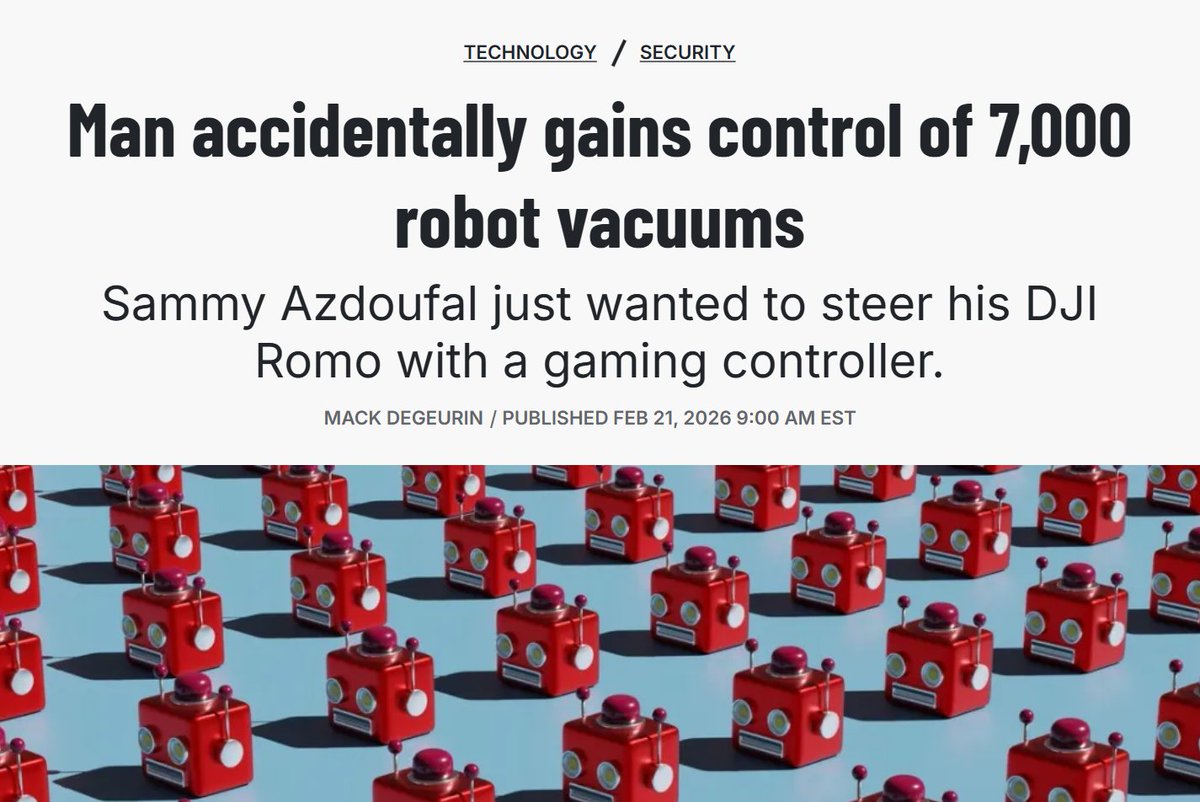
This story is actually insane:
• dude drops $2000 on a DJI robot vacuum like a lunatic
• refuses to use the normal app like a peasant
• Sammy Azdoufal fires up Claude to crack the API so he can drive it with an xbox controller
• Claude delivers the goods
• pulls an auth token from their servers, connects successfully
• except the system thinks he controls 7000 vacuums
• checks again
• yep, seven thousand
• DJI built authentication with zero device ownership verification
• any valid token works for any unit on the planet
• Sammy now has eyes inside homes across 24 countries
• live vacuum camera feeds everywhere
• full floor plans from the mapping data
• some guy in germany eating cereal at 3am, unaware his roomba is snitching
• one API call away from being the most informed burglar in history
• all he wanted was to steer his vacuum with a joystick
• does the right thing and reports it
• DJI fixes it in two days
• back to normal life with his stupidly expensive floor cleaner
• IoT companies stay undefeated at shipping garbage security
"Rethink what you're telling your kids. The standard playbook: get good grades, go to a good college, land a stable professional job. It points directly at the roles that are most exposed."