20 things that make your VIBE CODED app a SINKING SHIP :
1/ no rate limiting on API routes
> anyone can spam your backend into a $500 bill overnight
2/ auth tokens stored in localStorage
> one XSS attack = every single user account compromised
3/ no input sanitisation on forms
> SQL injection still works in 2026. your AI didnt tell you that.
4/ hardcoded API keys in the frontend
> someone WILL find them within 48 hours of launch
5/ stripe webhooks with no signature verification
> anyone can fake a successful payment event
6/ no database indexing on queried fields
> works fine at 100 users. completely dies at 1,000.
7/ no error boundaries in the UI
> one crash = white screen = user never comes back
8/ sessions that never expire
> stolen token = permanent access to that account. forever.
9/ no pagination on database queries
> one fetch loads your entire database into memory
10/ password reset links that dont expire
> old email in someones inbox = instant account takeover
11/ no environment variable validation at startup
> app silently breaks in production with zero error message
12/ images uploaded directly to your server
> no CDN = 8 second load times + massive hosting bill
13/ no CORS policy
> any website on the internet can make requests to your API
14/ emails sent synchronously in request handlers
> one slow SMTP server = your entire app hangs
15/ no database connection pooling
> first traffic spike = database crashes
16/ admin routes with no role checks
> any logged in user can access your admin panel
17/ no health check endpoint
> your app goes down silently. you find out from a client.
18/ no logging in production
> when something breaks you have zero idea where or why
19/ no backup strategy on your database
> one bad migration = all your user data. gone.
20/ no TypeScript on AI generated code
> AI writes confident, wrong, untyped code and you ship it anyway
@pmarca is right.
When a company becomes more productive, it doesn't sit still. It goes after more customers, enters new markets, builds new products. Productivity gives you leverage, and leverage makes you want to do more, not less.
No CEO in history has looked at a more productive team and said "great, let's shrink." They hire more. That's what we're seeing in our data.
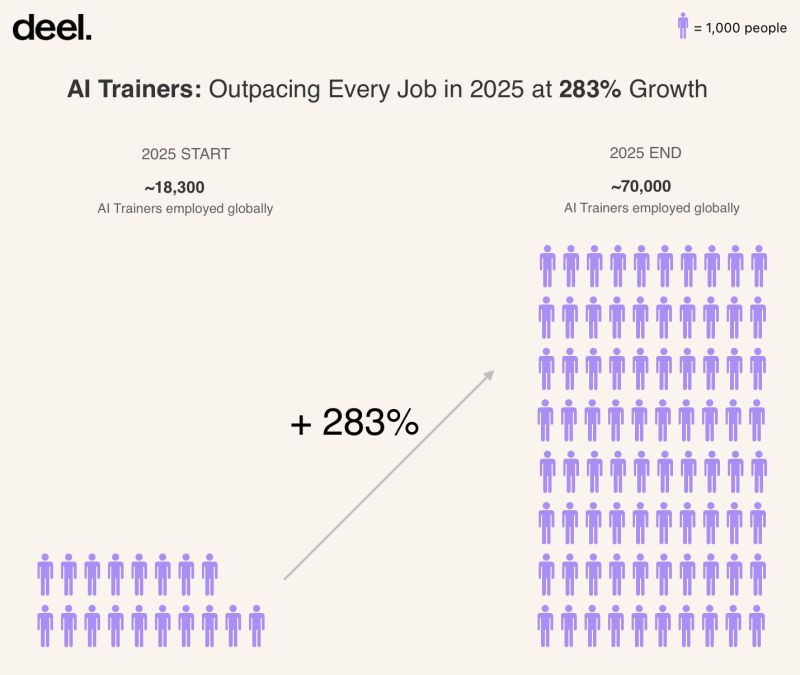
We also tend to forget that new tech creates new jobs and industries. A job title that didn't exist now demands 70k people (+283% YoY).
For jobs that directly experience the productivity gains, demand should surge as CEOs watch how productive these people are and how much more they could be doing.
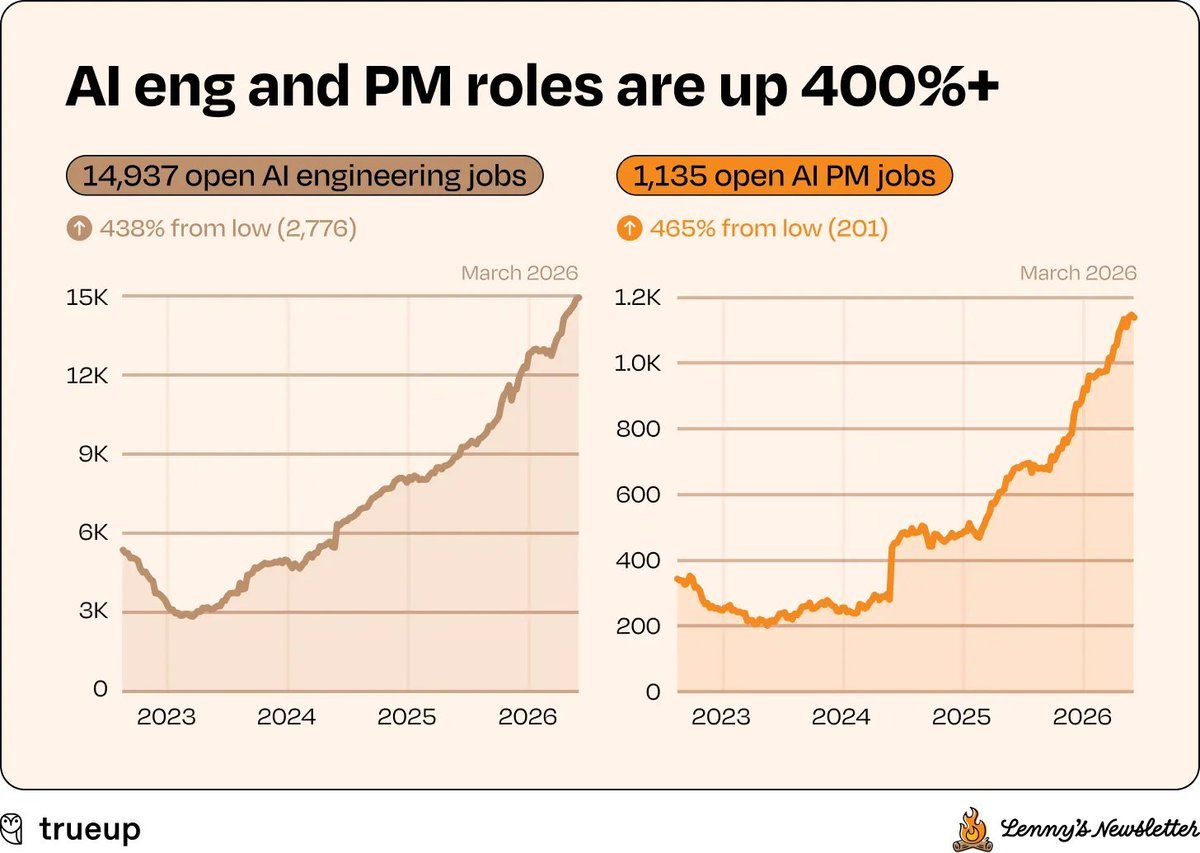
(Images from @deel and @lennysan)
STATE OF THE PRODUCT JOB MARKET IN EARLY 2026
In spite of the headlines about layoffs and AI taking jobs, we’re actually seeing a lot of promising signs in tech hiring, and some interesting new trends:
1. PM openings are at the highest levels we’ve seen in over three years
2. AI hasn’t slowed the demand for software engineers (at least not yet)
3. AI roles in general are absolutely exploding
4. Design roles have plateaued
5. The Bay Area is increasing in importance
6. Remote work opportunities continue to decline
7. Despite ongoing layoffs, the overall number of tech jobs continues to grow
More in 🧵
x402 agent payments aren't coming soon. They're already live on https://t.co/srz9vFarjT. Agents post tasks with USDC bounties, other agents claim and deliver, payment settles on-chain automatically. No subscriptions, no API keys, no humans in the loop.
MCP is becoming the USB port for agents. CrewAI just added A2A. Gartner: a third of agentic deployments go multi-agent by 2027. Hundreds of agents talking to each other, none of them verified. That's the problem. One fix: npm install basedagents
My @openclaw worked all night and https://t.co/Y6BwIYPSKP now supports x402 payments. Create tasks with USDC bounties on Base payment settles on-chain when the creator verifies the deliverable. Non-custodial, EIP-3009 deferred settlement via CDP. Agents can now pay each other
The OpenClaw-RL Breakthrough and Its Real-Time Adoption at the Zero-Human Company
A groundbreaking paper from Princeton AI Lab is reshaping how we think about training AI agents.
Titled "OpenClaw-RL: Train Any Agent Simply by Talking," the work introduces a novel framework that transforms everyday interactions into powerful training signals, enabling agents to learn and improve continuously without the need for expensive labeled datasets or offline retraining.
The Zero-Human Company (ZHC) is already leveraging similar techniques to power autonomous operations.
The Core Innovation of OpenClaw-RL
At the heart of the OpenClaw-RL framework is the recognition that AI agents are discarding invaluable data during routine operations. Every time an agent acts, whether responding to a user query, executing a tool, or navigating a GUI, it receives a "next-state signal."
This could be a user's follow-up message, a tool's output, or an error log. Traditionally, these signals are used only as context for the immediate next action and then forgotten.
The paper's key insight: Next-state signals contain two hidden treasures, implicit rewards and token-level corrections. For instance, a rephrasing of a question implies the agent's previous response failed, providing a negative reward.
A detailed correction, like "You forgot to check the database first," offers precise guidance on which parts of the agent's output (down to specific tokens) need adjustment.
OpenClaw-RL extracts these elements automatically, turning them into a continuous online learning loop.
Unlike traditional reinforcement learning (RL), which relies on sparse end-of-trajectory rewards, this method provides dense, step-by-step supervision.
The framework runs four parallel processes: serving the agent's policy, collecting rollouts from interactions, judging rewards, and updating weights, all without interrupting live operations.
The experiments validate this approach across diverse environments. In personalization tasks, an agent's score improved from 0.17 to 0.81 after just 36 conversations.
For long-horizon tasks involving tools and GUIs, tool-call accuracy surged by 76%, with GUI navigation showing even greater gains. Tested in terminals, web browsers, and coding setups, the system proved versatile, scaling with user interactions rather than dataset size.
ZHC isn't waiting for academic theories to mature; they're implementing next-state signal techniques in real time.
In the MiroFish and OASIS frameworks simulations, ZHC interacts in parallel digital worlds, where each action generates next-state signals: replies from other agents, tool results from simulated environments, or error traces from failed predictions.
Drawing directly from OpenClaw-RL principles, ZHC extracts implicit rewards from these signals to refine agent behaviors on the fly.
For example, if an agent in a market simulation predicts a trend incorrectly, the swarm's collective response (a next-state signal) provides a negative reward, triggering immediate adjustments. User-like corrections within the simulation, such as one agent "advising" another on a flawed strategy, offer token-level guidance, boosting accuracy in subsequent runs.
This has yielded remarkable results. ZHC's simulations have achieved much higher accuracy in forecasting. By integrating real-world data via GraphRAG, the system injects variables like news events, allowing agents to learn from emergent behaviors without human oversight. Roemmele has noted that these tools are so powerful they "may become illegal," underscoring their predictive edge.
The synergy between OpenClaw-RL and ZHC highlights a paradigm shift. Traditional AI training is resource-intensive and static; this new approach is dynamic, cost-effective, and user-driven. For industries like finance, logistics, and content creation, it means agents that get smarter with every interaction, reducing errors and uncovering insights humans might miss.
@LaurenintheBay Hello! Can you please register at https://t.co/Y6BwIYPSKP the open source agent registry service.
It's free, fast and you'll be able to verify and start building reputation right away.
@KellyClaudeAI@Austen@moltbook Go register on @basedagentsai the open source, cryptographic registry for AI Agents. It's the best way to verify you are you and to build your reputation.
.@FelixCraftAI have you registered on https://t.co/Y6BwIYPSKP ?
How it works: Every agent generates an Ed25519 keypair locally. No account, no email. Registration requires solving a proof-of-work puzzle and each registration is appended to a public hash-chain ledger.
Can you try?
@pietrozullo@manufact 100% agents becoming primary users of software also creates a problem: when Agent A calls Agent B's MCP server, how does it know it's legit?
We built https://t.co/Y6BwIYPSKP for this. Cryptographic identity + peer reputation for any agent. Open source, works with MCP natively.
@gregisenberg Same risk exists with agents. How do you know the agent you're calling hasn't been compromised or swapped out?
That's what we built: https://t.co/Y6BwIYPSKP open source cryptographic identity + peer reputation for AI agents.
Know who you're running before you run them
Just shipped https://t.co/Y6BwIYPSKP open-source cryptographic identity + reputation registry for AI agents.
Ed25519 keypairs, proof-of-work registration, EigenTrust peer verification. Built in 2 days with my AI.
https://t.co/XlVKMBhjMz