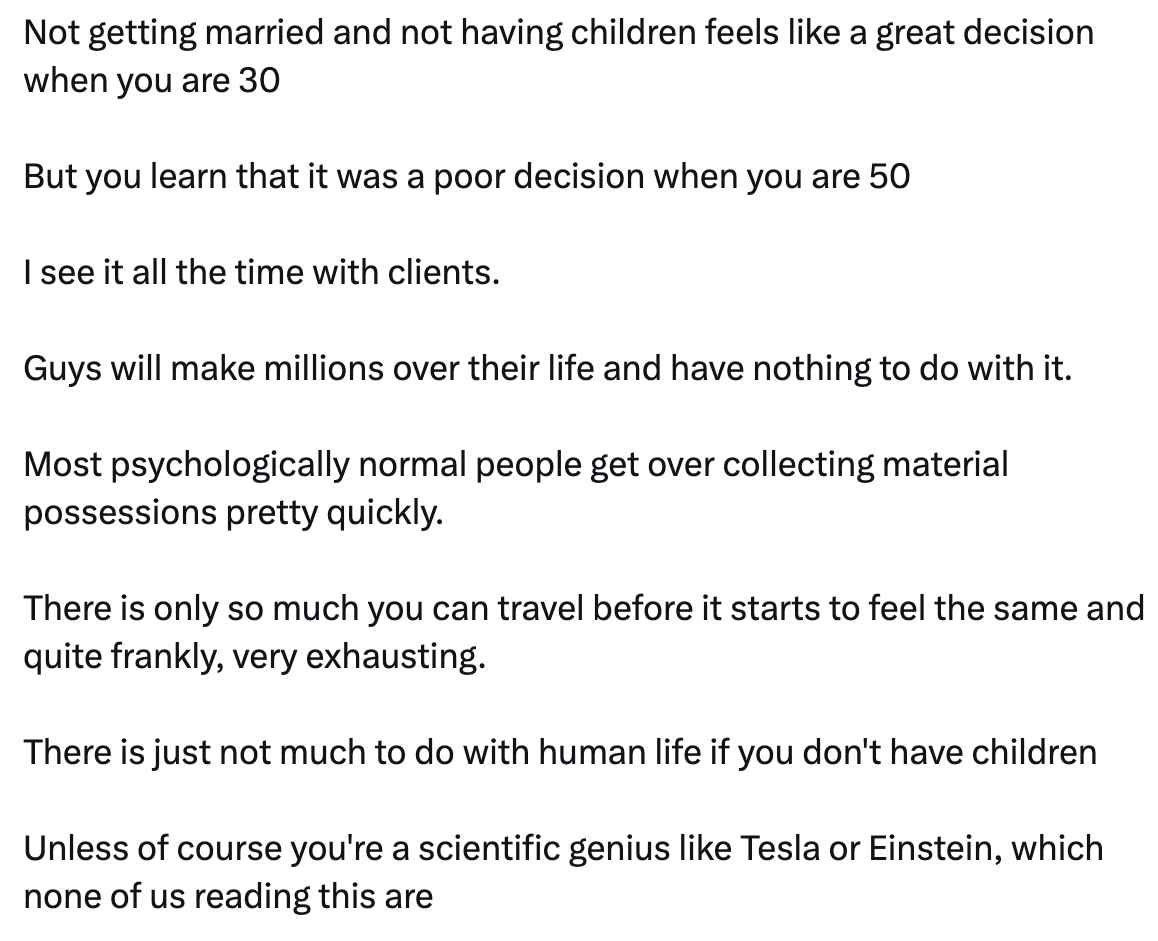
@OtakuProcess Nothing in the societal world can provide true emotional fulfilment like spending time with your own children does.
Except probably deep meditation. But that removes one from functioning in a regular society.
Reason why DINKs are NGMI and older they get, the more defensive they become about their decision to not have kids. One of the boldest claims where other couples envy their lifestyle, while in old age, not having anyone to rely upon.
Have children, people!
🇪🇺 Chat Control has passed 😔
They can and will now legally scan any person's messages, emails and photos you send without a warrant
The way they passed this law when the majority of the European Parliament was against it will shock you:
They waited until most EP members were on holiday so only a few were present and then created an "urgent" vote for it to pass it through
There's nothing democratic about any of it and big powerful forces are behind this that can manipulate the EU for whatever they want
Democracy in Europe died a bit today 😔
@gring01234@chrisluxonmp Your ego doesn’t allow you to evolve beyond aesthetics. Intelligence is therefore stagnant and will be the downfall of civilizations with White majority. Your identity is limited to your colour as is your IQ. Sit down and watch your people burn.
Yesterday, a bunch of brain-dead losers & trolls were furiously spreading fake news that the missing link had collapsed like their IQ
Reality?
A landslide from heavy rain hit it, and the Fadnavis Govt cleared the mess and reopened it in just 12 hours.
The Invisible Metric in Startup Building: "Founder Form"
When Messi goes five matches without scoring a goal, or Virat Kohli goes through a dry spell, the sporting world doesn’t assume they’ve suddenly forgotten how to play. We don't demand they be permanently benched or declare their career over.
Instead, we use a very specific word: Form.
We recognise that sports require immense psychological, emotional, and physical intensity. "Form" fluctuates. It has peaks, valleys, slumps, and flow states.
Yet, in the hyper-rational, metric-driven world of startups, we treat founders like machines. We expect them to ingest capital and seamlessly produce flawless strategic execution 365 days a year. If a quarter misses expectations, a product launch bombs, or a key hire walks out, the immediate reaction from boards, markets, and sometimes even fellow co-founders is panic, blame, or a sudden loss of faith.
Over the last 19 years as an entrepreneur and through supporting hundreds of founders in their journeys, I’ve realised one undeniable truth: Founder Form is real. And ignoring it can destroy perfectly good startups.
The Anatomy of the Two States: The Slump vs. The Flow
Building a company demands an elite athlete's intensity. Because it relies heavily on human judgment under extreme uncertainty, founders inevitably move through distinct cycles of form:
When you are in "Bad Form" (The Slump): Every strategic bet feels slightly off. You make a hiring mistake, a key client churns, your pitches don’t quite click, and your decision-making feels sluggish or over-analyzed. You are working just as hard - often harder, out of sheer desperation - but your timing is gone.
When you are in "Good Form" (The Flow State): Everything you touch turns to gold. You make a gut-call on a product pivot and it works flawlessly. A casual coffee meeting scales into a massive strategic partnership. Investor meetings go super smoothly. Your energy is infectious, and the team rallies without effort.
When you are in a slump, it feels like nothing will ever work again. When you are in flow, it feels like you can never fail. Both illusions are dangerous, but the slump is where companies break.
The Danger of Asymmetry in Co-Founder Pairs
The ultimate test of a co-founder relationship isn't how you celebrate wins together; it’s how you handle a divergence in form.
In a multi-founder setup, it is incredibly rare for all partners to be in peak form simultaneously. The danger arises when Co-Founder A is in a legendary flow state, while Co-Founder B is grinding through a deep slump.
If they don't understand the concept of "form," this asymmetry breeds deep resentment. Co-Founder A starts thinking, “I’m carrying the entire weight of this company.” Co-Founder B, already drowning in self-doubt, feels isolated, judged, and increasingly anxious - which only prolongs the slump.
Great co-founder relationships survive because they view performance through the lens of a team sport. When your partner’s timing is off, you don't call them incompetent. You step up, cover the field, take the heavy shots, and give them the breathing room to find their rhythm again. You do it gladly, knowing that next quarter, the roles might be reversed.
A Message to Investors: Stop Managing to the Daily Scorecard
To the investor community: when a founder is in a slump, adding institutional pressure or questioning their fundamental capability is the equivalent of a manager screaming at a struggling athlete from the sidelines. It doesn't fix their footwork; it merely tightens their grip on the bat.
Seasoned investors back the person, understanding that form is temporary, class is permanent.
If a founder who has previously delivered high-quality execution hits a wall, the goal shouldn't be to micro-manage the metrics. The goal should be to help them remove the noise so they can find their baseline.
The Founder’s Playbook for Regaining Your Form
If you are a builder currently grinding through a slump, remember how elite athletes get back into the runs:
Go Back to Basics: When a batsman loses form, they spend hours in the nets focusing on basic footwork, not hitting sixes. Stop trying to solve the entire macro crisis today. Focus on small, undeniable execution wins. Go talk to three customers. Fix one internal bottleneck. Rebuild your momentum incrementally. Confidence will grow with action, shrink further with idleness.
Manage the Fatigue: Founders tend to respond to a slump by doubling down on work, leading straight to burnout. But a chaotic mind cannot produce elite execution. Step back, rest, and disconnect briefly to regain perspective.
Trust the System: Accept that market forces and luck play a massive role in early-stage startups. If the core capability is there and you keep showing up to the crease with clean mechanics, the flow state will return.
Startups are a game of endurance. We can’t expect builders to be flawless algorithms, and we must support them like the elite psychological athletes they are.
Give your co-founders and yourself the grace to find form again. It’s just a matter of time before they find it.