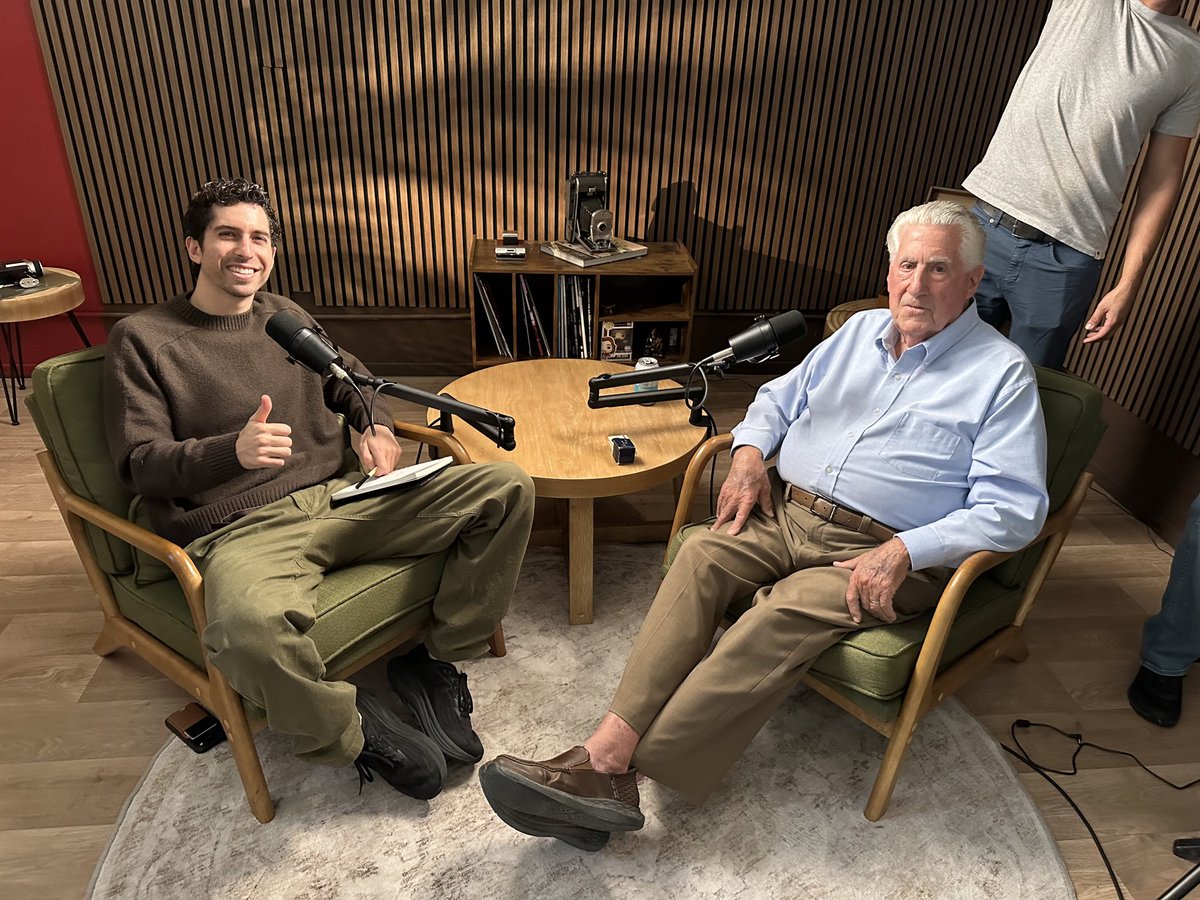
Great summary of my conversation with @timventura (thanks to him):
"Can Bell nonlocality lead to faster-than-light communication? Dr. Maaneli “Max” Derakhshani discusses quantum signaling, the no-communication theorem, and possible workarounds.
In this episode, Tim Ventura speaks with Dr. Maaneli “Max” Derakhshani, a theoretical physicist and philosopher of physics whose work spans quantum foundations, relativity, quantum gravity, statistical physics, semiclassical gravity, and alternative formulations of quantum mechanics.
The conversation explores one of the deepest questions in modern physics: whether Bell nonlocality points to real faster-than-light causal influence, and whether the standard No Communication Theorem is an absolute barrier to usable instantaneous quantum signaling.
Dr. Derakhshani discusses the assumptions behind no-signaling, including the Born rule, quantum equilibrium, linear Schrödinger evolution, local Hamiltonians, and standard quantum observables. He also examines possible theoretical routes around the theorem, including quantum nonequilibrium, nonlinear quantum mechanics, Bohmian mechanics, Nelsonian stochastic mechanics, and semiclassical gravity.
Topics include:
• Bell nonlocality versus usable faster-than-light signaling
• What the No Communication Theorem does — and does not — prove
• Whether the Born rule acts like a “statistical censorship” mechanism
• Quantum nonequilibrium and hidden nonlocal influence
• Nonlinear quantum dynamics and Schrödinger-Newton-type models
• Bohmian mechanics, Nelsonian stochastic mechanics, and alternative quantum theories
• Semiclassical gravity as a possible fundamental theory
• Relativity, causality, preferred frames, and messages into the past
• Whether instantaneous quantum signaling could ever enable deep-space communication
• What experiments might test these ideas
• What physicists should be careful not to overclaim
This is not a claim that faster-than-light communication has been demonstrated. Instead, it is a serious discussion about the foundations of quantum theory, the assumptions behind no-signaling proofs, and whether Bell’s theorem leaves open deeper possibilities than standard textbook quantum mechanics allows.
Dr. Maaneli “Max” Derakhshani is a theoretical physicist and philosopher of physics, Fellow of the John Bell Institute for the Foundations of Physics, and Senior Science Advisor to the CO2 Coalition.
Dr. Derakhshani earned his Ph.D. in the Foundations of Physics from Utrecht University, and has held postdoctoral research roles at Rutgers University and Utrecht University.
His work spans quantum foundations, relativity, quantum gravity, statistical physics, philosophy of science, and semiclassical gravity, with a particular focus on alternative formulations of quantum mechanics such as Bohmian mechanics, Nelsonian stochastic mechanics, collapse theories, and semiclassical approaches to gravity."
Can Bell nonlocality lead to faster-than-light communication? Dr. Maaneli “Max” Derakhshani discusses quantum signaling, the no-communication theorem, and possible workarounds. FULL INTERVIEW: https://t.co/e6MFRrzLPr
@MaxDerakhshani
This is an old idea that many physicists have suggested.
But it doesn't answer the question what started the Big Bang.
It just pushes the question back one level (or perhaps several levels).
The known laws of physics (General Relativity plus QFT in all its variants) still imply that the universe must have begun with a Big Bang a finite time in the past, even if our Big Bang wasn't the 'actual' or 'original' one.
A genuine answer to what started the Big Bang - literally the beginning of matter, space, and time itself - cannot come from within physics as we know it, because all physical explanations/causes presuppose matter, space, and time in some form or another.
So the cause of the (true) Big Bang had to be something non-material, non-spatial, and eternal or timeless.
To me, the most interesting question is, what started the big bang?
Suppose there is another civilization where scientists know how to unify quantum mechanics and gravity, so they understand what conditions are needed in order to start a big bang, a new universe, to give birth to a baby universe. And if they know how to do that, they might have the ambition to create a baby universe in the laboratory. Then, maybe our universe was created in the laboratory of a more advanced civilization.
@BrianScipioni I agree. But then I don’t understand what other instabilities you could be referring in your proposal. With no spacetime and no vacuum state of any kind, you cannot have either quantum or classical instabilities.
The laws of physics as we know them imply that the universe had to have begun a finite time into the past (where the beginning may or may not have been a space-time singularity). We cannot go asymptotically into the past.
Also, even if the initial conditions of the universe involved an equal admixture of positive and negative mass, that would not tell us anything about the cause of the beginning of the universe.
I also don’t see how an initially equal admixture of positive and negative mass helps to explain the extremely low-entropy (extremely homogeneous and isotopic and spatially flat) initial conditions of the universe. Any quantum-stochastic ‘instabilities’ in the initially equal admixture would, with overwhelming probability, produce an early (near-initial) distribution of positive and negative mass corresponding to a state of vastly higher (near maximum) entropy than we know the universe had at the Big Bang.
Such instabilities also would not explain how the positive and negative mass got so sharply and cleanly separated so that the latter is nowhere to be found in our Hubble horizon.
Yes, the cause of the universe that I describe has most of the traditional theological properties of God. It just lacks the properties of personhood, intentionality, free will, and moral perfection. But if you can get people to see that the beginning of the universe had to have a cause, and that that cause had to be non-material, non-spatial, and eternal, it’s much easier to then accept that this cause is a personal being (as opposed to an abstract object) and has the other traditional theological properties of God.
If that’s the quadratic gravity explanation, it’s plainly incoherent. It presupposes a temporal sequence between “initially there was no time” and “then there were tiny fluctuations in the time dimension”. But there cannot be any such temporal sequence if there is no time to begin with.
Jimmy Hernandez says an unexpected helicopter reached USS Nimitz after the Tic Tac UFO encounter. Two men later left with a fuller-looking bag; he never saw its contents.
We’ve mapped what he saw and what others told him.
https://t.co/vh0zf9a1vj
@zpfTechnologies Yes it does — I meant for looking for potentially ruined artificial constructions on the surface of Mars, which is not what JPL is doing with it (I assume).
An image processing method developed at JPL – for Mars – is helping uncover ancient rock art, buildings, and even tattoos on mummified human remains on Earth.
See more (literally): https://t.co/hvDTt0S0FN
Really excited to be teaming up with @M31Capital for another headline Deep Tech Week event - Physics of Consciousness
This is a real tour de force - talks by @MaxDerakhshani@StuartHameroff Garret Moddel, Thomas Brophy, and of course @Jason_Jorjani
I’m looking forward to speaking at Deep Tech Week in Austin, but my talk will be on a different topic than described in the post below. Here’s the abstract/summary of what I will speak on:
This talk addresses the physics of consciousness directly by specifying, in the most general terms, what “physics” and “consciousness” mean. I argue that even ordinary (non-psi) consciousness cannot be reduced to physics, cannot be localized to the brain and body, and yet interacts bidirectionally with them. These conclusions do not depend on quantum mechanics. If they are right, the prima facie possibility of psi is substantially higher than it is under a physicalist view of consciousness.
What does the experimental record actually say about psi?
M31 Fellow Maaneli Derakhshani joins Physics of Consciousness at @deeptechweek to examine the evidence.
Sept 25 at 3:02pm | Austin
Program + registration:
https://t.co/zIWE0klHUy
@MaxDerakhshani
A bonus surprise speaker has joined the lineup, none other than Hal Puthoff
Hal joins @Jason_Jorjani , @StuartHameroff , Thomas Brophy, James Tagg and @MaxDerakhshani
I think this is shaping up to be one of the most interesting and frontier events @deeptechweek has ever hosted
thanks again to @M31Capital for making it possible
Is the Moon the next battleground?
Robert Bigelow reveals more about his meeting with @realDonaldTrump, including his proposals for a @USSpaceForce presence on the Moon, #AI -engineered biological threats, and newly released #UAP documents from #AAWSAP. https://t.co/aXAgN3r8fu
Trouble is, I don't believe it. The "science" too often comes along to back up a particular political scare, like covid, climate change, and the long list of world-enders that went before them and didn't happen.