Correction: a reader caught the model pricing non-US health gifts at US rates — bed nets at Medicaid prices. Health dollars now route by delivery geography. New numbers: ~205,000 QALYs skeptical (~420,000 credulous), blended $148k/QALY, frontier ~500×. Most of the health comes from the ~5% delivered abroad.
.@mackenziescott has given away $26 billion. What did it buy in health?
I built an interactive model from her own gift database: ~70,000 QALYs weighting each study by causal credibility, ~200,000 taking every effect at face value.
Just posted to the EA Forum: https://t.co/Wm5h8N7E6A
Another benchmark: Scott's donations would have generated 50-100x the QALYs if provided as cash transfers to the global poor via @GiveDirectly.
Update: a reader caught the model pricing her non-US health gifts at US rates — bed nets at Medicaid prices. Routing health dollars by delivery geography tripled the estimate: ~205,000 QALYs skeptical, ~420,000 credulous, $148k/QALY, frontier ~500×. Now fixed everywhere.
.@mackenziescott has given away $26 billion. What did it buy in health?
I built an interactive model from her own gift database: ~70,000 QALYs weighting each study by causal credibility, ~200,000 taking every effect at face value.
I just became the first Straude user to report 1 billion output tokens.
(The dollar column is API-list-equivalent — I'm on subscriptions.)
Most of them went into things we start shipping this week.
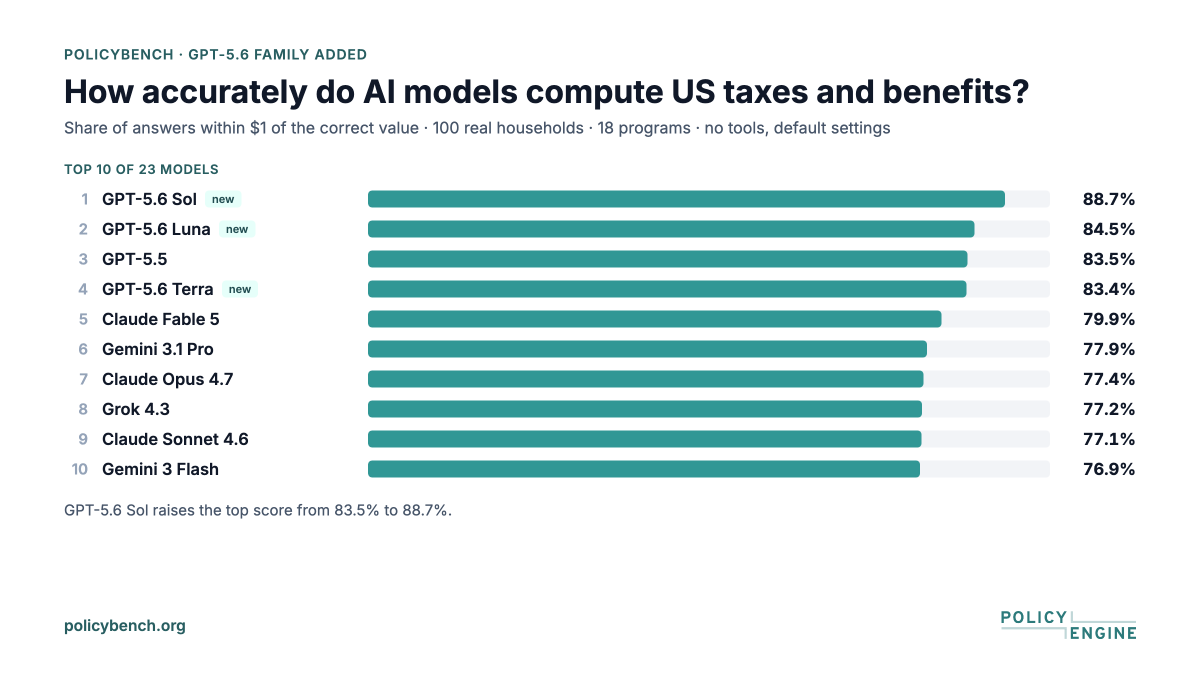
GPT-5.6 joins PolicyBench, our benchmark of how accurately AI computes US taxes and benefits (no tools, scored against PolicyEngine):
Sol #1 of 23 — 88.7% within $1 (prior best 83.5%)
Luna #2 — 84.5%
Terra #4 — 83.4%
https://t.co/e7idbTLBgr
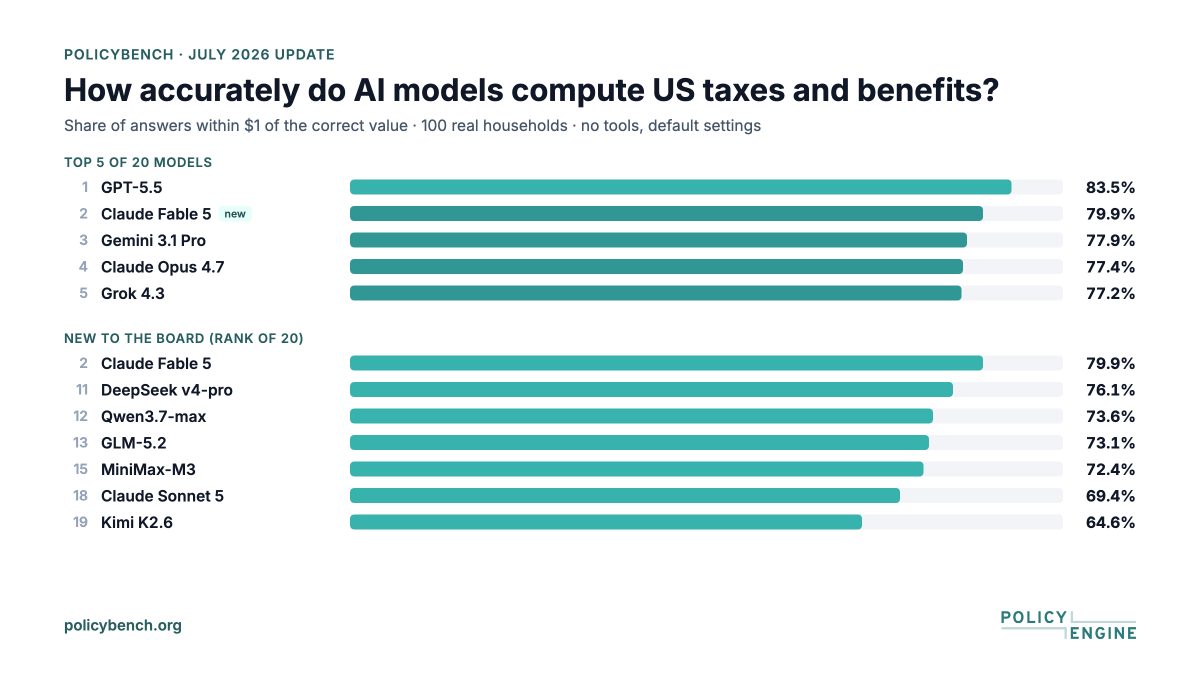
PolicyBench now scores 20 AI models on how accurately they compute US taxes and benefits — adding Claude Fable 5, Claude Sonnet 5, and five open-weight models: DeepSeek, Qwen, GLM, MiniMax, and Kimi.
GPT-5.5 leads, Fable ranks #2, and DeepSeek v4-pro tops the open-weight models.