It's highly likely that @zama will officially TGE at the end of January 2026 after the auction bid is completed. Let's see what our community predicts regarding the valuation of @ZAMA after the listing.
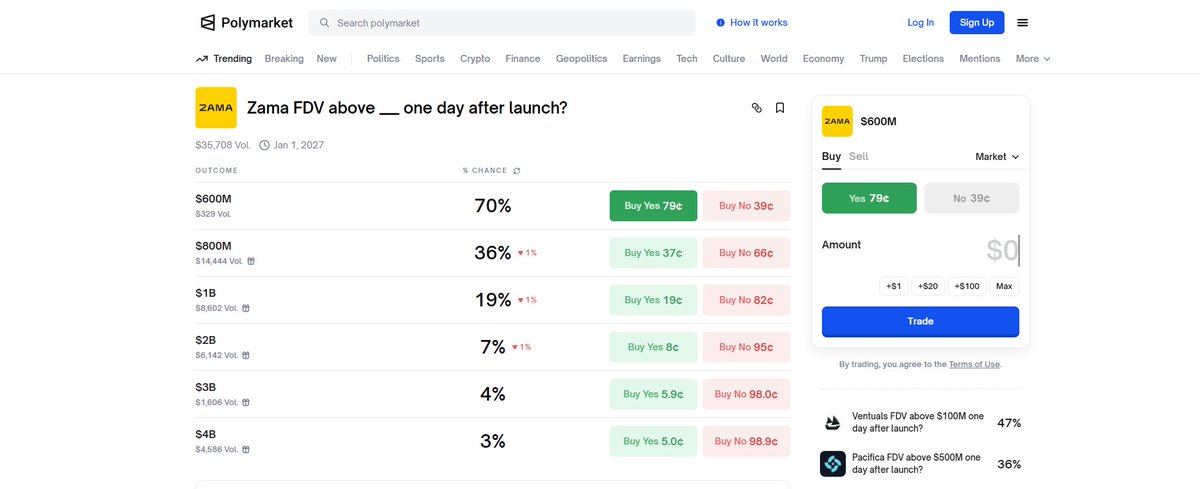
Currently, Polymarket has a pool predicting @zama 's FDV one day after the TGE. The results are as follows:
- 70% predict FDV above $600M
- 36% predict FDV above $800M
- 19% predict FDV above $1B
- Notably, 3% predict FDV above $4B
Regardless of the outcome, I believe the TGE and listing of @zama will definitely be the most explosive and impactful event of early 2026. What do you guys think?
#ZamaCreatorProgram
Yesterday, Zama officially announced the following massive benefits for OG NFTs: - Each Zama OG NFT can be purchased for a maximum of $200 at a valuation of $55M. Therefore, if you own 5 NFTs, you can purchase $1000 worth of NFTs, receiving 200,000 $ZAMA. - Those who own NFTs will also receive an additional 5% token bonus upon successful participation in the public bid auction. There will likely be no airdop, but these benefits have already exceeded my expectations. Remember that @zama raised $130M at a FDV valuation of $1.2B; listing at this valuation alone would have yielded a 40x return. to everyone!
Congratulations to everyone!
The Zama OG NFT rewards creators and developers who believed in Zama’s mission early. Thanks in part to your support, Zama went from moon-math curiosity to a top-trending protocol, putting privacy + FHE on the map forever. As a token of appreciation (no pun intended), OG NFT holders get two exclusive benefits:
I have 5 Zama OG NFT to give away.
To enter:
1️⃣ Follow @zama.
2️⃣ Like & retweet the announcement quoted.
3️⃣ 📝Comment this post with "Done" to be eligible.
(Announcing the winner tomorrow, December 24, at 1 PM CET, in this thread.).
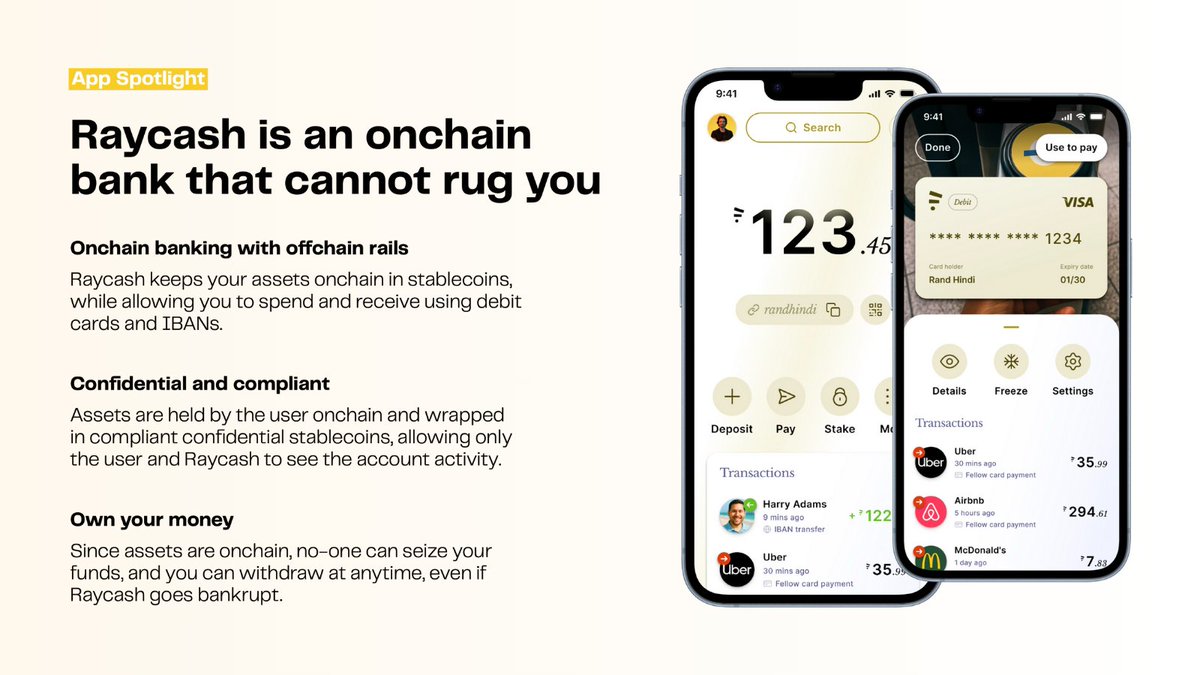
The team at @raycashxyz is building a self-custodial bank that can’t rug you.
Building on top of the Zama Protocol, they use confidential stablecoins to keep your funds secure and private onchain, while still letting you stake, swap, and spend them offchain with a debit card and IBAN.
Want to learn more about them? If you’re in Buenos Aires for @EFDevcon, stop by tomorrow for Raycash Day at the Zama CoFHE Shop.
All info: https://t.co/7h6VyNRvez
💡 Explaining the Access Control List (ACL) feature of the Zama Protocol.
The ACL is a permission management system designed to control who can access, compute on, or decrypt encrypted values in Zama's FHEVM. By defining and enforcing these permissions, the ACL ensures that encrypted data remains secure while still being usable within authorized contexts.
Why is the ACL important?
Encrypted data in FHEVM is entirely confidential, meaning that without proper access control, even the contract holding the ciphertext cannot interact with it.
The ACL enables:
◼️ Granular permissions: Define specific access rules for individual accounts or contracts.
◼️ Secure computations: Ensure that only authorized entities can manipulate or decrypt encrypted data.
◼️Gas efficiency: Optimize permissions using transient access for temporary needs, reducing storage and gas costs.
Read more about it here: https://t.co/2y56Hd6YAF
⚠️ Important reminder
The Zama Protocol is not a new L1 or L2, but rather a cross-chain confidentiality layer sitting on top of existing chains. As such, users don’t need to bridge to a new chain and can interact with confidential dapps from wherever they choose.
It leverages Zama’s state-of-the-art Fully Homomorphic Encryption (FHE) technology, which enables computing directly on encrypted data. FHE has long been considered the “holy grail” of cryptography, as it allows end-to-end encryption for any application, onchain or offchain. We believe that just like the internet went from zero encryption with HTTP to encrypting data in transit with HTTPS, the next natural step will be to use FHE to enable end-to-end encryption by default in every application, something we call HTTPZ.
Until recently however, FHE was too slow, too limited in terms of applications it could support, and too difficult to use for developers. This is what our team at Zama has spent the last 5 years solving. We now have a highly efficient FHE technology that can support any type of application, using common programming languages such as Solidity and Python, while being over 100x faster than 5 years ago. Importantly, Zama’s FHE technology is already post-quantum, meaning there is no known quantum algorithms that can break it.
While FHE is the core technology used in the Zama Protocol, we also leverage Multi-Party Computation (MPC) and Zero-Knowledge Proofs (ZK) to address the shortcomings of other confidentiality solutions:
◼️ FHE enables confidentiality while being fully publicly verifiable (anyone can recompute the FHE operations and verify them). Using GPUs will soon allow scaling to 100+ transactions/s while dedicated hardware accelerators (FPGAs and ASICs) will enable scaling to thousands of transactions per second.
◼️ MPC enables decentralizing the global network key, ensuring no single party can access it. Using MPC only to generate keys and decrypt data for users minimizes latency and communication, thereby making it far more scalable and decentralized than using it for private computation.
◼️ ZK ensures the encrypted inputs provided by users were actually encrypted correctly. Using ZK only for this specific purpose makes the ZK proofs lightweight and cheap to generate in a browser or mobile app.
Read more: https://t.co/f8UjmKpSRk
Great insights from @juanbenet on the state of onchain privacy, his thesis on FHE, and the future of private compute. Watch the recording from last week’s fireside chat with @analog_kyle at the Zama CoFHE Shop ⬇️