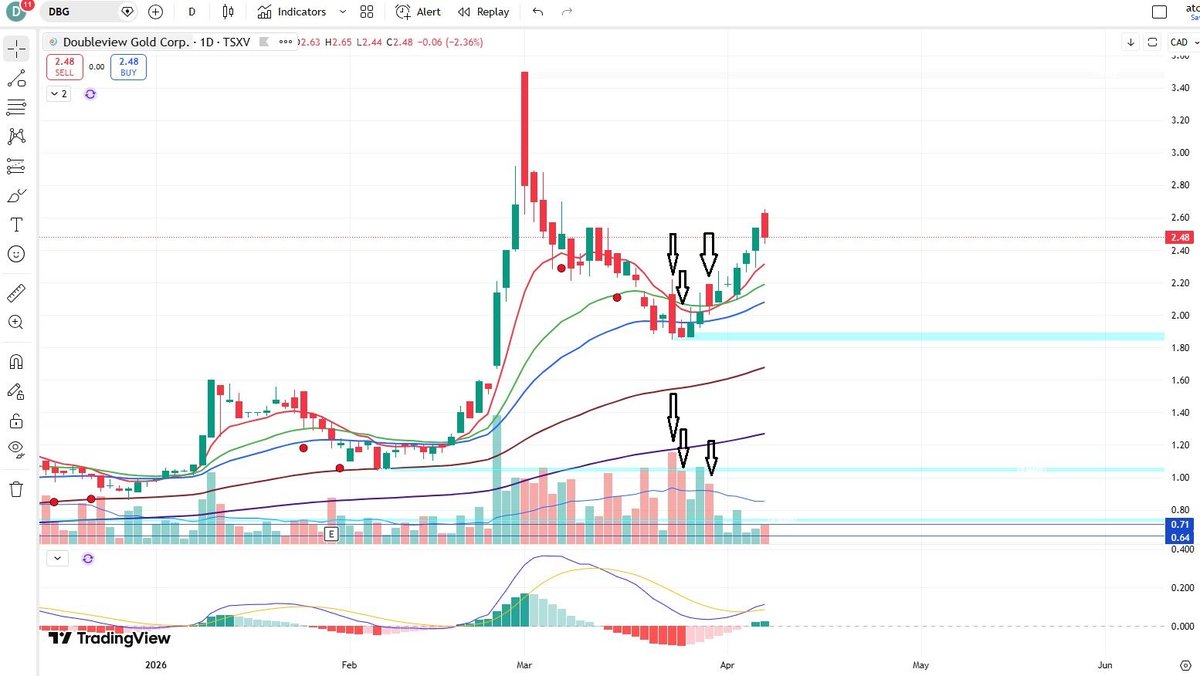
good looking setup $scd.v Up around 20% in 6 trading days! I love how it was trading tight between moving averages for a month before popping above that range on above average volume! #scandium is used in #aerospace so probably more upside coming! #swingtrade#swingtrading#tsxv
METAL MINING BULL CYCLE RESUMPTION FOR SUMMER 2026???
#GOLD#COPPER#SILVER#Preciousmetals
$COPX $GDX $SLV $GLD $SILJ $COPJ $SETM $SCCO $HBM $ERO $TECK $HSLV $SCZ $FDY $EXN $MUX $NEM ... there are HUNDREDS of setups out there, just to name a few! RT
These are 10 timeless principles that I’ve picked up from @OliverKell_ over the years.
I’ve spent a lot of time studying these concepts, making mistakes & slowly integrating them into my personal system.
Here’s how I personally think about and apply each one in my own trading:
--
1. PUT RISK FIRST.
This completely changed my trading, because I used to be obsessed with making money. Now I’m obsessed with protecting mental/physical capital. Before entering any trade, I already know:
> where I’m wrong
> how much I can lose
> whether the reward justifies the risk
Most of my focus is honestly around avoiding disaster. One really bad trade can wipe out months of progress.
"Best losers win."
--
2. IF YOU FAIL TO PLAN, YOU ARE PLANNING TO FAIL.
Most of my work happens late at night + before the market even opens.
I’m building focus lists, marking pivots, studying leadership, identifying themes, setting alerts, reviewing earnings dates, and visualizing different scenarios beforehand. Once the bell rings, I don’t want to be “thinking,” I want to be reacting to preparation.
The traders who consistently look calm usually prepared the hardest.
--
3. DON’T TRUST YOUR STOCKS, TRUST YOUR STOPS.
The market does not care about my opinion or thesis.
This was one of the hardest lessons for me emotionally because I used to marry ideas. Now I understand that my stop is what protects me from myself. If price breaks my level and the trade loses character, I respect it and move on.
I can always re-enter later!
Don't be the big ego guy...take the hit and move on.
--
4. IT’S BETTER TO BE OUT AND WANT IN THAN IN AND WANT OUT.
There is nothing worse than being trapped emotionally in a position you know you oversized, chased, or forced. I’d much rather miss upside than sit frozen in a trade that’s completely violating my rules.
There will always be another setup.
Always.
FOMO is expensive.
--
5. LET YOUR PNL GUIDE YOUR LEVEL OF AGGRESSION.
This is something I think newer traders massively overlook.
When my system is working, leadership is acting well, and my equity curve is healthy, I naturally press harder. When conditions become choppy, or I’m in a drawdown, I intentionally reduce size and become defensive.
I trade in bursts.
You don’t need to force activity every single day. Some environments are designed to pay trend/momentum traders extremely well. Others are designed to chop you apart!
Learning the difference is a huge edge.
--
6. ONLY PRICE PAYS.
I love narratives and themes, but price always comes first.
A stock can have the greatest story in the world, but if institutions are not supporting the move through price action, volume, and relative strength, it’s irrelevant to me.
That’s why I focus so heavily on:
* leadership
* compression
* breakouts
* EMA behavior
* relative strength
* reactions to pullbacks
The chart tells me whether institutions agree with the story.
--
7. SELL INTO STRENGTH OR YOU WILL SELL INTO WEAKNESS.
Especially with Options!
Selling into strength feels uncomfortable because greed convinces you the move will never end. But when names become extremely extended from key moving averages, euphoric, or crowded, I’ve learned to start paying myself gradually.
* large extensions from the 9EMA
* emotional momentum expansions
* vertical moves
* major target levels
If you never sell strength, the market usually forces you to sell weakness later.
--
8. FROM FAILED MOVES COME FAST MOVES.
One of my favorite concepts :))
Failed breakdowns and failed moves often create violent reversals because positioning becomes trapped. Once price reclaims key levels, shorts cover, buyers step in aggressively, and momentum accelerates quickly.
That’s why I pay so much attention to:
- EMA crossbacks
- undercut & reclaim setups
- failed breakdowns
- reclaiming prior pivots
- failed gap-downs
The fastest moves in the market come from failed positioning.
--
9. DON’T GAMBLE ON EARNINGS.
I learned this lesson the hard way multiple times.
Earnings reactions are largely out of our control. You can have the right thesis and still get destroyed because guidance, margins, positioning, or expectations shifted.
Now I’m much more intentional around earnings:
> reducing size
> trimming beforehand
> avoiding oversized exposure
> planning scenarios ahead of time
The most recent example being $CRWV this last week, reduced position into ER and was stopped @ b/e.
Stop trying to hit a home run every quarter.
--
10. NEVER BUY EXTENDED STOCKS.
This principle alone probably would’ve saved me tens of thousands early on.
When stocks become massively extended from their moving averages, your risk/reward immediately worsens. Chasing usually comes from emotion, not process!!
I spend most of my time waiting for price to come into areas of interest. For ex: pullbacks into the 9/21EMAs, tight consolidations, inside days, compression areas, weekly support pivots, etc.
--
At the end of the day, all 10 of these principles really tie back into one bigger idea.
Survive long enough for my edge to compound.
Simple concepts, but very difficult to execute every single day.
Save/bookmark this post for later.
I hope this helps!
Win rate is one of the most overrated metrics in trading.
Risk-to-reward is what actually pays you, so let me break it down for you.
Back in 2021-2022, a lot of “furus” sold beginners on flashy stats like 90% win rate because it sounds impressive to people who don’t understand the math. New traders hear that and think consistency. I hear that and immediately ask one question:
What’s the average winner vs. average loser?
Because that’s the whole game.
I think @NickSchmidt brought up a very important topic.
Trading is not a popularity contest, and definitely not about how often you’re right. It’s simply a math problem that only YOU can solve.
And the traders who understand that early skip years of pain and frustration. I’ll give you a real example.
1) Example 1: High Win Rate, Terrible Risk/Reward
Trader A wins 9 out of 10 trades.
Sounds amazing, right?
But every winner makes +$100, and the one loser is -$1,200.
Math:
9 wins = +$900
1 loss = -$1,200
Net = -$300
So despite being right 90% of the time… he lost money.
That’s the trap.
A lot of traders build systems designed to feel good, not make money. They take tiny gains quickly, then freeze when wrong and let one loser wipe out weeks of work.
That style works… until it doesn’t. And when it breaks, it breaks violently.
--
2) Example 2: Lower Win Rate, Strong Risk/Reward
Trader B wins only 4 out of 10 trades.
Sounds mediocre to most beginners.
But each winner makes +$500, and each loser is capped at -$100.
Math:
4 wins = +$2,000
6 losses = -$600
Net = +$1,400
Wrong more often, but far more profitable.
That’s real trading.
I would rather have a 30% win rate with 5:1R setups than a 90% win rate with sloppy negative expectancy.
Why?
Because one compounds, and the other eventually implodes.
This is why risk-to-reward is my main focus every single day. Before I enter any trade, I’m asking:
- Where am I wrong?
- How much am I risking?
- Does the reward justify the attempt?
- What is the realistic upside if I’m right?
If the answer is no, I pass.
"But... how do I incorporate this into my OWN system?"
1. Tight entries at major pivots:
I’m looking for asymmetric spots where I know quickly if I’m wrong. EMA reclaim, gap support, 15/30 min pivot, weekly breakout retest, etc.
That keeps risk small.
2. Leaders in strong groups:
I want names that can actually move if I’m right. No point risking $1 to make $0.80 in dead names.
3. Immediate invalidation:
If price loses the level that made the trade attractive, I’m gone.
I think of small losses as business expenses.
4. Let winners breathe:
If I catch momentum, I trim strategically and let part of the position work.
That’s where the asymmetry comes from.
I see most beginners obsess over being right, but you'll see the best traders obsess over expectancy/probabilities.
Which means...
(Win rate x average win) - (Loss rate x average loss)
That’s what matters.
1) You can be a bad trader with a high win rate.
2) You can be an excellent trader with a low win rate.
...the scoreboard is your equity curve.
What I gravitate towards:
- Average winner
- Average loser
- Max drawdown
- R multiple per trade
- Did you follow the plan?
Trading is simple math wrapped in difficult psychology. And once you understand that…
Risk-to-reward becomes the edge.
I don't see #fintwit talking enough about this topic:
@keter_slater And by the time price gets up there to test the buyers conviction I will be up 60%! If you know how to read volume, those 3 candles were screaming sellers exhaustion!
@EggBert19412178@SJosephBurns Haha yes I've been busy lately...will post some good looking charts soon! Traded mainly oil stocks lately but now I'm out of anything oil related...I'm now back into mining stocks...added over 30 mining stocks in the past week or 2, and looking to add more!