Jacinta Allan is already under fire over her new-look cabinet, as prominent property industry figures accuse her of neglecting key sectors by overloading senior ministers with critical portfolios. > https://t.co/8xFr42DfFS
@theage This was meant to stimulate the economy and deliver homes—fast.
Instead, it’s another reminder that headlines don’t house people.
In a housing crisis, every year counts.
🤯 Victoria’s COVID Fast Track Planning program promised speed when it mattered most.
6 years later:
• 0 of 19 projects approved in the announced timeframe
• Only 2 of 19 have commenced construction
Read more in @theage
@theage Intrapac’s Kinley project (former Lilydale Quarry) was one of them.
Rezoning approved Jan 2022.
Yet construction still hasn’t begun due to prolonged process delays across multiple authorities.
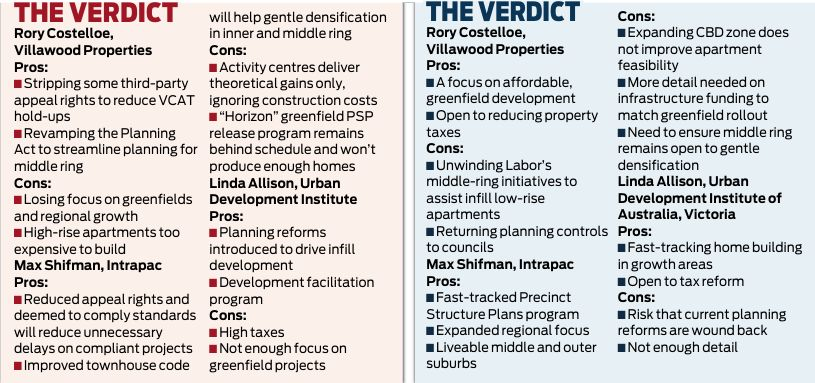
I was asked by @theheraldsun to opine on the policy announcements from @VictorianLabor and @LiberalVictoria.
My thoughts were slightly truncated in print, so here is what I actually said in full.
Labor Party
✅Positives
• Reduced appeal rights and deemed to comply standards will reduce unnecessary and vexatious delays on compliant projects
• Improved townhouse code will help gentle densification in inner and middle rings
⛔Negatives
• Activity Centres program delivers theoretical gains only. It ignores high construction costs and subdued demand relative to other types of homes.
• "Horizon" greenfield PSP release program is substantially slower than in the past and remains behind schedule.
• Infrastructure overspend in SRL precincts takes away from spend needed in other emerging areas
Liberal Party
✅Positives
• Fast tracked PSP program has potential to make a big housing supply difference - as long as infrastructure is delivered to match
• Expanding regional growth focus will help offset growth challenges in Metro Melbourne
⛔Negatives
• Expanding CBD zone does not improve apartment feasibility
• More detail needed on infrastructure funding to match greenfield rollout
• Need to ensure middle ring remains open to gentle densification
🤔I'm sure many more announcements to come into the lead up to 28 November.
#housingsupply #elections #policyreform #victoria #planningreform #feasibility
We see @VictorianLabor announcing higher taxes and higher property price today, to build their white elephant @suburbanloop.
In 20 years from now you will have a choice - get into an autonomous car, that will pick you up from your door and drop you directly where you want for half the price of getting on a train, that you will have to walk km’s to the station at both ends of your trip.
This isn’t just economic vandalism, it’s blatant corruption, jobs for unions to stay in power. They shouldn’t just be kicked out of parliament, those responsible should be considered for criminally prosecution for intentionally and fraudulently misappropriating taxpayers money.
#Auspol2025
➕Let's do some quick @suburbanloop "value capture" math ✖️:
- Land Tax ($5.7B) - Not value capture. It's a cynical redirection of existing state taxes, robbing funding from other things.
- 70,000 dwellings + contributions ($2.9B) - quick math shows this is an average of $41,428/dwelling? #mathaintmathin. At the new Activity Centre $11,500 rate = $805 million, growing to ~$34,000 per dwelling -from 2035. Developers can't make projects #feasible now, let alone with additional cost imposts. Don't forget the actual the uplift is only 25,000 dwellings over status quo.
- Windfall Gains Tax ($450M) - astounding if it delivers this much across the precincts based on current valuations and exemptions
- Carpark Levy ($800M) - talk about disincentivising commercial investment in these areas! The current Melbourne CBD levy raises around $110m p.a., so what fraction of that would SRL precincts do? 10%?
- "State Initiated" Development ($1.6B) - Made up number, basically assuming government land has zero value as-is. I'd be amazed if $1.6B was even the completed value of developments, which is not remotely the same as creating $1.6B of (increased) value.
There is no conceivable way these value capture mechanisms will get close to delivering $11.5 billion of new value, especially once the double counting on land tax is removed (robbing Peter to pay Paul...).
#SRL #boondoggle
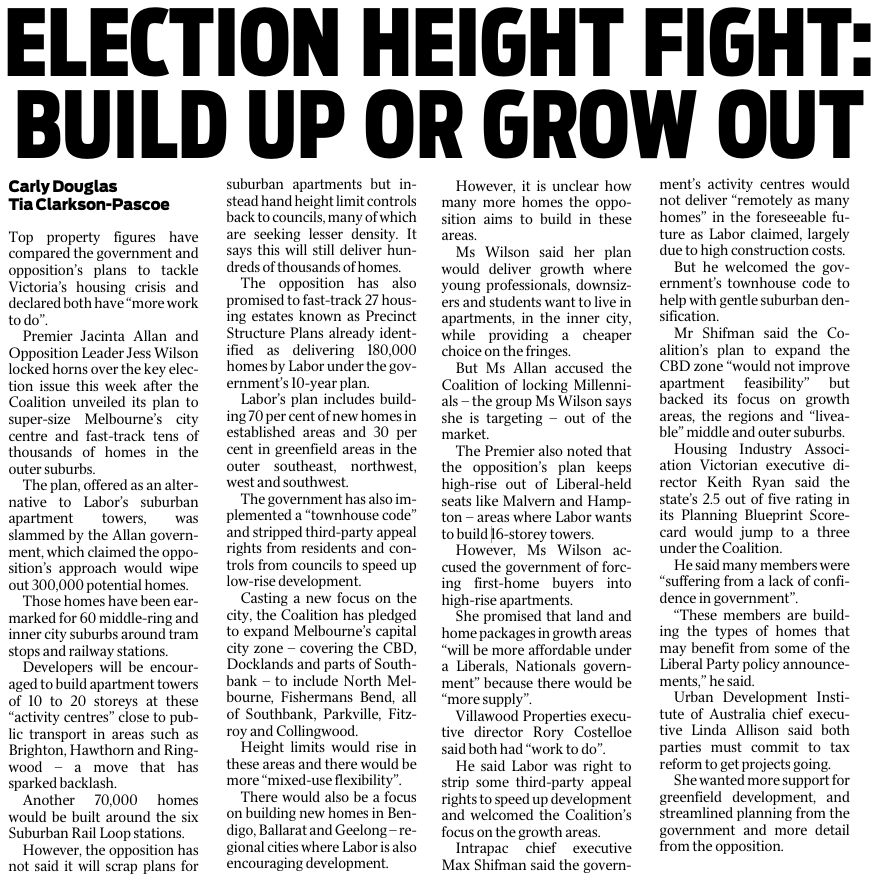
Max Shifman, said the government needed to stop treating property development like its “personal cheque book” and start clearing planning backlogs and boosting funding in growth areas.
“Quit focusing on announcements and new processes, and just get stuff done,” he said.
“And roll out better infrastructure spending spread across Victoria.”
You seriously don't understand the cost of new development or what makes it feasible.
In most suburbs across Australia, it is not the case, and certainly not like:like which is my primary point. If it was the case, why aren't we seeing scale new development everywhere?
There is a reason new apartments are almost exclusively being built in expensive suburbs, where that dynamic actually is true.
Don't confuse relative affordability with actual affordability.
I disagree that it "generally" holds true. It rarely does, particularly with the newer cost base.
How often do you see a house get knocked down in an established area, only to be replaced with 2-3 townhouses each more expensive than the original dwelling?
New apartments need an absolute minimum of $15k/m2 anywhere in Melbourne ($20k/m2+ would be the starting point in better locations).
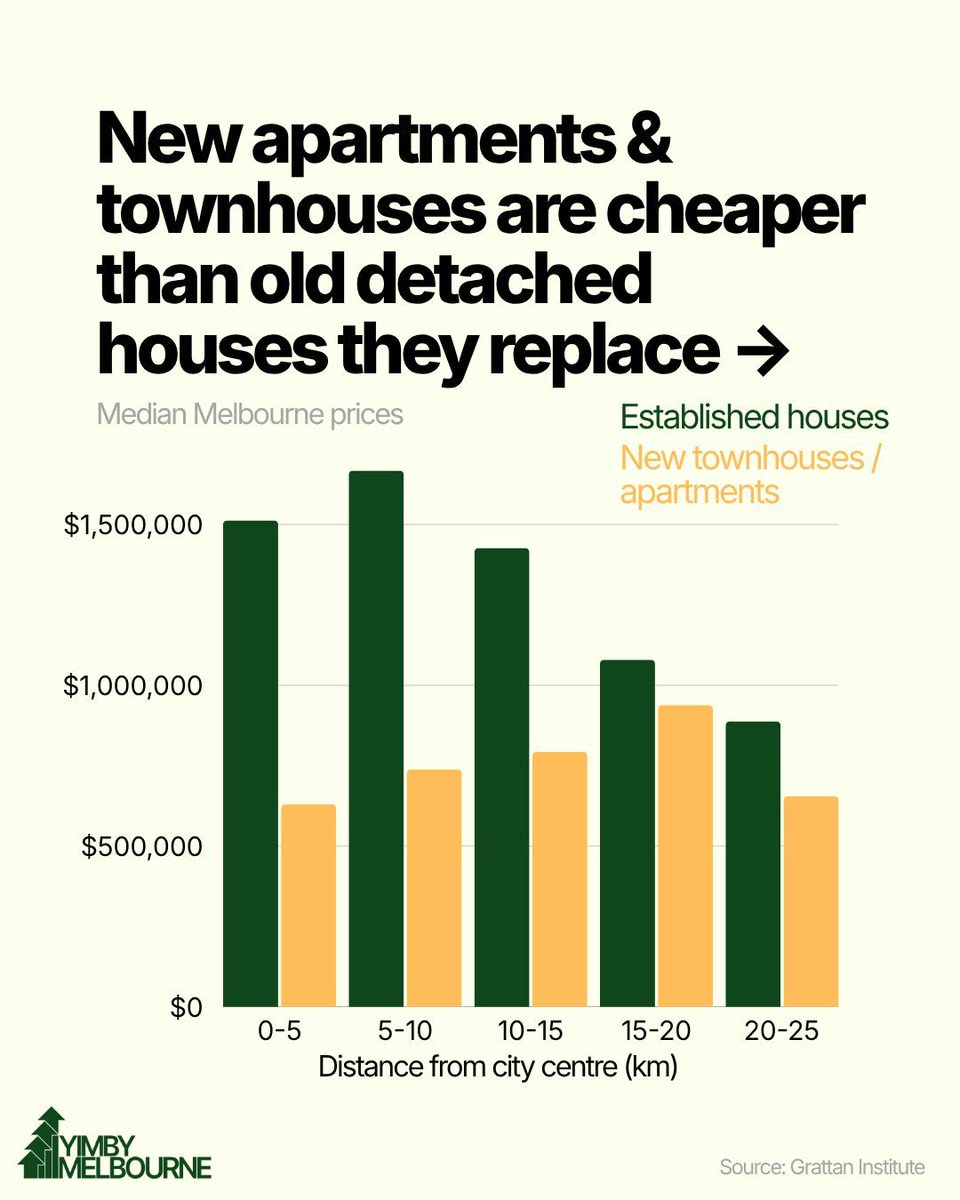
This chart remains fundamentally disingenous in the message it is trying to convey.
This @GrattanInst and @yimbymelbourne nonsense has to cease.
The chart compares the price of all homes against all "new" units - "new" being sales of units within the last 5 years.
1. Established houses have more space/utility (bedrooms etc.) than what they have compared as "new" unit. Not a like:like comparison.
2. So-called "new" dwellings, especially in the 10km inner ring, are mostly small 1-2 bedrooms units in high rise which have for the most part lost value over their new price.
3. The replacement cost for the same units in today's market would be anywhere between 30% and 100% more than the prevailing "existing" price due to cost escalation. In many cases paying more for a new, smaller unit than an existing detached house.
4. Comparing a new like:like (i.e. 3bed home vs 3bed apartment) you would find the cost of the apartment is likely greater than the median house price.
New apartments & townhouses are cheaper than the old detached houses they replace.
We should allow cheaper housing options to be built where people want to live.