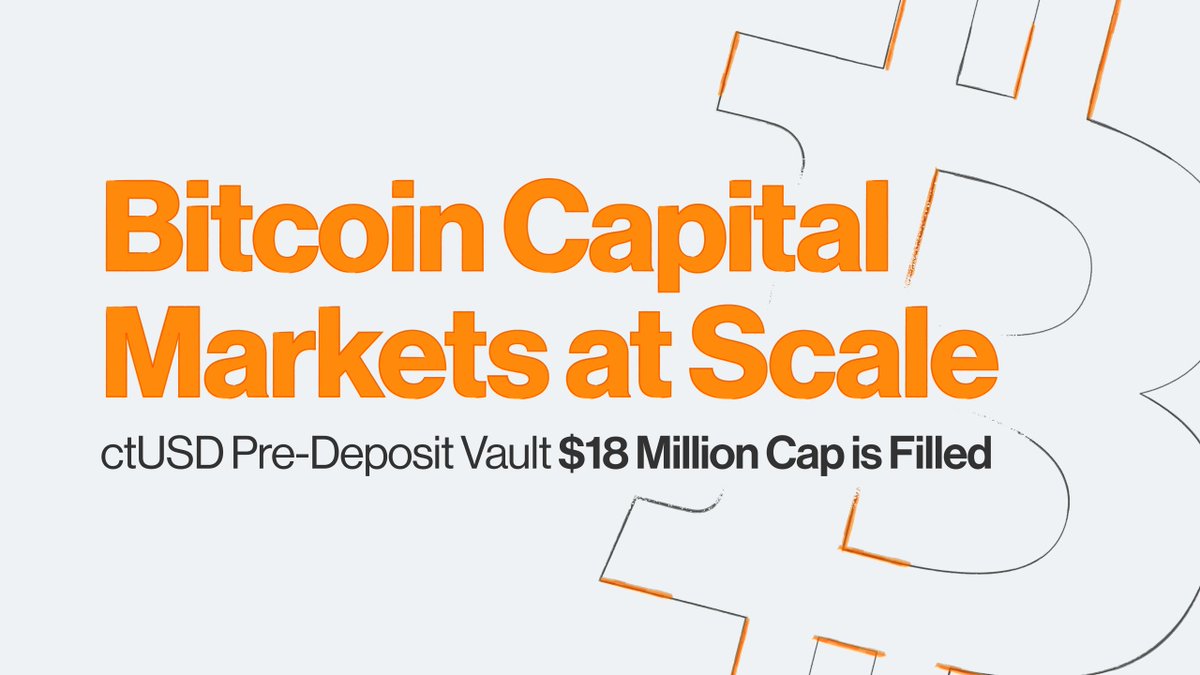
Happy to lead and anchor this one with @yield_network and @y10kcapital
One of the cleanest launches this cycle. Congrats to the team and everyone who participated!
$18 million cap filled 🍊
After the anchor liquidity from @yield_network & others, the ctUSD pre-deposit vault opened for public deposits.
The first public phase filled in seconds, so the cap was increased.
The new cap extension of $3 Million filled under 5 minutes 🧵
Good to see this one fill. 8 days from zero to cap
A few weeks ago the structure was still being finalized. Goes to show - when the product is right and LPs have time to do their work, capital finds it
The @pharos_network Alpha Vault on Ember has reached $50M in deposits, filling its full capacity in just 8 days since launch.
We thank everyone for the support and for participating! It has been exciting to see the momentum carry through each phase.
@SteakhouseFi Crazy work when support agents can disable 2FA because someone called them and said your name. Do you know what other information was shared by the attacker to lift the security and whether that information was a private leak from Steakhouse team or publicly available ?
Pharos pAlpha High Yield RWA Vault is going live on Monday 4pm UTC.
- 18% APY — Phase 1
- USDC on Ethereum
- Treasury underlying (JTRSY + MMF)
- Fully withdrawable
Curated by Axil. Vault infra by @EmberProtocol
Pre-register your wallet:
https://t.co/CucGNndXyl
Proof of Liquidity landed in Cannes during @EthCC week 🇫🇷
Supply side, demand side, and the infra connecting them - all in one room.
Proof of Liquidity: Cannes Edition - done.
Stay tuned for the next one 👀
Been sitting on it for a while but finally excited to roll out.
DeFi has a capital formation problem. Millions spent on incentives, single-digit retention. Protocols rent liquidity for 30 days and call it a launch.
We spent the last year building the coordination stack to fix this at @yield_network. Today, we're adding the deployment stack, partnering with @Rockaway_X.
The thesis: real opportunities in DeFi aren't on Defillama. In most cases, they're negotiated privately, capped pre-deposits, genesis launches, curated lending markets with defined windows, and terms for institutional LPs. Accessing them requires origination and risk infrastructure, not an aggregator.
Y10k Capital - the name is a commitment. Year ten thousand. Deliberately absurd because the current time horizon in DeFi is deliberately short.
If you're building an onchain product and looking for aligned liquidity, DM me here or on Telegram
Y10k Capital is an actively managed onchain vehicle providing access to curated yield mandates: pre-deposits, genesis launches, and lending markets.
Risk operations by @Rockaway_X. Distribution by @yield_network
https://t.co/SMB3jDiq1Z
Everyone's racing to tokenize assets.
Almost nobody is solving how capital actually finds those assets, commits to them, and stays.
That's the gap. Joining this one tomorrow.
Not another RWA talk.
A real discussion about what's actually working.
Behind the Asset EP2: RealFi Uncovered - Building the Future of Onchain Finance
📆 March 19, 11AM EST
🔗 https://t.co/r0YbRKwoKh
Featuring:
- @Alchemy - @glennonchain (Glenn Rothwell, Business Development)
- @AquaFluxPro (Jackie, Head of Strategy)
- @Dune - @filippoarman (Filippo, Research Lead)
- @yield_network - @maxyamp (Max Yamp, Founder & CEO)
Hosted by @michellek_web3 (Michelle Kang, CMO)
Tokenization ≠ usable asset.
Infrastructure is everything else.
Set a reminder 👇
The bridge facilitator model is compelling for T-bill collateral where NAV is stable and settlement is T+1.
Genuine question: how do the facilitator economics change for RWAs with longer settlement windows and less liquid primary markets? Think energy credits, infrastructure receivables - assets where settlement might be T+30 or quarterly. The bridge capital lockup goes from 1 day to weeks, and the collateral deterioration risk within that window is materially harder to price.
Asking because we're working on tokenized energy yield instruments where the looping drag is the exact bottleneck capping leverage demand. Would be good to compare notes on how 3F thinks about extending the model beyond short-duration collateral