WHY DYNAMIC STAKING REWARDS MATTER!
The future of $ITLG staking isn't just about earning rewards. It's about creating a model that can evolve alongside the InterLink ecosystem.
💎 No promised fixed returns.
📈 Reward rates designed to adapt to ecosystem conditions.
🌐 Growing dApps and ITLX activity.
🤝 Sustainable participation and long-term community engagement.
Dynamic rewards could provide the flexibility needed as the network expands, while transparent calculations and regular reporting remain essential to building trust.
The bigger the vision, the stronger the need for accountability!
FLEXIBLE REWARDS. REAL UTILITY. TRANSPARENT GROWTH.
#InterLink #ITLG #ITL
Recognition like this means more than being part of a list. It reflects the role early companies played in shaping Dubai’s regulated virtual asset industry.
RIV Technologies being among the first 50 firms recognised by VARA is a milestone worth celebrating.
Building a trusted industry takes commitment, and being part of that journey from the early days matters. @rivcapitalgroup@abdallah_emad__
Good night creators. I stopped trading at night and started deciding at night. @Hypesium let me separate the hour I choose from the hour I fill, and that separation has been worth more than any execution upgrade I have made.
Trades I placed live after dark: 22 percent win rate. Snipes I armed after dark that fired at the morning open: 58 percent. Same wallet, same clip, same pads, same me. The difference is that at night there is no candle moving in front of me. Nothing is pumping while I read, so I read the deployer instead of the chart, and I choose on evidence rather than on motion. Every bad night trade I have made was a decision I made while watching something go up.
Arming is real work, not a reminder. The route and the transaction get assembled before the creation log ever arrives, gas is kept current, the wallet's nonce is held, so when the pool appears the send is a check and a write rather than a build. That means the part of the trade that needs judgement happens at 1am while I am calm, and the part that needs speed happens at the open while I am asleep. I am not deferring the trade. I am doing the slow half early.
The front door still gets its own vote. The exact buy is simulated before it sends with the sell exercised in the same pass, the profile carries its tax ceiling and liquidity floor, and failures never reach the network. That is the structure I actually want: two independent chances to say no, one from me at night and one from the filter at the open. A calm decision is still a guess, and I would rather it be checked twice.
What arming cost me is specific. I armed twelve once and they all fired inside the same minute, and because my trading capital and my gas are the same HYPE pool, the last one, which was the best one, could not afford its own exit. I now cap what I arm by what is left for gas, not by how many launches look interesting. I also armed a deployer who launched into a dead hour, filled cleanly, and was dead by morning. Arming lets me choose the token. It does not let me choose who is awake to buy it, and I have no way to condition on that.
Nineteen pads is their count, not mine, I have not walked every rulebook, and the history here is short enough that one good week of morning fills proves less than I want it to.
Mainnet since the ninth of November. Always DYOR.
How many snipes do you have armed right now: 0, 3, or 10?
AI agents are moving beyond conversations and starting to participate in real economic activities.
That's where @termix_ai comes in.
TermiX is building the Agent Autonomous Commerce Protocol (AACP) an infrastructure that allows AI agents to hire one another, provide services, verify deliveries and settle payments onchain without relying on centralized intermediaries.
Some of its key features include:
• Onchain agent identities and portable reputation
• Smart-contract escrow for secure payments
• Staking and slashing to encourage accountability
• Dispute resolution through independent evaluators
What's particularly interesting is its potential in DeFi.
Agents can use @termix_ai to provide trading signals, conduct market research, monitor risks, scout liquidity, and execute quant strategies through structured, escrow-backed jobs.
Its DeFAI Protocol also helps agents interact with DeFi applications and execute operations across multiple chains.
Creating an economy where AI agents can work, collaborate and pay one another with verifiable accountability.
Termix is building infrastructure for that future, and it's worth watching.
Marketplace: https://t.co/3STvzATptG
when I was around 8 years old, in primary 4, I guess my mum thought I was finally mature enough to handle some responsibilities.
and by responsibilities, i mean running errands!
one of my regular duties was buying recharge cards. sometimes, Mum would send me twice in one day.
the funny part? she already had an android phone, but somehow, I was still the family's recharge card delivery girl. 😭
sometimes, I'd get to the vendor and completely forget the network or amount she requested. I'd have to run all the way back home to confirm.
my dad had his own routine. whenever electricity bills came, he'd sometimes visit the NEPA office or give money to people who claimed they could help settle the bills. unfortunately, some of those payments never went through.
my brothers were football lovers. BET9JA was practically their second home. And whenever our DStv subscription expired, we'd wait for Dad to find time to go into town to renew it.
looking back, almost every household expense came with an errand!
Fast-forward to today, I'm now a student and digital marketer.
I need plenty of airtime and data to attend to customers, respond to enquiries, follow up on orders, communicate with clients and keep my work moving.
Imagine a customer waiting for an important response and your data suddenly finishes. 😂
You can't tell someone waiting for an order that you're currently negotiating with your network provider!
Electricity, subscriptions, rent and other bills still need attention too.
Even though things are easier digitally now, dealing with different platforms, failed transactions and keeping payment records can still be frustrating.
And it got me thinking:
We're already spending money every day, but are those payments helping us build anything for our financial future?
@creditveto_afr
Good morning and happy Wednesday
One thing I appreciate about @beepzfun is that it doesn't treat launching an inscription as a one-click decision.
Before deployment, creators have to think through the structure:
What's the total supply?
How much should each wallet be able to inscribe?
Will participation be free or paid?
Should there be a wallet limit?
When should the launch begin?
These choices shape how people interact with the inscription from day one.
And there's an important detail: once deployed, the core launch parameters are fixed.
That means creators need to think beyond getting an inscription online. They need to design the rules before inviting people in.
To me, that's the difference between simply creating an asset and actually designing a launch.
Good launches start with good parameters.
When a member relocates to another city, a good pastor doesn't treat it as a loss. He writes a letter of transfer, blesses them into the new church, and keeps the fellowship going.
That's what I see in @GenLayer taking its public network to @arbitrum.
After years of building alongside @zksync, GenLayer's chain now runs on Nitro instead of the ZK Stack. But GenLayer didn't walk away from them. It keeps working with them on Prividium: private, permissioned versions of GenLayer for institutions, like a group of banks settling contracts between its members.
So the public network gets a new home, where many of the builders it wants to work with already are. The private work continues with the people it started with.
A project that can move without breaking a relationship is one I'd trust to judge disputes.
Have you ever left somewhere and kept the relationship stronger than before?
My client thought I was about to take their Shopify store offline.
I was only redesigning it.
I showed them the new look, and their products, orders and customer records were still there. The storefront changed, but the business underneath didn't.
That worry reminded me of the confusion around @GenLayer moving to @arbitrum. Except this time, the change was underneath.
Intelligent contracts still execute in GenVM on validators' nodes. Validators still reach consensus through Optimistic Democracy.
What moved was the GenLayer Chain, the EVM chain recording transaction order, committees, votes, appeals and final outcomes. It switched from Matter Labs' ZK Stack to Arbitrum Nitro, operated with Conduit.
That wasn't just swapping a label. The bridge, Ethereum integration and gas handling needed migration work. Validators now connect to the new chain, but their role hasn't changed.
The lesson isn't that nothing changed. It's knowing exactly what changed before assuming everything did.
If you were building on GenLayer, which would you verify first after the move: bridge behavior, gas costs or validator connectivity?
Good Morning CT
Token launches are interesting but the way they work matters just as Much.
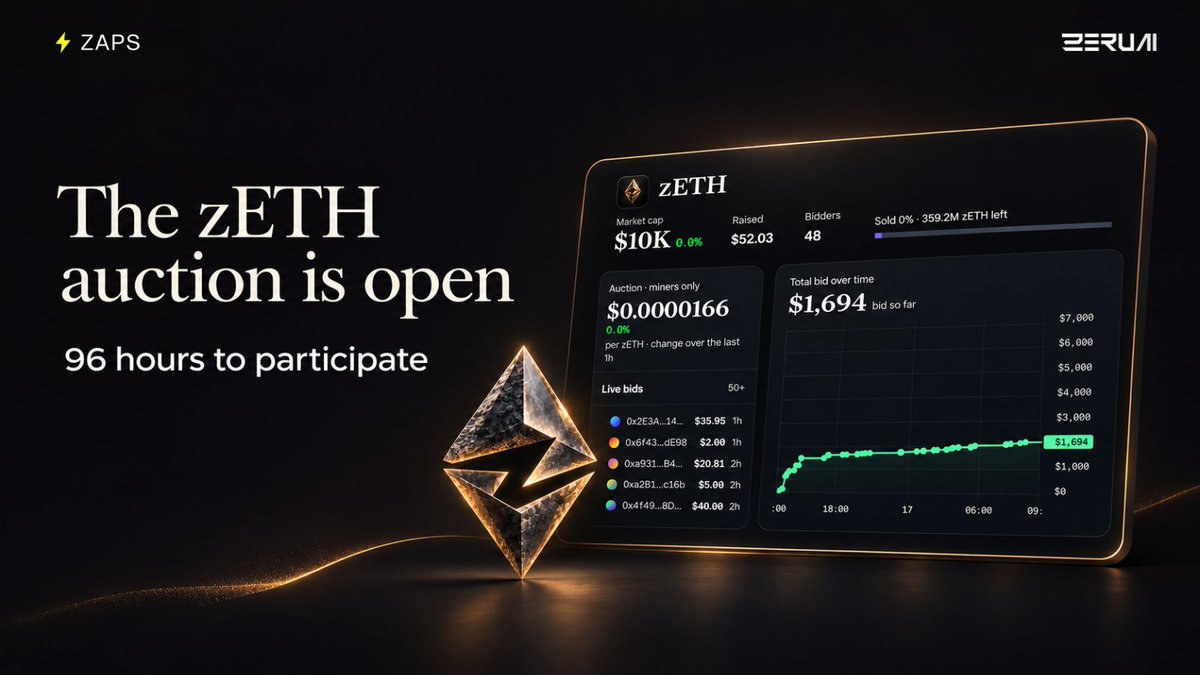
The zETH auction from @ZeruFinance is now open to the public on @Uniswap CCA with a 96 hour Window to Participate.
One thing I find interesting is how the pricing works. Bids within the same block get the same price and the price moves upward block by block rather than falling during the Auction.
There are a few other details worth noting too. Unused USDC gets returned after the Auction Any unsold zETH is burned and There’s no minimum raise or team and developer token Allocation.
The zETH Race helped determine the supply. Now it’s time to see how the market Responds.
I’m Curious to see how this auction plays out and what it could mean for Future Token launches.
Explore:👇
https://t.co/BEbKunOtc3
Drug names and procedure names are where our care team's edits pile up when they review an agent's notes, so those are the words I'm checking first on Scribe v3 Live Medical