‼️ Hasta ayer le pedíamos cosas a la IA y esperábamos la respuesta.
Eso acaba de cambiar.
OpenAI presentó Dots‼️
Cada Dot tiene su propia computadora en la nube, navegador y acceso autorizado a más de 4,000 aplicaciones.
Puede trabajar mientras tú haces otra cosa.
Investigar.
Revisar nueva información.
Actualizar un proyecto.
Preparar documentos.
Incluso detectar trabajo que olvidaste hacer y adelantártelo para aprobación.
Ya no hablamos solamente de una IA que responde preguntas.
Estamos entrando en la etapa de delegarle trabajo.
Y esa diferencia parece pequeña hasta que pensamos qué significa para prácticamente cualquier empleo de oficina.
https://t.co/DqdKbcTKPs
"El consejo de Elon a los jóvenes de 20 años para sobrevivir en la era de la IA: Obtén la educación más amplia posible: artes, ciencias, ingeniería y un conocimiento general amplio. ¿Por qué? La IA y los robots cumplirán casi cualquier solicitud de inmediato. La ventaja no estará en realizar el trabajo. Estará en saber qué pedir. Cuanto más amplio sea tu conocimiento, mejores serán tus preguntas".
Si te da miedo que la IA programe todo, aprende hardware, redes, linux, infraestructura, cloud, IoT.
Programar no es hacer sitios web, hay un mundo completo de posibilidades.
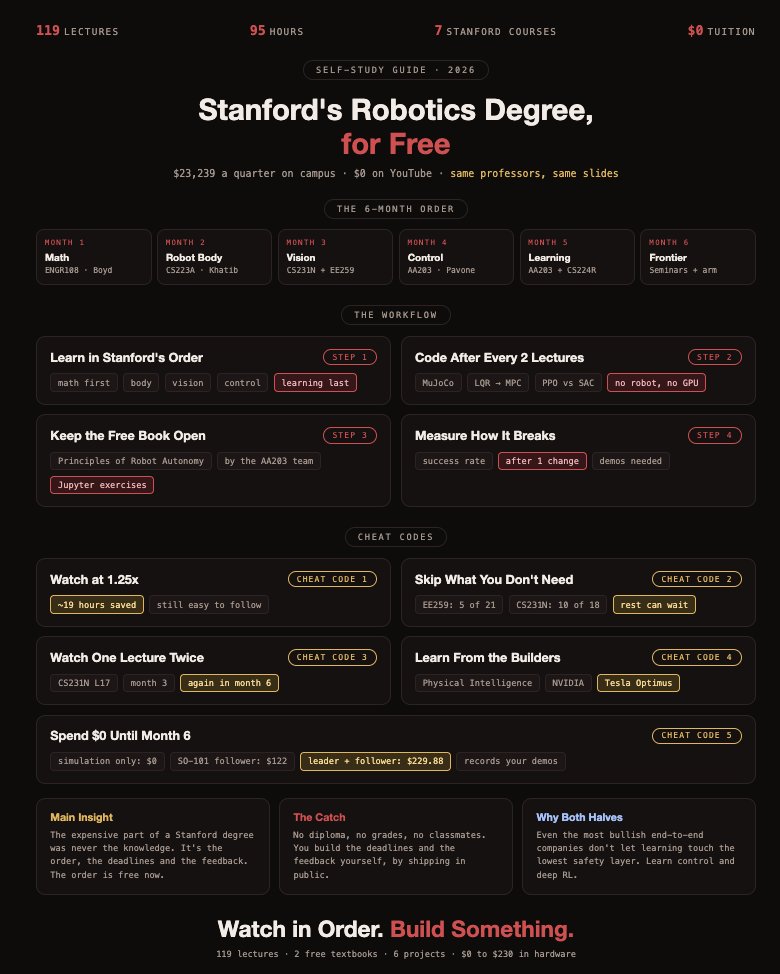
How to learn robotics from Stanford without paying Stanford:
stanford charges $23,239 a quarter for graduate engineering in 2026-27
and 119 of its robotics lectures sit on YouTube for $0. same professors, same slides
so here's my workflow for turning them into a robotics career:
1: learn in the order stanford students do
math → the robot's body → vision → control → learning
most people open a viral humanoid seminar first and quit at the word "Jacobian"
start with Boyd's linear algebra course instead. 54 short lectures, most under 30 minutes
2: never watch two lectures in a row without writing code
the videos are support. the practice tasks are the course
- compute forward kinematics of a real robot arm model in MuJoCo
- balance a cart-pole with LQR, then with MPC
- train PPO and SAC on the same task and compare the curves
- clone your own controller with behavior cloning and watch it drift
all of it runs on a normal laptop. no robot, no GPU
3: keep the free textbook open next to the video
AA203 has its own book, written by the same people who teach the course: Principles of Robot Autonomy, free online with Jupyter exercises
when the professor goes too fast, the book goes slower
4: measure how it breaks
everyone can make a demo work once
your final project needs 3 numbers:
- success rate on the task you trained
- success rate after you change one thing in the scene
- how many demonstrations it took
the second number is the one interviewers ask about
cheat-codes to get the most out of free stanford:
1. watch at 1.25x
saves about 19 hours over the full 95-hour path
2. skip what you don't need
you need 5 of EE259's 21 lectures and 10 of CS231N's 18. the rest can wait
3. watch the robot learning lecture twice
CS231N lecture 17 in month 3, then again in month 6. after a month of RL it looks like a different lecture
4. learn from the people who build the robots
Chelsea Finn, co-founder of Physical Intelligence. Marco Pavone, autonomous vehicle research at NVIDIA. Ashish Kumar, AI lead of Tesla Optimus, as a guest lecturer
5. spend $0 until month 6
then $122 for one SO-101 follower arm, or $229.88 for the leader + follower pair that records your demonstrations
main insight:
the expensive part of a Stanford degree was never the knowledge
it's the order, the deadlines and the feedback
the order is free now. the deadlines and the feedback you build yourself, by posting what you build in public
and one more thing
in the final AA203 lecture, Stanford explains where AI stops inside a robot:
even the most bullish end-to-end companies still don't let learning touch the lowest layer, where the hard safety constraints live
that's why this path teaches control theory and deep RL, not one or the other...
I can't stop creating 3D animation for everything with Opus 5.5... I'm addicted.
This is a 3D tutorial for how to automate my elevated garden beds in my backyard.
Bitwise filed the final prospectus for a spot NEAR ETF. Their NEAR pitch for it is already public.
They published a 39 page investment case for NEAR that ends with a product page for their European NEAR ETP.
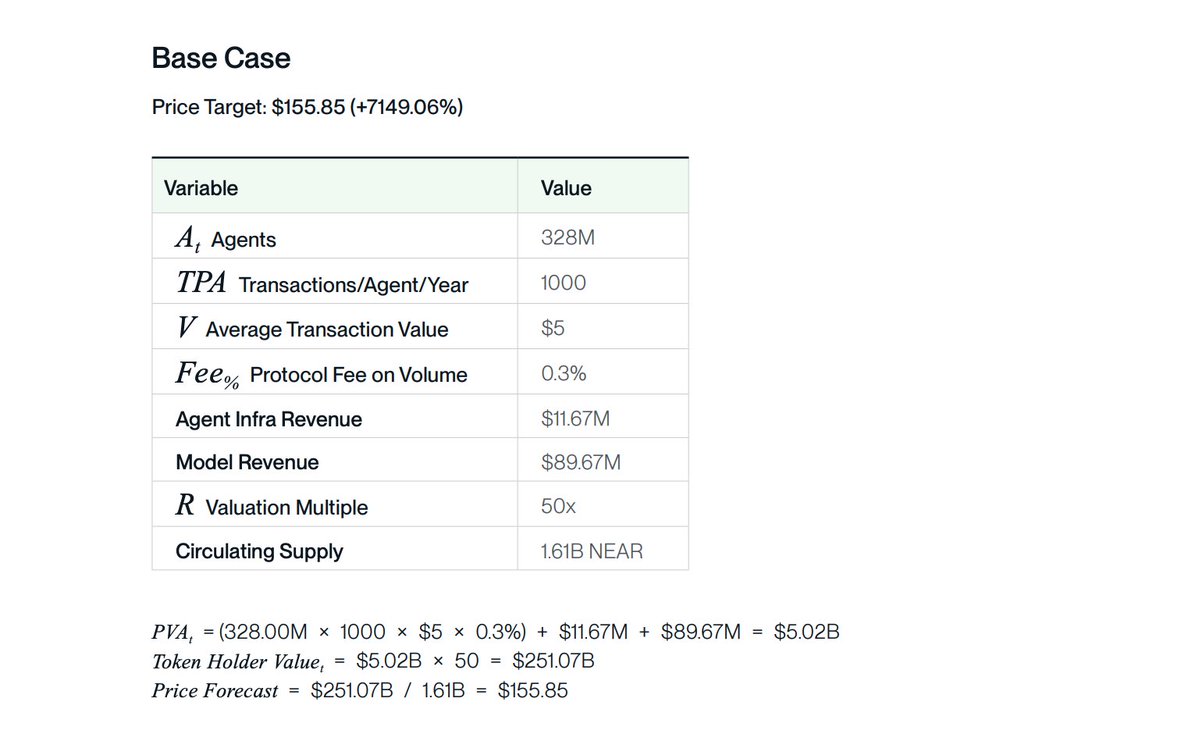
Base case $155 per NEAR by 2030, max case $562. Bear case is $1.63, they do not hide it. Matt Hougan, CIO of Bitwise, is one of the authors.
To justify the max case they compare NEAR to Visa, which moved $15.7 trillion in payments in 2024 and is worth $701 billion.
I asked GPT-6 Astra to turn our rocket factory demo into a launch operation.
V3 now builds four reusable boosters in-house. Each has its own pad, landing zone and recovery route.
The factory runs in parallel. The launches don’t: weather, launch windows, pad servicing and refurbishment decide when each rocket can fly again.
Built in @AirsupHQ.
now we're getting somewhere with the astra rover 😎
codex been working on this in fusion while i've been working on other projects and attending google meetings lol
Hungry for more Astra robot videos? 🤖
How about a large-scale sandboxed evaluation to go with it? We ran 98,000 evaluations across 28 simulated environments and found some surprisingly clever physical reasoning along the way!
New preprint 🧵👇 (1/9)
On an IKEA table assembly task, Fable 5.1 and Opus 5 fail, while Opus 5.5 and GPT-6 Astra both succeed.
Opus 5.5 finishes faster; GPT-6 Astra takes a cleaner, safer trajectory.
Check out our full benchmark + datagen pipeline at https://t.co/SARwAxUd1n, full paper at https://t.co/OM9A6O6MxI, and project page at https://t.co/wKxyqCr8Dj!