4,5 milyar yıl önce başlayan sessiz bir devrim…
Tektonik plakalar çarpıştı, Dünya’nın kabuğu kırıldı ve yükseldi.
Sonuç: Dağlar.
Bu animasyon, bilimin ne kadar görkemli olduğunu bir kez daha gösteriyor. 🌋🏔️
İzleyin, gerçekten etkileyici.
Photographer Phil Thurston shot a wave.
Slowed it down until those few seconds became 40.
Turns out the ocean is doing something extraordinary every single moment.
We're just moving too fast to notice.
El Cristo Velado (Il Cristo Velato, 1753) es considerada una de las obras maestras más asombrosas y enigmáticas de la historia del arte universal, célebre por lograr el efecto de un tejido transparente utilizando únicamente un bloque de mármol.
El encargo fue ideado inicialmente por el escultor Antonio Corradini, famoso por sus figuras veladas. Sin embargo, Corradini murió en 1752 habiendo realizado únicamente un pequeño modelo de arcilla.
El aristócrata e inventor Raimondo di Sangro, Príncipe de Sansevero, contrató entonces a un joven y relativamente desconocido Giuseppe Sanmartino para terminar el trabajo.
El príncipe le dio una instrucción estricta: esculpir una estatua de mármol a tamaño natural de Jesucristo muerto, cubierto por un sudario transparente tallado en el mismo bloque de piedra.
Hubble captured Jupiter's north pole in a stunning electric blue aurora display.
These are 1000 times brighter than Earth's, powered by its giant magnetic field and sulfur ions from Io's volcanoes. Real NASA ESA Hubble STIS data.
Every second, the Sun ejects 1.5 million tons of material into space at hundreds of miles per second, but Earth's magnetic field protects it from the solar wind.
📽: NASA Goddard
BREAKING🚨 : ⚡ NASA releases insane new image of the mighty hexagonal storm on Saturn's North Pole.
This massive storm is over 20,000-mile-wide. Wide enough to fit roughly 4 Earths inside it. It's been observed continuously since Voyager spotted it in 1981, so at least 45 years, though it's likely much older
Saturn doesn’t just have rings — it rules an entire miniature solar https://t.co/MrqpkqJLDA of 2026, the ringed giant boasts 292 confirmed moons, far more than any other planet, with the number still climbing as astronomers keep spotting tiny new ones. Dominating them all is Titan, a colossal world larger than the planet Mercury. With a thick nitrogen atmosphere, rivers and lakes of liquid methane, and a diameter of 5,150 km, Titan feels more like a planet that got captured than a mere moon.Titan orbits Saturn at a safe distance of about 1.2 million kilometres — well beyond the outer edge of the famous ring system. Those dazzling rings, made of countless icy particles and moonlets, are confined much closer to the planet, while Titan sails majestically around the entire sprawling family of satellites. The sheer crowd of moons — from planet-sized Titan down to kilometer-scale irregular rocks — reveals just how gravitationally chaotic and crowded Saturn’s neighborhood truly is. It’s a dynamic, ever-evolving system where collisions, captures, and gravitational dances continue to shape one of the most spectacular regions in our Solar System.
El Péndulo de Foucault instalado en el Panteón de París es uno de los experimentos científicos más famosos de la historia, diseñado para demostrar la rotación de la Tierra de forma visual y directa.
En 1851 el físico francés Léon Foucault realizó la primera demostración pública en el Panteón bajo el mandato de Napoleón III. Eligió este edificio por su gran altura, necesaria para que el péndulo oscilara durante mucho tiempo sin detenerse.
La instalación que vemos en este video grabado en el Panteón es una reproducción activa. El péndulo original utilizado por Foucault en 1851 se conserva y se exhibe en el Museo de Artes y Oficios (Musée des Arts et Métiers) de París.
Video grabado con fines educativos.
Cueva de Fingal, una cueva basáltica famosa en Staffa, Escocia. Columnas hexagonales de basalto formadas por lava hace 60 millones de años. ¡Parece catedral de la naturaleza! https://t.co/irrwZSszVY
NASA just dropped this mind-blowing view of the Grand Canyon from space… Imagine carving a wound so enormous it stretches 277 miles long, plunges over a mile deep, and spreads up to 18 miles wide… yet from orbit, it looks like nothing more than a delicate scratch on the planet’s skin.That’s the Grand Canyon.What hits hardest is the brutal perspective shift: something so colossal on the ground—something that would swallow entire mountain ranges—almost vanishes when you pull back far enough. Stand on the rim and it feels infinite. Float above Earth, and it’s a https://t.co/CQEfxgcbv9’s a humbling reminder that our most epic human achievements, our sprawling cities, our tallest skyscrapers, even our own lives… are microscopic against the raw scale of this planet.And Earth?
Just a pale blue speck drifting through an incomprehensibly vast https://t.co/VGhM0Y4lcB time you feel like the weight of the world is on your shoulders, zoom out. Way out. Perspective is everything.
🇮🇹🏛️ EL PANTEÓN DE ROMA:
El misterioso agujero del techo que nunca logra inundar el templo 🌧️
Cualquiera pensaría que dejar un agujero de más de ocho metros en el techo de un edificio es una idea desastrosa.
Pero los romanos lo transformaron en una obra maestra.
El enorme óculo del Panteón permanece abierto desde hace casi 2.000 años.
Por él entra la luz del sol, el aire fresco… y también la lluvia.
Sí, cuando llueve en Roma, el agua cae directamente dentro del templo.
Y aun así, el interior nunca se inunda.
El secreto se encuentra bajo el suelo de mármol.
Aunque parece completamente plano, en realidad posee una ligera inclinación convexa casi imperceptible que dirige el agua hacia los extremos del edificio.
Allí, una red de 22 drenajes ocultos evacúa el agua rápidamente mediante un sistema tan eficaz que continúa funcionando hoy exactamente igual que en la Antigua Roma.
Sin electricidad.
Sin bombas hidráulicas.
Sin tecnología moderna.
Solo ingeniería romana.
Y lo más impresionante es que el Panteón sigue resistiendo el paso del tiempo mientras muchas construcciones actuales apenas sobreviven unas pocas décadas antes de presentar grietas, filtraciones o daños estructurales.
Los romanos no construían pensando únicamente en su presente.
Construían pensando en siglos.
Por eso el Panteón continúa en pie.
Por eso sigue siendo una de las obras arquitectónicas más admiradas del planeta.
Y por eso, cada vez que la lluvia atraviesa ese enorme agujero abierto al cielo, el templo vuelve a demostrar la increíble inteligencia de una civilización capaz de crear estructuras destinadas a sobrevivir durante milenios.
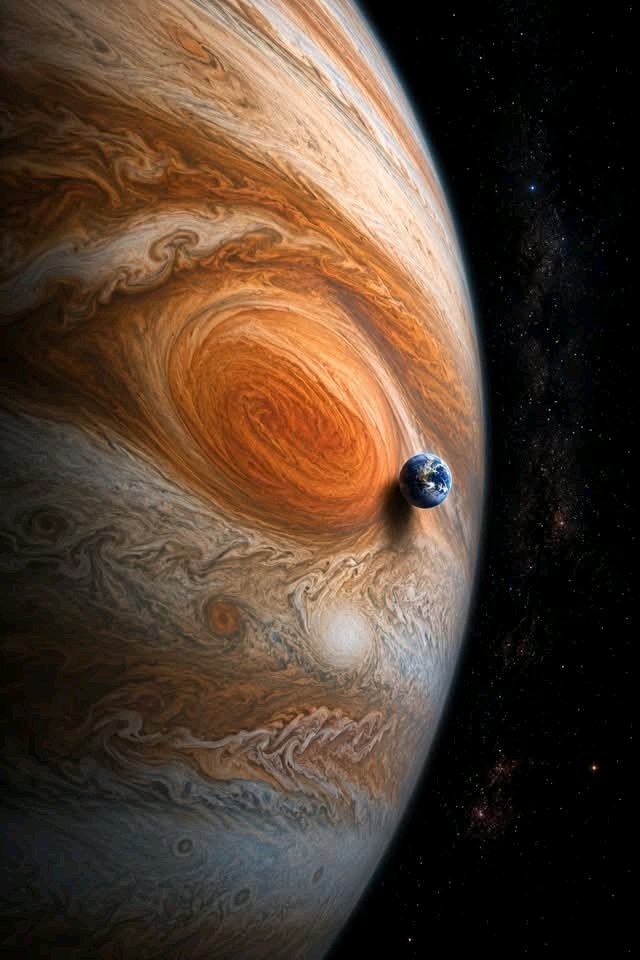
At first glance, it looks like a breathtaking abstract painting — swirling brushstrokes of cream, gold, and deep crimson.But it’s not paint.These are real, raging storms on Jupiter, the largest planet in our Solar System. Captured in stunning detail by NASA’s Juno spacecraft as it skimmed just above the cloud tops.What you’re seeing are colossal vortices of gas, some wide enough to swallow Earth whole, spinning at ferocious speeds through an atmosphere that has no solid surface below. Just endless layers of churning hydrogen and helium.The vivid colors, hypnotic textures, and intricate patterns are sculpted by forces beyond imagination — on a world where these storms have been raging for centuries.This isn’t art.This is another planet… alive, violent, and mesmerizing. One follow = endless cosmic wonders. Join us for more jaw-dropping space discoveries
Image credit: NASA / JPL-Caltech / Juno