VoidZero, the team behind Vite, Vitest, Rolldown, Oxc, and Vite+, is joining Cloudflare. Vite stays open source, vendor-agnostic, and built for everyone. https://t.co/DJTpX4Q9Xt
I suggest you make time this week (and definitely prior to its IPO on June 12th) to watch the @SpaceX IPO roadshow pitch.
This is a pretty funny but true story. When I took @Bazaarvoice public as our co-founder and CEO back in 2012, we had a meeting with the IPO reporter at the The Wall Street Journal. I asked the reporter, who named us one of the top five IPOs of 2012, if he had watched our IPO roadshow. He said, "How could I have done that?" I was dumbfounded. IPOs are publicly disclosable events, including the IPO roadshow! All he had to do is go to https://t.co/SsAcrENz5U. It was the best pitch I had ever given as our CEO, and he had missed it (and I couldn't share it with him either.)
Well, it's that time now for SpaceX and you can watch it at this link: https://t.co/eQAknz5h7P (https://t.co/SsAcrENz5U will direct you there, so I'm just saving you time). By SEC law, this link will go dark when SpaceX gets priced by the lead-left banker (in this case, Goldman Sachs, and with Morgan Stanley having a huge role on this historic IPO as well). SpaceX will likely get priced on the evening of June 11th and then started publicly trading on June 12.
At Bazaarvoice, we raised $114 million in our IPO in 2012. The IPO window had only recently reopened back then. Our IPO, priced by Morgan Stanley as our lead-left banker, was $12 per share, above our original "cover-price" range of $8–$10.
By contrast, SpaceX is raising $75 billion in their IPO, which is 658 times the amount we raised at Bazaarvoice back in 2012! The largest IPO raises prior to SpaceX were Saudi Aramco's 2019 IPO, where they raised $25.6 billion, and Alibaba's 2014 IPO, where they raised $21.8 billion. We are in uncharted levels of scale here, and Anthropic is right behind them and then OpenAI after that.
Decoding space will enable us to decode energy, telecommunications, transportation, and much, more more. We only know what 4% of the universe is made of (we call that matter) and we have no idea about the other 96% (we call it "dark energy" and "dark matter" for now). Decoding space originally helped us invent GPS - we are only beginning and we are currently very landlocked in a universe of hundreds of billions of galaxies, and it took us more than 50 years just to get back to the Moon (and not even land on it, although I love Artemis II and also the James Webb Telescope coming out of NASA).
Let's go, Team Humanity - bring on the Age of Abundance for All as Love Conquers Fear (@LCFpodcast)!
Welp, that happened faster than I predicted. Thought it would be end of 2027, then early 2027, but agentic traffic growing so fast that bots have now passed human traffic online for the first time in the Internet's history. https://t.co/2zX5bHdhsa
Texas is the growth engine of the Western world.
With 32 million people, Texas generates nearly $2.9 trillion in GDP. Elon @elonmusk ‘s new Terafab project in Grimes County is projected to add another $1 trillion to the Texas economy over the next decade.
At current pace, Texas will surpass France 🇫🇷 in GDP by 2031.
For comparison: France has 66 million citizens and a GDP of roughly $3.3 trillion. Yet Texas GDP per capita is nearly twice that of France.
President Macron and his government should take a hard look at why a single U.S. state is creating wealth at this scale.
This piece from the Economist gets the gist right but the dynamism and understanding of the sheer scale of what’s happening is missed.
https://t.co/Jz454PEpkV
Big, proprietary Foundational Models - YES!
Tuned & customized models for enterprises - YES!
Inference & AI Infra providers - YES!
Big 3 CSPs - YES!
On-device inference - YES!
I guess it is human nature to think zero-sum (SAD!), but sure feels like there's demand for all of it.
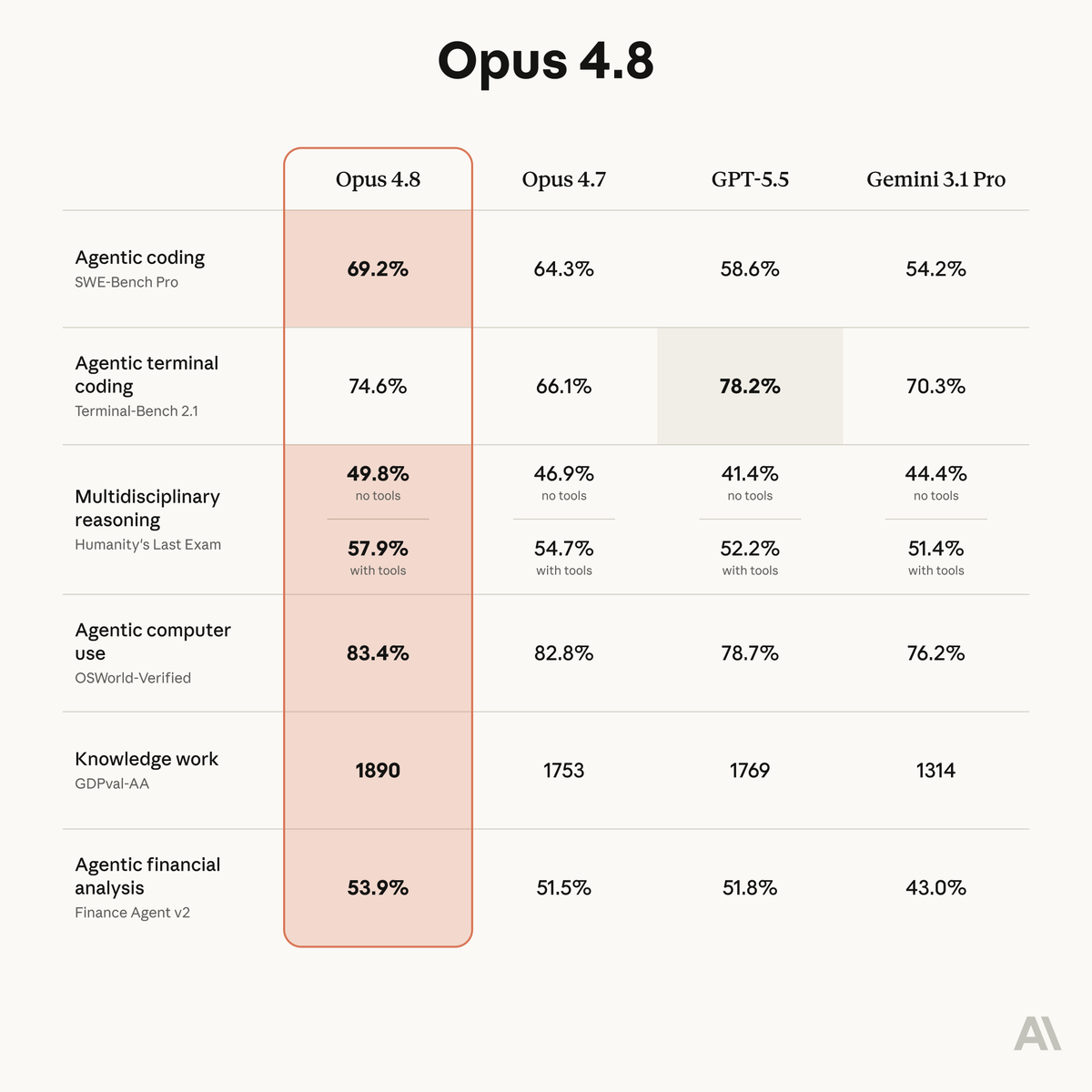
Introducing Claude Opus 4.8: it builds on Opus 4.7 with sharper judgment, more honesty about its own progress, and the ability to work independently for longer than its predecessors.
Available today at the same price.
OpenAI and Anthropic are effectively telling the market they can't solve every problem with a generic AI coworker.
You don't pour billions into massive forward-deployed joint ventures if you think the next model release is going to take care of it.
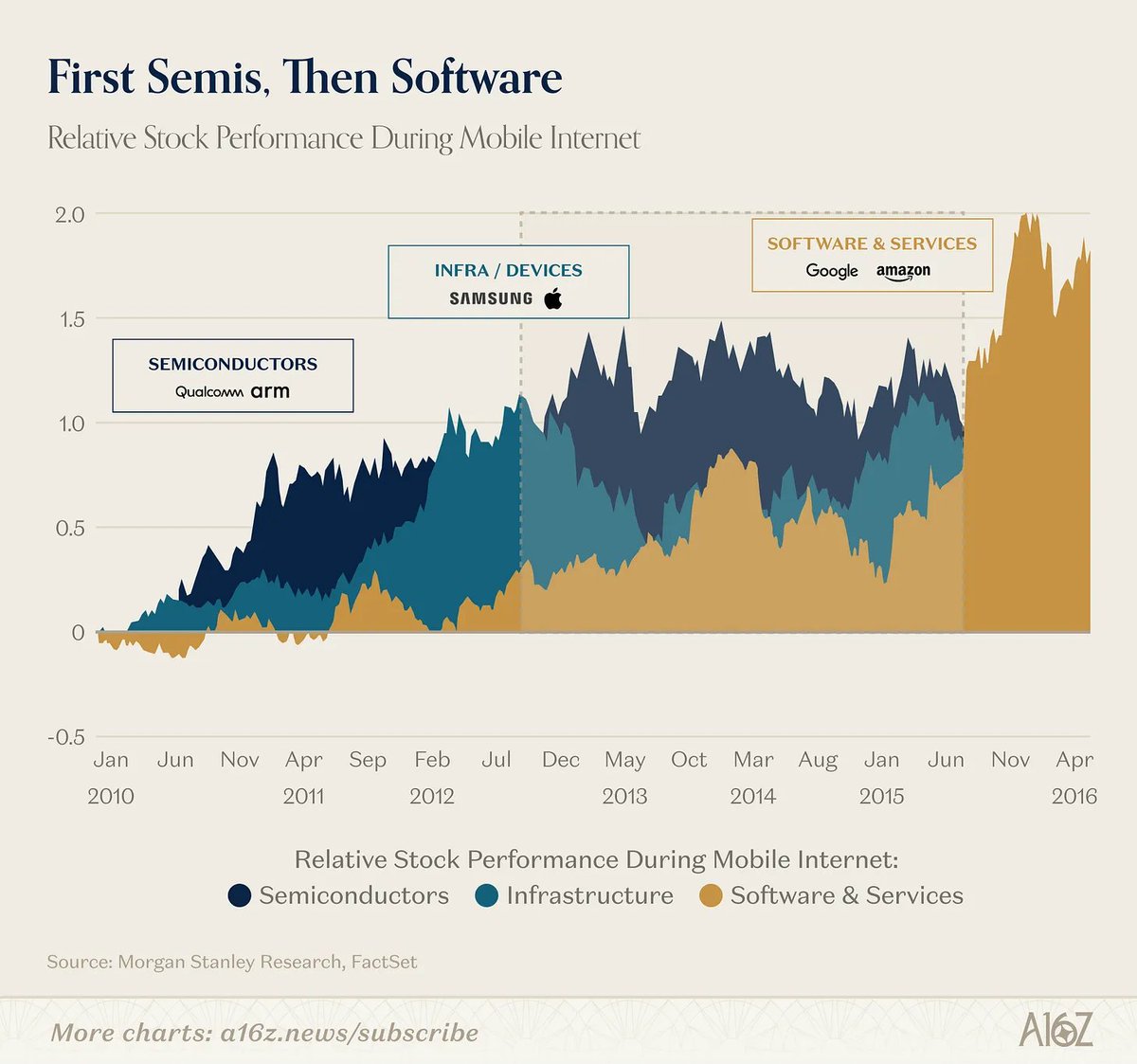
In the cloud supercycle, semis led and software followed (and you didn't need Qualcomm or ARM to tell you the value was migrating up the stack).
In AI, the infra layer itself is telling us the application layer is a separate, massive opportunity they can't fully capture.
a16z's @joeschmidtiv on why the app layer isn't dead: https://t.co/84QN5Mj9T3
The end of the software era is the beginning of the harness era.
The LLM is the smallest part of the system. The harness around it does the work.
7 components separate a demo from a production agent : 🧵
We’ve enabled higher usage limits, faster performance, better reliability, and increased shipping velocity for our Browser Run product by rebuilding on top of Cloudflare’s Containers. Here’s how: https://t.co/AoCmQwRjtk
Nobody will open Gmail five times a day in five years.
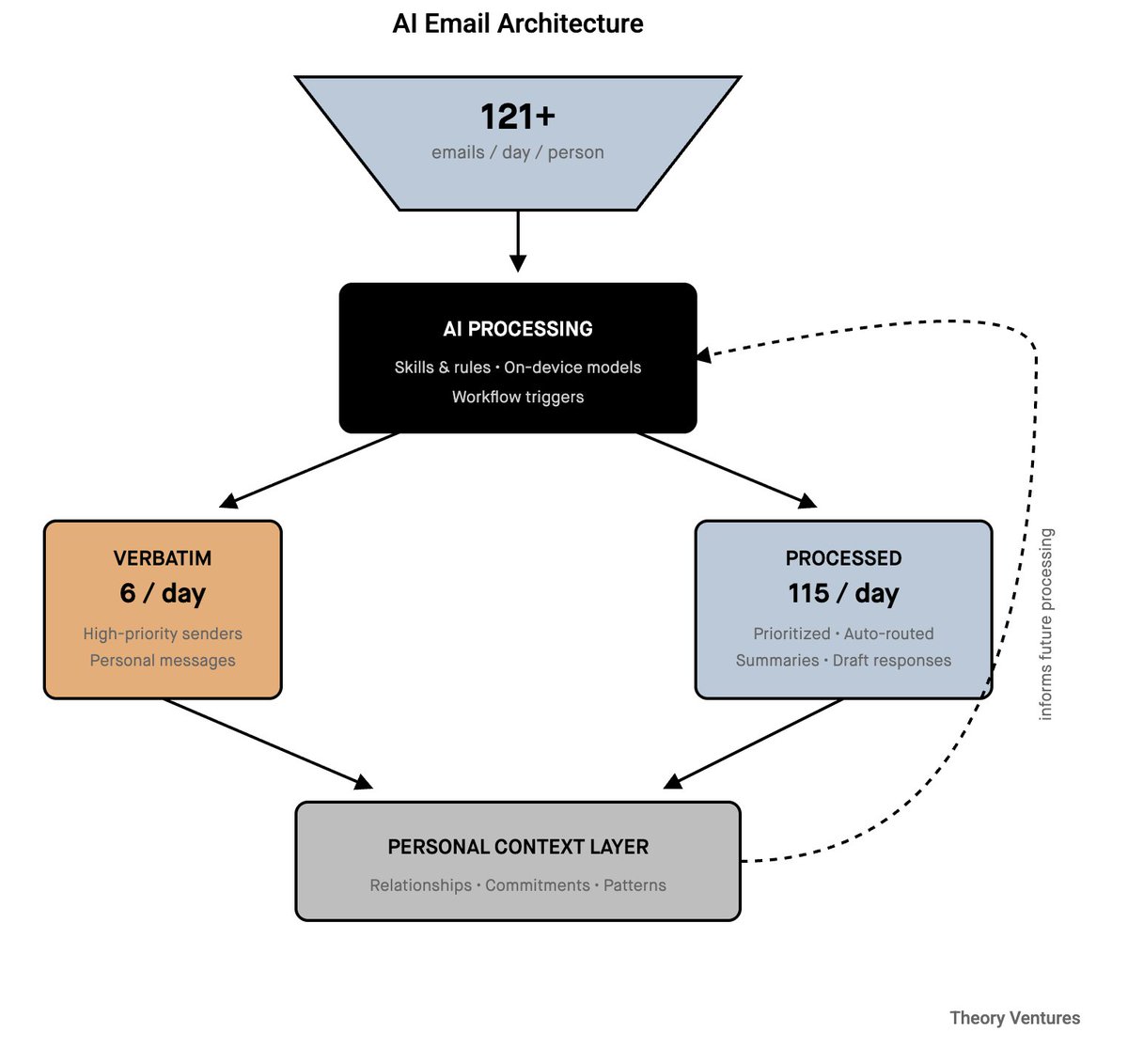
The average knowledge worker receives 121 emails per day. That's one every four minutes during working hours.
The inbox is a conveyor belt that keeps accelerating. You open Gmail. You read. You decide. You respond. One at a time. But the belt doesn't wait. It just moves faster.
Today's triage is generic : "This is from your boss. I need to work on that today. Next. Spam. Archive. Spam. Archive. Newsletter, read & archive." Tomorrow's is personal. User-defined skills & rules. Programming in English that encodes your priorities, your relationships, your workflow.
A receipt arrives & forwards itself to the expense platform before you see it. An inbound lead hits the CRM, gets scored, & a draft proposal waits in your outbox. The workflow starts the moment the email lands.
Then there's the archive. Years of context about every relationship, commitment, & decision you've made. That history becomes a personal context layer that informs how your AI handles the next message. On-device models process sensitive messages privately.
The inbox disappears. What remains are the 6 messages that actually matter.
https://t.co/qNLrpCHqLm
Apparently ~160 people in Austin, TX may make $100M+ from the SpaceX IPO. 12 will clear $1B.
Don't sleep on Austin - that's a lot of capital formation, very quickly.
WOW!!!!
This is a gigantic deal.
Imagine what happens when Amazon has humanoids and autonomous transport.
Alright time to start loading up on $AMZN lol
@chrisgraham@mercury I would suggest a status page at the very least @mercury / @immad. Everyone has downtime but transparency goes a long way with users. @eastdakota / @Cloudflare are great role models to follow when it comes to communicating outages.
The old sales motion asked : what’s your software budget for this category?
The new motion asks customers three questions :
1. What’s your software budget?
2. What’s your total labor budget?
3. What do you want that ratio to be in three years?
That third question shifts a software sale into a strategic planning conversation, the same conversation every board is having right now.
The higher the ratio today, the larger the opportunity. Sales runs 10:1. Support runs 4:1. Engineering runs as high as 25:1. If AI collapses the labor side, the software budget isn’t the ceiling. It’s the floor.
Not all departments will compress equally. The Anthropic Economic Index shows computer & math occupations at 36% AI task coverage, office & admin at 34%, while construction & transportation sit below 15%. Customer service reps show 70% coverage. Higher task coverage suggests more room for compression.
This reframe implies a two-step sales process : land on the software budget, then expand into the labor budget. The initial sale justifies itself against existing software spend. The expansion sale captures the labor savings AI creates.
Challenge the buyer’s perspective on budget. Not : can I have a slice of your software spend? But : what do you want that ratio to be in three years?
I came back to code because AI made it possible for me to build at a level I couldn't before.
I'm not coding despite being CEO of YC. I'm coding because this is the most important technological shift since the internet and I'd be an idiot to experience it from the bleachers.
I'm 45, running the most important startup institution in the world, and I can ship production software at 2am. That's not a distraction from the job.
That is the job understood correctly.