We are pleased to share our latest research, now published in Nature Communications: “Smart Cellular Bricks: Physical Modules That Recognize Their Own Shape and Repair Themselves.”
Blog: https://t.co/FMkbCv8mpP
Paper: https://t.co/rxzbpU3zTu
A long-running theme in our work is collective intelligence: the idea that sophisticated, robust behavior can emerge from many simple parts following local rules, with no central controller, as it does in a colony, a tissue, or a brain. We had mostly studied this in software and simulation. So this time we asked a simple question. Do the same decentralized principles hold up in the physical world, where communication is noisy and modules fail?
To find out, we built a collection of simple cubic bricks. Each brick runs the same small neural network and talks only to the bricks it is physically connected to. No brick is told its position, or which shape it is part of.
Yet from these purely local exchanges, the collective converges on the correct global shape, locates where modules are missing or damaged, and can even guide its own repair, inspired by how living tissue self-organizes and regenerates after injury.
For us, this is a first step in a broader direction: taking the principles of collective intelligence we have studied in software and letting them emerge, decentralized and robust, in the physical world. In the future, we imagine smart materials that let structures sense and report damage on their own, and LEGO-like systems that recognize their own configuration and adapt in real time, pointing toward environments that are more robust, adaptive, and regenerative.
This work is a collaboration between Sakana AI, IT University of Copenhagen and Autodesk.
New Anthropic research: A global workspace in language models.
Of everything happening in your brain right now, only a tiny fraction is consciously accessible—thoughts you can describe, hold in mind, and reason with.
We found a strikingly similar divide inside Claude.
BREAKING: @IneffableLabs has raised an INSANE $1.1bn Seed round - the UK's and Europe's largest EVER 🇬🇧 🇪🇺
The round values the company at $5.1bn.
The company has been founded by David Silver - one of the earliest researchers at DeepMind who was responsible for reinforcement learning.
This is a way of training AI models from experience rather than historical data (i.e. they learn by trial and error as opposed to learning from historical data).
David was involved in some groundbreaking projects at @GoogleDeepMind, including those responsible for defeating the world champion in Go.
Today the company has announced a $1.1bn seed led with backing of the following investors:
> @sequoia: @Alfred_Lin, @sonyatweetybird
> @lightspeedvp: @ravi_lsvp, @ravirajjain
> @EvanticCapital: @MattEvantic
> @UKSovereignAI: Joséphine Kant, @Jameswise
> @Indexportfolios: @dannyrimer
The aim of the company is to create an AI superlearner that can discover knowledge from its own experience. This new capability will be driven by the world’s most powerful reinforcement learning algorithms.
If this goes well this will become more powerful than any LLM created. And it's being built here in Europe.
LETS GO
Will be presenting The Serial Scaling Hypothesis at #ICLR2026 ✈️. See you guys there! 🖐️
TLDR; Complexity theory 🤝 Deep learning. Under serial tasks, not all FLOPs are equal. Solving tasks efficiently requires certain number of steps. This fact explains a lot of observed DL bottlenecks, including Why diffusion models don't scale step-wise.
I see every week on X an announcement or demo which implies that robotic manipulation has been solved. The only reason I don't believe it is because manipulation had already been solved last week by somebody else! So may I propose the "5 year old paired comparison test" ? At the next conference let's set up a number of tables to which you can bring your robot hardware. Next to it we will have another table where there will be a 5 year old child. In parallel we will try 100 different manipulation tasks that a neutral person has chosen- we could start with "pick up anything" - only household objects (e.g. as might be found in a typical American home) will be used, and we compare the performance of your robot with that of the 5 year old. Can you pick up a coin? Or a book? Or untwist a bottle top? Or insert any plug into a matching socket? Rotate one face of a Rubik's cube? Until your robot can do all the "open world manipulation" that a 5 year old kid can, some humility is in order.
Accepted at CVPR2026🎉Infants see the world through staged, low-acuity, color-limited, continuous vision; and it works for AI! We show infant-like visual diets boost Self-Supervised AI: better generalization, and human-aligned responses. Link: https://t.co/qAKx8MkYvX #CVPR#SSL
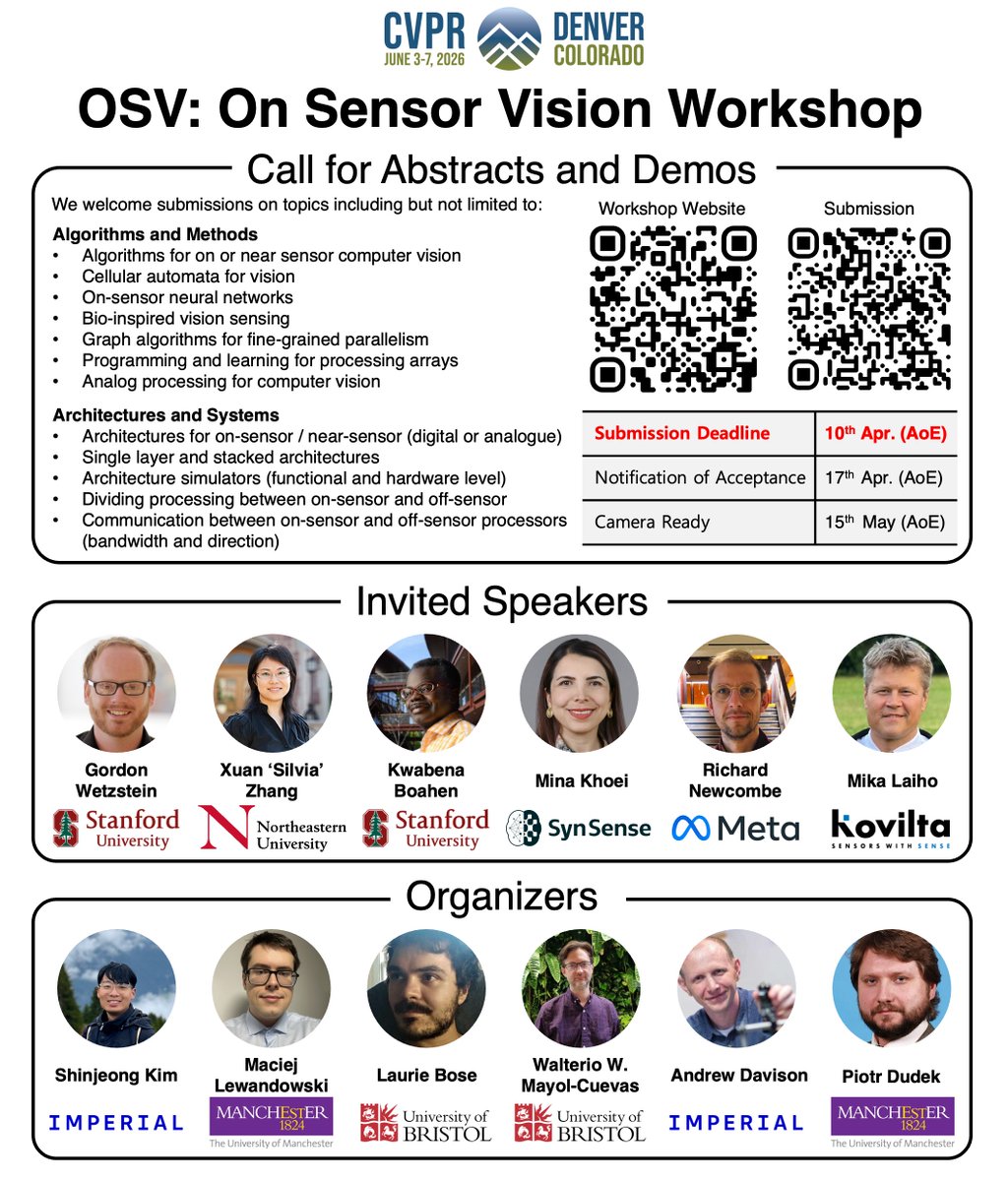
On Sensor Vision Workshop at #CVPR2026. New deadline for abstracts and demos: 10th April; we welcome submissions of work-in-progress or work published elsewhere. Come and discuss the future of ultra-efficient computer vision on the edge, where pixels and processing come together.
🚀 Our paper at ICLR26 show that powerful priors can be learned entirely from object instances (no labels, no language, no manual annotations) -> test-time iterative inference and true OOD generalization. Read here: https://t.co/nebQYwVhzZ
#ICLR2026#SelfSupervisedLearning#AI
We’re excited to introduce Doc-to-LoRA and Text-to-LoRA, two related research exploring how to make LLM customization faster and more accessible.
https://t.co/ApVzVsBuv1
By training a Hypernetwork to generate LoRA adapters on the fly, these methods allow models to instantly internalize new information or adapt to new tasks.
Biological systems naturally rely on two key cognitive abilities: durable long-term memory to store facts, and rapid adaptation to handle new tasks given limited sensory cues. While modern LLMs are highly capable, they still lack this flexibility. Traditionally, adding long-term memory or adapting an LLM to a specific downstream task requires an expensive and time-consuming model update, such as fine-tuning or context distillation, or relies on memory-intensive long prompts.
To bypass these limitations, our work focuses on the concept of cost amortization. We pay the meta-training cost once to train a hypernetwork capable of producing tasks or document specific LoRAs on demand. This turns what used to be a heavy engineering pipeline into a single, inexpensive forward pass. Instead of performing per-task optimization, the hypernetwork meta-learns update rules to instantly modify an LLM given a new task description or a long document.
In our experiments, Text-to-LoRA successfully specializes models to unseen tasks using just a natural language description. Building on this, Doc-to-LoRA is able to internalize factual documents. On a needle-in-a-haystack task, Doc-to-LoRA achieves near-perfect accuracy on instances five times longer than the base model's context window. It can even generalize to transfer visual information from a vision-language model into a text-only LLM, allowing it to classify images purely through internalized weights.
Importantly, both methods run with sub-second latency, enabling rapid experimentation while avoiding the overhead of traditional model updates. This approach is a step towards lowering the technical barriers of model customization, allowing end-users to specialize foundation models via simple text inputs. We have released our code and papers for the community to explore.
Doc-to-LoRA
Paper: https://t.co/87xEEpf0GN
Code: https://t.co/zBfQi2L9LW
Text-to-LoRA
Paper: https://t.co/emLRZ4Vdvo
Code: https://t.co/b9mrdoWWRB
Diffusion models operate step-by-step, hence they are serial models right?
However, that doesn't sit well because we have been seeing that diffusion models don't scale well with "steps".
In this thread: Diffusion models are not truly serial models.
I am speechless. Pay attention to how exactly the playback is displayed on different monitors.
Genie 3 is mindblowing. I can’t even imagine what we will see end of this year.
For anyone doing their first NeurIPS rebuttal, some advice (full post below)
Note: 50% of NeurIPS spotlights were rejected by an independent review committee in an RCT. *Before* LLMs! Don't take the RNG too seriously. But don't be too defensive to engage with real feedback
System is so broken:
- researchers write papers no one reads
- reviewers don't have time to review, shamed to coauthors, use LLMs instead of reading
- authors try to fool said LLMs with prompt injection
- evaling researchers based on # of papers (no time to read)
Dystopic.
@RichardSSutton, a recipient of the 2024 ACM A.M. Turing Award, is the 3rd speaker for our @NUSingapore (NUS) 120 Distinguished Speaker Series after Yann LeCun and Yoshua Bengio (https://t.co/E2AZJJSziR).
I was really excited to be a moderator for his Q&A session: (a) Richard is an author of the #ReinforcementLearning: An Introduction book that I've read in the senior year of my CS undergrad in @NUSComputing, and (b) it is my first time as a moderator for such a big event of NUS120!
In his talk on 'Shaping the Future of AI and Reinforcement Learning' (recap here: https://t.co/xEhCsu0xPc) , Richard has delivered three key messages, which have provided me with a number of insights:
(1) The scientific trend in AI is anticipated to shift from the era of human data to the era of experience with #ContinualLearning.
The video example given in his talk was illustrative: a toddler continuously exploring the surrounding environment, actively learning (i.e., possibly driven by curiosity) with each new experience being different and adaptively shaped by the previous ones. Can an AI agent learn likewise? What is the value of each experience?
For more information, see the recent article from David Silver and Richard Sutton here: https://t.co/hmM5qcwjFp.
(2) Seeking decentralized cooperation over centralized control in a society of agents. Such agents who seek mutual benefit would come together to collaborate despite having different goals.
This reminds me of the research done in our group on how and why AI agents with different goals and self-interests would be incentivized to collaborate in machine learning or reinforcement learning tasks. What mutual benefits or #incentives can they gain from doing so? For more details, do visit our https://t.co/Dkw3c6ky3C group's website at https://t.co/2zk0vpFGKX and click on the tag 'Incentives'.
An interesting question raised during the Q&A session sets me into thinking how different real-world scenarios would fit within the spectrum of decentralized cooperation vs. centralized control. Would we observe likewise in AI, if not already?
(3) We live in and fulfill the Age of Design. Richard mentions that we have "taken design to vastly greater heights", but questions whether we have taken it all the way. He suggests that to do so, "it would mean designing things that are themselves capable of designing", which is "what we are doing with AI".
I can't help but wonder whether we can have AI to design AI. A preliminary effort from our group is on using an AI algorithm to design an AI system; we call it AutoAI: https://t.co/oqMOyBIwaK
Looking forward to hearing his future research work in the Openmind Research Institute!
Something I've realized recently that oftentimes people love to project their career ambitions on other people. For example, some people may think building large teams or their own fancy research lab (e.g., academia) is the definition of a successful career. They then use this criteria to judge others, as if it's an objective truth. 😅
For myself, I enjoy being directly plugged in, i.e., writing code and being on the cutting edge where the code or experiments I run could have a potential impact of getting us to AGI 😇.
But every now and then, I would stumble across an (annoying) professor friend who thinks that "success" is to run a lab and have 100 grad students under them to "scale their impact". 🤡
When I was the exec (cofounder & chief scientist) of Reka AI, many people assumed that I was just "running the team", but the truth was that I was IC 100% of the time. Even as a co-founder or "senior leadership" I had zero reports and was just mostly focused on building the models. But yet >80% of the time, people assume I'm doing "exec" stuff like setting direction or telling people to do things.
IC (individual contributor) culture is a big thing in the LLM era these days but not the rest of the world has caught up with this yet (e.g., it's possible for l7+ in other companies or orgs to have very large teams after all). Therefore, it is not uncommon that out-of-domain folks (other fields, academia or regular SWEs) always associate being an "not a manager" as a nerf 😅 Triggering sometimes.
I think just being "research scientist" or "member of technical staff" is the coolest title/job ever. Being able to write code / do research to potentially get us to AGI is a big privilege. 😃